
সব বই

পেশাদার

1 Markets I: The Ecosystem and Exchange-Traded Marketsবাজার অনলাইন 2 Markets II: Rates, FX and Creditবাজার অনলাইন 3 Markets III: Commodities, Energy and Cryptoবাজার অনলাইন 4 Quantitative Methodsপদ্ধতি অনলাইন 5 Derivatives and Volatilityডেরিভেটিভস অনলাইন 6 Rates, Credit, XVA and Riskসুদহার, ঋণ ও ঝুঁকি অনলাইন 7 Research Craft: Predictors, Backtests, Measurement, Portfoliosগবেষণা অনলাইন 8 Strategies I: Equities and Futuresকৌশল অনলাইন 9 Strategies II: Volatility, Relative Value, Macro and the Bank Desksকৌশল অনলাইন 10 Microstructure and Executionএক্সিকিউশন অনলাইন 11 Market Making and High-Frequency Tradingমার্কেট মেকিং অনলাইন 12 Machine Learning for Marketsমেশিন লার্নিং অনলাইন 13 Low-Latency Softwareপ্রযুক্তি অনলাইন 14 Networks, Hardware and Trading Infrastructureপ্রযুক্তি অনলাইন 15 Research, Data and Risk Platformsপ্রযুক্তি অনলাইন 16 The Desk and the Firmপ্রতিষ্ঠান অনলাইন 17 The Industry: Firms, Roles and Careersক্যারিয়ার অনলাইন 18 Interviews I: Maths, Probability and Speedক্যারিয়ার অনলাইন 19 Interviews II: Markets, Trading Games and the Final Roundক্যারিয়ার অনলাইন 20 Interviews III: Codeক্যারিয়ার অনলাইন
অ্যাপ পরিচিতি Coach সাইন ইন পড়া শুরু করো

বইগুলো এখনো বাংলা ভাষায় পাওয়া যায় না — ইংরেজি সংস্করণ দেখানো হচ্ছে।

Physics · পরিভাষা

In series কী?

অন্য নাম: series circuit

Definition 23.1 Primary & Middle School Physics · অধ্যায় 23 — Series Circuits

Players in a circuit are in series when they sit on a single loop, one after another, like beads on one necklace: the current’s road passes through the first, then the second, then the third, with no branching anywhere. A circuit built this way is a series circuit.
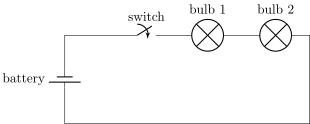
A series circuit: battery, switch and two bulbs on one single loop — every player threaded on the same necklace.

উদাহরণ

Example 23.5 (The party lights, solved)

The old mystery is now no mystery: the party bulbs are in series, dozens of beads on one necklace. One missing bulb is a gap, and rule one darkens the whole string. Finding the guilty bulb by trying them one by one taught generations of families rule one the hard way — modern strings are built differently, as next year will show.

Example 23.7 (Nose to tail)

Batteries can also queue up in series — but they are fussier than bulbs: they must stand nose to tail, each battery’s ++ touching the next one’s −-. Two batteries queued this way push together, and the bulb shines clearly brighter than with one. Turn one battery around — nose to nose — and the two pushes fight each other: the bulb gives nothing.

Example 23.8 (Inside the flashlight)

Open a flashlight: the batteries slide in one behind the other in a tube — a ready-made nose-to-tail queue — then the bulb and the button-switch complete one single loop through the case. A flashlight is a series circuit in a pocket. And now you know why it goes dark if a single battery is inserted backward: nose to nose, the pushes cancel.

প্রসঙ্গসহ পড়ো →