Primary & Middle School Physics · Grades 1–9
23Series Circuits
Last year, a string of party lights went dark because one single bulb was missing — and we promised that its arrangement had a name. Here it is: the series circuit, the simplest way to put many players on one loop. It has strict house rules, and a flashlight in your drawer has been obeying them all along.
23.1 One loop, several players
Definition 23.1 (In series)
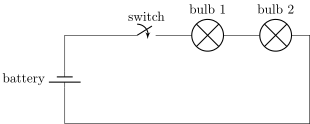
Players in a circuit are in series when they sit on a single loop, one after another, like beads on one necklace: the current’s road passes through the first, then the second, then the third, with no branching anywhere. A circuit built this way is a series circuit.
Method 23.2 (Building it)
With one battery, two bulbs, a switch and wires:
- start at the battery’s terminal with a wire to the switch;
- wire from the switch to the first bulb, from the first bulb to the second;
- close the loop: from the second bulb back to the battery’s terminal;
- click the switch and watch both bulbs together.
Trace the loop with your finger before switching on: if your finger must ever choose between two roads, it is not a series circuit.
23.2 The house rules
Proposition 23.3 (Rules of the single loop)
In a series circuit:
- all or nothing: one gap anywhere — an open switch, a broken bulb, a loose wire — and every player stops at once;
- order does not matter: swap the bulbs, move the switch to the other side of the loop — everything behaves exactly as before;
- sharing: the more bulbs on the loop, the dimmer each one glows; the battery’s push is shared along the whole necklace.
Example 23.4 (Seeing the rules)
Build the two-bulb circuit and test each rule. Unscrew either bulb: both go dark — rule one (the unscrewed socket is a gap). Swap the two bulbs, or move the switch between them: no change at all — rule two. Now rebuild with a single bulb: it shines noticeably brighter alone than it did with its partner — rule three, in reverse.
Example 23.5 (The party lights, solved)
The old mystery is now no mystery: the party bulbs are in series, dozens of beads on one necklace. One missing bulb is a gap, and rule one darkens the whole string. Finding the guilty bulb by trying them one by one taught generations of families rule one the hard way — modern strings are built differently, as next year will show.
Remark 23.6 (The switch commands everyone)
Rule two has a handy consequence: a single switch, placed anywhere on the loop, commands every player on it. That is why one wall switch can control a whole row of ceiling lights — and why, for the same reason, you cannot switch off just one bulb of a series string without killing them all.
23.3 More batteries on the necklace
Example 23.7 (Nose to tail)
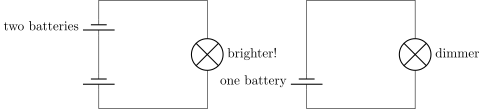
Batteries can also queue up in series — but they are fussier than bulbs: they must stand nose to tail, each battery’s touching the next one’s . Two batteries queued this way push together, and the bulb shines clearly brighter than with one. Turn one battery around — nose to nose — and the two pushes fight each other: the bulb gives nothing.
Example 23.8 (Inside the flashlight)
Open a flashlight: the batteries slide in one behind the other in a tube — a ready-made nose-to-tail queue — then the bulb and the button-switch complete one single loop through the case. A flashlight is a series circuit in a pocket. And now you know why it goes dark if a single battery is inserted backward: nose to nose, the pushes cancel.
23.4 Exercises
Exercise 23.1 ★
What does “in series” mean? What picture from everyday life does the chapter use for it?
Solution
Solution of Exercise 23.1.
Players sit on one single loop, one after another, with no branching — like beads threaded on one necklace.
Exercise 23.2 ★
State the three house rules of the series circuit.
Solution
Solution of Exercise 23.2.
All or nothing (one gap stops everyone); order does not matter (swapping players changes nothing); sharing (more bulbs on the loop means each glows dimmer).
Exercise 23.3 ★
In the two-bulb circuit, bulb 2 is unscrewed. What happens to bulb 1, and why? Which rule is at work?
Solution
Solution of Exercise 23.3.
Bulb 1 goes dark too. The empty socket is a gap in the single loop, and rule one — all or nothing — stops every player at once.
Exercise 23.4 ★
Zoe moves the switch from before bulb 1 to after bulb 2. What changes in how the circuit behaves? Which rule says so?
Exercise 23.5 ★
One battery lights one bulb nicely. Predict the brightness with: two bulbs in series; three bulbs in series. What is being shared?
Exercise 23.6 ★
How must two batteries stand to push together? Draw the queue with and marked on each battery.
Solution
Solution of Exercise 23.6.
Nose to tail: the of one touching the of the next, so both push the same way around the loop. Drawing: queued in one line.
Exercise 23.7 ★
Trace the loop of a flashlight: name the players the current visits from the battery’s back to its .
Exercise 23.8 ★
A doorbell circuit has a battery, a button and the bell in series. Where could you add a second button so that the bell rings only when both buttons are pressed?
Solution
Solution of Exercise 23.8.
Anywhere on the same loop — for instance right after the first button. In series, both buttons must be closed to complete the one road, so the bell rings only when both are pressed together.
Exercise 23.9 ★
A string of ten series party lights is dark. The bulbs all look fine. Describe a patient plan, using a known-good bulb, to find the broken one.
Solution
Solution of Exercise 23.9.
Replace the first bulb with the known-good one; if the string lights, the removed bulb was the culprit. If not, put the original back and move to the second socket, and so on down the string. At some socket the string will light — the bulb just removed is the broken bead.
Exercise 23.10 ★★
Tom’s flashlight takes two batteries and shines brightly. After changing batteries in the dark, it gives nothing — yet both new batteries are full, the bulb is fine, and no wire is loose. What has Tom done, and why does the flashlight stay dark? (See Example 23.7.)
Exercise 23.11 ★★
An engineer must place one emergency stop-switch for a machine whose motor sits on a single loop with its battery. She says: “Anywhere on the loop will do.” Is she right? And why would her plan fail if the machine’s circuit had branching roads? (Next year’s chapter has the name for those.)
Solution
Solution of Exercise 23.11.
She is right: on a single loop, a switch anywhere commands everything — order does not matter. With branching roads, the current could detour around her switch through another branch, and the motor might keep running; branched circuits need more careful switch placement (they are next year’s parallel circuits).