Physics · Glossary

What is Ladder operators?

Definition 9.1 University Physics — Year 3 · Chapter 9 — The Quantum Harmonic Oscillator

For H^=p^2/2m+12mω2x^2\hat H = \hat p^2/2m + \tfrac12 m\omega^2\hat x^2, introduce the dimensionless, non-Hermitian pair

a^=mω2(x^+ip^mω),a^=mω2(x^ip^mω).\hat a = \sqrt{\frac{m\omega}{2\hbar}}\Big(\hat x + \frac{\iu\hat p}{m\omega}\Big) , \qquad \hat a^\dagger = \sqrt{\frac{m\omega}{2\hbar}}\Big(\hat x - \frac{\iu\hat p}{m\omega}\Big) .

From [x^,p^]=i[\hat x, \hat p] = \iu\hbar:

[a^,a^]=1,H^=ω(N^+12),N^=a^a^.[\hat a, \hat a^\dagger] = 1 , \qquad \hat H = \hbar\omega\Big(\hat N + \tfrac12\Big) , \quad \hat N = \hat a^\dagger\hat a .

N^\hat N is Hermitian; its eigenvalues will count quanta, and a^\hat a, a^\hat a^\dagger — the annihilation and creation operators — will remove and add one.
The oscillator’s ladder: equal steps , climbed by a and descended by a, standing on a floor half a step above the classical rest energy.
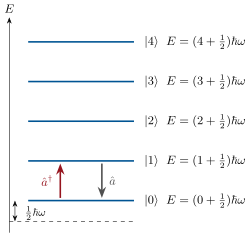
The oscillator’s ladder: equal steps ω\hbar\omega, climbed by a^\hat a^\dagger and descended by a^\hat a, standing on a floor half a step above the classical rest energy.
Read in context →
