University Physics — Year 3 · Bachelor Year 3
9The Quantum Harmonic Oscillator
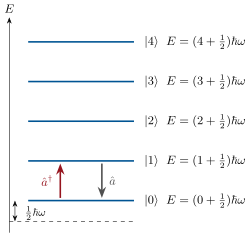
Almost nothing in nature is exactly a harmonic oscillator, and almost everything is approximately one: any system nudged from stable equilibrium — a molecule’s bond, an atom in a crystal, a bridge, a mode of the electromagnetic field — feels a restoring force proportional to the displacement, because every smooth potential is a parabola at the bottom of its well. Whoever solves the quantum oscillator once therefore solves the small vibrations of the whole world. This chapter solves it in the algebraic style that has become the signature of quantum mechanics: two ladder operators climb and descend a perfectly even staircase of levels , the half-step at the bottom — the zero-point energy — being a theorem, not an option. The consequences reach from why helium never freezes to how a carbon dioxide molecule, ringing at its own , intercepts the Earth’s outgoing heat.
9.1 The ladder
Definition 9.1 (Ladder operators)
For , introduce the dimensionless, non-Hermitian pair
From :
is Hermitian; its eigenvalues will count quanta, and , — the annihilation and creation operators — will remove and add one.
Theorem 9.2 (The spectrum, by algebra alone)
The eigenvalues of are exactly
— an infinite ladder of equal steps above a ground level that is not zero: the zero-point energy . The normalised eigenstates are connected by
Proof. From the commutator, : if has -eigenvalue , then is an eigenvector with (or the zero vector). Each descent is allowed only while , since ; the descent must therefore terminate, and it terminates only on a state with , whence . So runs over the non-negative integers. The normalisations follow from and . ∎
Proposition 9.3 (The states in space)
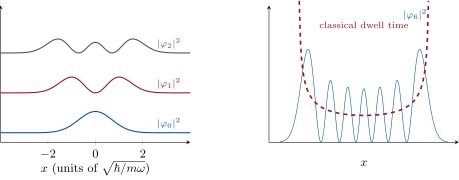
The ground state is the Gaussian
obtained by solving the first-order equation ; it saturates Heisenberg’s inequality, , with . Applying repeatedly generates : a polynomial of degree (with nodes) times the same Gaussian. For large , oscillates rapidly about the classical dwell-time distribution, largest near the turning points — the correspondence principle in a picture.
Partial proof. reads : the Gaussian, normalised. Saturation: the Gaussian is the equality case of Theorem 8.10. The polynomial structure follows from being first order in and ; the large- statement is checked in Exercise 9.12. ∎
9.2 The zero-point energy is real
Remark 9.4 (Why the floor cannot be lower)
A state of zero energy would need : perfectly still and perfectly centred, forbidden by . The ground state is the best compromise the inequality allows, and is the rent. It is not a bookkeeping constant: zero-point motion smears X-ray diffraction patterns at absolute zero; it gives lighter isotopes weaker effective bonds (H and D dissociate at measurably different energies from the same electronic well); and in helium it is so violent — light atoms, feeble attraction — that the liquid never freezes under its own vapour pressure: the only element still liquid at absolute zero, solidifying only under 25 atmospheres of help.
Example 9.5 (Scales of )
Carbon monoxide bond (): , ten times room temperature’s — molecular vibrations are frozen in everyday air, which is why diatomic heat capacities puzzled the nineteenth century. A pendulum (): , hopelessly beyond resolution — the correspondence limit. A LIGO mirror of , suspended so that it swings at , has as an oscillator mode the zero-point amplitude — and the observatory routinely resolves displacements at this quantum floor: the zero-point motion of a forty-kilogram object is now an engineering constraint (Exercise 9.3).
9.3 Coherent states: the classical face of the quantum oscillator
Definition 9.6 (Coherent states)
A coherent state is an eigenvector of the annihilation operator, , with any complex number. Expanded on the ladder,
the quantum count is Poisson-distributed with mean and spread .
Proposition 9.7 (Why lasers are classical)
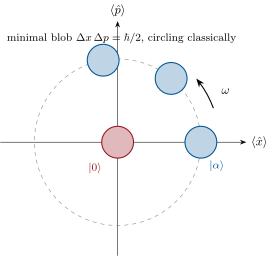
A coherent state is the ground-state Gaussian displaced in phase space; under the oscillator’s evolution it stays coherent, : its centre executes exactly the classical motion, , while its widths remain the minimal forever — a wave packet that never spreads. Coherent states are how a quantum oscillator impersonates a classical one; the light of a laser is a coherent state of a field mode, its photon number Poissonian (the shot noise of every photodetector), its field oscillating like Maxwell said.
Partial proof. The expansion follows by writing in : . Evolution: each picks up , which resums to a coherent state of (global phase apart). from . That the state is the displaced Gaussian is admitted here. ∎
Method 9.8 (Oscillator algebra)
(1) Express whatever is asked in , : , . (2) Move ’s to the right with ; use . (3) Matrix elements: connects only neighbouring rungs — the selection rule of vibrational spectroscopy. (4) Any quadratic Hamiltonian (coupled oscillators, circuits, field modes) diagonalises into independent ladders: find the normal modes first, quantise each. (5) Numbers first: against decides whether the system is quantum or classical before any algebra.
9.4 Exercises
Exercise 9.1 ★
(a) Verify from . (b) Verify by direct expansion. (c) Invert to express and . (d) Show is Hermitian and explain why alone could not be an observable.
Solution
Solution of Exercise 9.1.
(a) Expanding, the and terms cancel between and , leaving . (b) : multiply by . (c) , . (d) ; is not Hermitian, and its “eigenvalues” are complex — no measurement apparatus returns them.
Exercise 9.2 ★
On the eigenstate : (a) show ; (b) compute and ; (c) deduce ; (d) check the virial ratio .
Solution
Solution of Exercise 9.2.
(a) and shift by : diagonal elements vanish. (b) , (the terms). (c) : only the ground state is minimal. (d) Both averages equal : the equipartition of the classical oscillator, level by level.
Exercise 9.3 ★
Zero-point amplitudes : compute for (a) the CO molecule (, ), compared with the bond length ; (b) a hydrogen atom in a solid (, ); (c) a LIGO mirror (, ); (d) rank the three as fractions of their systems’ sizes and comment on who is “quantum”.
Solution
Solution of Exercise 9.3.
(a) : three per cent of the bond — a molecule is a slightly blurred object even at zero temperature. (b) , over a tenth of an ångström: hydrogen is the blurriest atom in any crystal, which neutron scattering sees directly. (c) — twenty-five orders below the mirror’s size, yet LIGO’s readout reaches it. (d) Fractionally: molecule , hydrogen , mirror : “quantum” is not about being small but about against everything else — and yet with enough finesse even forty kilograms show their floor.
Exercise 9.4 ★
(a) Using the ladder relations, compute and show it vanishes unless . (b) Deduce the vibrational selection rule for light absorption (the coupling is ). (c) Why does a heteronuclear molecule (CO) absorb infrared light while N does not? (d) Real molecules show weak “overtone” lines at : what does that reveal about the potential?
Solution
Solution of Exercise 9.4.
(a) . (b) The interaction with light can only step one rung: , one infrared frequency per mode. (c) CO’s vibration modulates a nonzero dipole; N’s symmetric charge cloud produces none at any stretch: infrared-inactive. (d) Overtones exist only because the true potential is not exactly quadratic: anharmonicity mixes rungs and weakly allows — and shifts the high rungs closer together, as real spectra show.
Exercise 9.5 ★★
(a) Solve as a differential equation and normalise. (b) Generate and by applying . (c) Verify by parity alone. (d) Sketch the three densities and check the node count.
Solution
Solution of Exercise 9.5.
(a) : the normalised Gaussian of the text. (b) ; . (c) even, odd: the overlap integrand is odd. (d) Zero, one, two nodes — the oscillation theorem in miniature.
Exercise 9.6 ★★
Boltzmann preview. A collection of identical oscillators at temperature occupies level with probability (Year 2 volume, Boltzmann factor). (a) Show the mean quantum number is . (b) Evaluate for the CO vibration at and at . (c) Show the mean energy tends to at high temperature (equipartition recovered) and to at low. (d) At what temperature does a vibration (carbon dioxide’s bend) hold ?
Solution
Solution of Exercise 9.6.
(a) With : . (b) CO at : , — frozen; at : , — waking up. (c) for ; for . (d) : , — Earth’s atmosphere keeps carbon dioxide’s bend partly lit.
Exercise 9.7 ★★
Coherent-state statistics. (a) From the expansion of , show is Poisson with mean . (b) Show and . (c) A laser at : photons per second, and the relative fluctuation in one second. (d) Shot noise: show the photocurrent noise-to-signal falls as — why bright beams look smooth.
Solution
Solution of Exercise 9.7.
(a) : Poisson. (b) Mean and variance of Poisson are both . (c) photons per second; . (d) The photocurrent inherits the Poisson spread: noise over signal — the shot-noise floor, audible in faint light, negligible in bright.
Exercise 9.8 ★★
Evolution of a coherent state. (a) Apply the evolution phases to the expansion and show with (up to a global phase). (b) Deduce and and compare with the classical solution. (c) Why does an energy eigenstate, despite being stationary, not describe a swinging pendulum — which feature of the coherent state does? (d) Estimate for a real pendulum (, amplitude, ) and comment.
Solution
Solution of Exercise 9.8.
(a) Each term gains (global phase aside): the sum is again coherent with . (b) : a pure cosine at , amplitude and phase set by — exactly classical. (c) An eigenstate’s density never moves; the pendulum we see is a coherent superposition of many rungs whose phases conspire to swing. (d) , : , — macroscopic motion is coherence with astronomical quantum numbers.
Exercise 9.9 ★★
The quantum LC circuit. A superconducting loop with and oscillates charge and flux like and . (a) Its resonance frequency (Year 1 volume) and the quantum in . (b) Below what temperature is , so the circuit sits in its ground state? (c) Why are superconducting qubits operated in dilution refrigerators at ? (d) The zero-point voltage fluctuation with : evaluate it.
Solution
Solution of Exercise 9.9.
(a) (); . (b) : well below about . (c) At , thermal excitation : the circuit sits in , ready to be a qubit — room temperature would bury the quantum in thermal quanta. (d) (a few electron charges); of irreducible hum.
Exercise 9.10 ★★★
Van der Waals from zero-point motion. Model two neutral atoms at distance as two identical dipole oscillators (charge , mass , frequency ) whose displacements couple by the dipole energy with . (a) Show the normal coordinates oscillate at . (b) The ground energy is : expand to second order in and show the interaction energy is
(c) Why is this attraction universal — present between atoms with no permanent dipoles at all? (d) The law is the van der Waals force of the Year 1 volume’s real-gas corrections: what, microscopically, is “fluctuating” — and what would happen to this force in a world with ?
Solution
Solution of Exercise 9.10.
(a) In normal coordinates the Hamiltonian splits into two oscillators with . (b) : , and gives . (c) It needs no permanent dipoles — only the zero-point fluctuations of each atom’s charge cloud, which the coupling correlates so that attraction outweighs repulsion. (d) The fluctuating quantity is the instantaneous dipole of the ground state; with the ground state would be motionless and dipole-free, and the van der Waals glue — geckos, liquefied gases, much of soft matter — would vanish.
Exercise 9.11 ★★★
Sidebands of a trapped ion. An ion in a harmonic trap () absorbs laser light. Because the ion moves, its absorption spectrum shows the electronic line at flanked by lines at : transitions that change the motional quantum number by alongside the electronic one. (a) What is in , and why does resolving sidebands need a very narrow line? (b) Driving the line removes one motional quantum per cycle: explain sideband cooling to the ground state. (c) Once , the lower sideband disappears entirely — why is that asymmetry a proof of reaching the quantum ground state? (d) This is how the motional ground state of a single atom — and of kilogram-scale LIGO mirrors, by other means — is certified: state what “temperature” the ion has reached for and .
Solution
Solution of Exercise 9.11.
(a) : the optical line must be narrower than a megahertz — only long-lived “clock” transitions qualify. (b) A red-sideband photon raises the ion electronically while removing one motional quantum; the subsequent decay returns the electronic energy at the carrier frequency on average: each cycle extracts of motion. (c) From there is nothing left to remove: the red sideband’s disappearance is a background-free certificate of the ground state. (d) : .
Exercise 9.12 ★★★
The classical limit, quantitatively. A classical oscillator of amplitude spends in the fraction . (a) Derive this dwell-time distribution. (b) For the quantum state , take from and compare the classical distribution with the (given) locally averaged : where do they agree and where must they differ? (c) Show the fractional spacing between adjacent levels, , vanishes as : energy becomes effectively continuous. (d) For the pendulum of Exercise 9.8(d), estimate and , and conclude the correspondence argument in one sentence.
Solution
Solution of Exercise 9.12.
(a) with , over the half-period . (b) They agree on local averages in the classically allowed region; they must differ at the turning points (classical divergence, quantum finite peaks) and beyond them (quantum tails in the forbidden region). (c) . (d) : spacing one part in — no conceivable measurement resolves the ladder, and mechanics looks continuous.
9.5 Problem: The molecule that warms the Earth
Problem 9.1
Weekend problem — carbon dioxide’s quantum ladder and the greenhouse effect
A carbon dioxide molecule is a linear O=C=O chain: a few quantised oscillators. That its bending mode’s happens to sit in the middle of the Earth’s outgoing thermal glow is why this trace gas — four molecules in ten thousand — steers the planet’s climate. Data: bend wavenumber (the spectroscopist’s unit: , ); asymmetric stretch ; symmetric stretch ; at is ; Wien’s law (Year 2 volume): .
Part I — The modes of a linear molecule.
- Three atoms have nine degrees of freedom: how many are translations of the whole molecule, how many rotations (the molecule is linear), and how many vibrations remain?
- Describe the four vibrations: symmetric stretch, asymmetric stretch, and a doubly degenerate bend — why does the bend come twice?
- Light couples to a vibrating electric dipole (Exercise 9.4). Which modes of O=C=O modulate the dipole moment, and which one is infrared-silent?
- Convert the three wavenumbers to photon wavelengths, and place them: which are in the thermal infrared?
- Why do the two main air gases, N and O, absorb essentially no infrared at all — with what consequence for the atmosphere’s transparency?
- Water vapour, bent and dipolar, absorbs across much of the infrared: in which spectral “window” does carbon dioxide’s bend operate largely alone (compare with water’s strong bands below and above )?
Part II — The quantum ladder of the bend.
- Compute in meV, and the ladder .
- What fraction of molecules occupies at (relative to , Boltzmann factor)? And ?
- Which photon wavelength drives ? Why does the same wavelength dominate emission?
- Justify from the harmonic ladder that one wavelength serves the whole ladder ( for every ): what property of the level spacing is at work?
- The molecule also rotates, adding fine structure: the feature is really a band some wide. Why does band width matter for a greenhouse gas (think of what happens once the band centre is opaque)?
- A vibrationally excited CO in air is far more likely to lose its quantum by collision than by radiating (radiative lifetime , collision time ): where does the absorbed radiant energy actually go?
- Conversely, air at keeps a thermal population in (question 8): what does that population do that matters for the energy budget?
Part III — The planet’s radiation ledger.
- The Sun radiates as a body: compute its Wien peak. Does CO’s bend intercept much sunlight?
- The ground radiates as a body: compute its Wien peak, and locate on that thermal curve.
- Explain the greenhouse mechanism in four sentences: sunlight in, thermal infrared out, interception at , re-emission both up and down.
- The re-emission that escapes to space comes from high, cold layers (): why does emitting from a colder layer reduce the planet’s outgoing power at those wavelengths (recall that thermal emission grows with )?
- More CO pushes the emitting layer higher and colder: state in one sentence why the surface must then warm to rebalance the books.
- The band centre is already opaque; the effect of added CO works in the band’s wings, giving a logarithmic growth of forcing with concentration: connect this to question 11.
Part IV — Isotopes: the quantum fingerprint.
- An oscillator’s frequency scales as : for the asymmetric stretch, replacing C by C changes the effective mass; the observed line shifts from to about . Check the order of magnitude of this shift from the masses.
- Lasers tuned to these two lines count CO and CO separately in a gas sample: explain why the quantised ladder makes such isotope-resolved detection possible at all.
- Plants prefer the lighter isotope, so fossil carbon is C-poor: what has the measured isotopic ratio of atmospheric CO done as its concentration rose — and what does that prove about the source of the added gas?
- The same physics operates on Venus ( CO, ): what does its surface illustrate?
- Mars also breathes nearly pure CO, but at , and is frigid: what does the Venus–Earth–Mars trio demonstrate about which variable controls the strength of the effect?
- Summarise the named result: a quantum of — of a bending triatomic — parked at on a planet’s thermal spectrum, absorbed, thermalised in nanoseconds and re-emitted from cold altitudes, is the mechanism by which of the air sets the temperature of the Earth.
Solution
Solution of Problem 9.1.
1. Three translations; two rotations (spinning about the molecular axis moves nothing); vibrations. 2. Stretch modes along the axis (symmetric: both O out together; asymmetric: C shuttles between them); the bend can happen in either of two perpendicular planes — same frequency, double degeneracy. 3. The asymmetric stretch and the bends move the charge centres apart: oscillating dipole, infrared-active. The symmetric stretch keeps the molecule’s dipole zero throughout: infrared-silent. 4. , and : all infrared; sits deep in the thermal infrared of terrestrial temperatures. 5. Homonuclear molecules never acquire a dipole while vibrating: the bulk atmosphere is transparent to infrared, and the entire greenhouse rests on trace polyatomic gases. 6. Between water’s bands lies the – window; carbon dioxide’s band operates at its edge, where water competes weakly — the gas guards a gate water leaves ajar. 7. ; . 8. in ; in : the ladder is lightly, permanently lit. 9. ; the same spacing that absorbs is the spacing that emits — one wavelength both ways. 10. Equal spacing: every step costs the same photon, so one line serves the whole thermal population. 11. Each vibrational line splits into many rotational-vibrational lines spread over : once the band centre is fully opaque, only this width offers new absorption — the band’s wings are where extra gas still acts. 12. Collisions win by nine orders of magnitude: the photon’s energy is shared with N and O within nanoseconds — absorbed radiation becomes heat of the air. 13. By the same collisions run backward, air keeps feeding molecules into , which radiate in all directions — including down: the sky itself glows infrared at the ground. 14. : sunlight peaks in the visible, far from — carbon dioxide lets the Sun in. 15. : the Earth’s glow peaks at ten microns, and lies on its broad shoulder, carrying a substantial share of the outgoing power. 16. Sunlight enters mostly unhindered and warms the ground. The ground re-emits in the thermal infrared. At that radiation is absorbed within metres and thermalised. The heated air re-emits both upward and downward, and the downward half is extra income for the surface: it must warm until outgo matches income. 17. Emission grows steeply with temperature: radiation escaping from a altitude carries much less power than the surface would have sent directly — the band is a dimmer patch in the planet’s outgoing spectrum. 18. With outgoing power reduced at fixed sunshine, the whole column — surface included — must warm until the books balance again. 19. Saturated centre, active wings: each doubling of the gas widens the opaque region by a similar increment, hence a roughly logarithmic forcing — the wings of question 11 doing the work. 20. The asymmetric-stretch frequency squares as : the ratio for C over C is — a drop, matching . 21. Quantisation gives each isotopologue its own sharp comb of lines; a laser parked on one comb counts one isotope only — impossible if absorption were a classical continuum. 22. As CO rose, its C fraction fell (the Suess effect): the added carbon is isotopically light — plant-made, long-buried, i.e. fossil. The atmosphere carries the signature of its source. 23. Venus: the same quantum, applied over a -fold column, holds a surface hotter than an oven — the mechanism has no built-in ceiling. 24. Mars, nearly pure CO yet freezing, shows that column amount and pressure (which broadens the lines), not the gas fraction, set the strength. 25. An quantum at , absorbed on a planet’s thermal shoulder, thermalised in nanoseconds, re-emitted from cold heights: the harmonic oscillator’s ladder, weighed against Wien’s law, is the machinery by which four molecules in ten thousand govern a climate.