 Coach
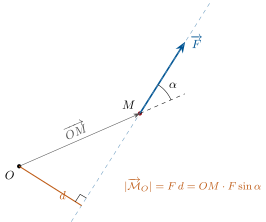
CoachThe moment (or torque) about a point of a force applied at is the vector
perpendicular to the plane of and , of norm , where — the lever arm — is the distance from to the line of action of . The moment about an oriented axis (unit vector ) through is the scalar , independent of the choice of on ; it vanishes if is parallel to or meets it. Two opposite forces on different lines of action form a couple, whose moment is the same about every point.
Examples
Example 15.2 (The door)
A push perpendicular to a door at from the hinges has moment about the hinge axis; the same push at , ; along the door (line of action through the hinges), zero. The hinge’s own reaction, meeting the axis, has no moment about it: that is what makes the axis the natural place to take moments.
Example 15.6 (The pendulum by moments)
Simple pendulum, axis through the pivot perpendicular to the plane of swing: ; the tension meets the axis (no moment), the weight’s moment is (lever arm , restoring). The theorem gives , the equation of Example 12.12 without ever writing the tension — the chief advantage of moments: forces through the axis disappear.
Example 15.10 (The skater)
Arms out, a skater’s body has plus two arms at : . Arms in (): . The ice’s reaction and the weight have no moment about the vertical axis: is conserved and the spin rate rises by — from to turns per second — while the kinetic energy rises by the same factor, paid by the muscles pulling the arms in.