A figure skater spinning with arms outstretched pulls them in and, with no push from anyone, whirls twice as fast. A door yields to a fingertip at the handle and resists a shoulder at the hinge. Planets sweep out equal areas in equal times — Kepler noticed it four centuries ago, long before anyone could say why. And the Moon, tugged by the tides it raises, drifts away from the Earth by a few centimeters a year while our days grow imperceptibly longer. Behind all four stands one vector quantity, the angular momentum, and one law, its rate of change equals the moment of the forces. This chapter defines both, proves the law for a particle and for a system, and puts it to work on pendulums, orbits and spinning things.
Definition 15.1(Moment about a point; about an axis)
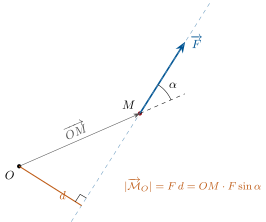
The moment (or torque) about a point O of a force F applied at M is the vector
MO(F)=OM∧F(Nm),
perpendicular to the plane of OM and F, of norm OM⋅Fsinα=Fd, where d — the lever arm — is the distance from O to the line of action of F. The moment about an oriented axis Δ (unit vector eΔ) through O is the scalar MΔ=MO⋅eΔ, independent of the choice of O on Δ; it vanishes if F is parallel to Δ or meets it. Two opposite forces on different lines of action form a couple, whose moment F∧AB is the same about every point.
Example 15.2(The door)
A 20N push perpendicular to a door at 0.80m from the hinges has moment16Nm about the hinge axis; the same push at 0.10m, 2Nm; along the door (line of action through the hinges), zero. The hinge’s own reaction, meeting the axis, has no moment about it: that is what makes the axis the natural place to take moments.
The moment of F about O: the cross product OM∧F, of norm Fd with d the distance from O to the line of action (the lever arm), directed perpendicular to the figure — here toward the reader.
15.2 Angular momentum of a particle
Definition 15.3(Angular momentum)
The angular momentum about O of a particle of mass m at M with velocity v is
LO=OM∧mv(kgm2/s),
and about an axis Δ through O, LΔ=LO⋅eΔ. For a motion in a plane perpendicular to Δ, in polar coordinates about the axis, LΔ=mr2θ˙; for a circle of radius R, LΔ=mR2ω=mRv.
In an inertial frame, for a point O fixed in that frame,
dtdLO=∑MO(Fi),dtdLΔ=∑MΔ(Fi)
for a fixed axis Δ. If the total moment about O vanishes, LO is conserved.
Proof.d(OM∧mv)/dt=v∧mv+OM∧ma=0+OM∧∑Fi, using Newton’s second law (O fixed so that dOM/dt=v). Project on eΔ. ∎
Corollary 15.5(Central forces: planar motion and the law of areas)
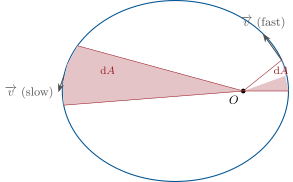
A particle subject only to a central force (always directed along OM, toward or away from the fixed center O) keeps LO constant. Its motion stays in the plane through O perpendicular to LO, and in that plane r2θ˙=C (constant): the radius vector OM sweeps out area at the constant areal velocity
dtdA=21r2θ˙=2mLO=2C.
Proof.OM∧F=0 for F∥OM: LO is constant. OM⊥LO always, hence the plane; LO=mr2θ˙ is constant. The area swept during dt is the triangle of sides OM and vdt: dA=21OM∧vdt=21r2θ˙dt. ∎
The law of areas for a central force: in equal times the radius vector from the center O sweeps equal areas, so the particle moves fast when close to O and slowly when far — Kepler’s second law, a consequence of the conservation of LO alone, whatever the law of force.
Example 15.6(The pendulum by moments)
Simple pendulum, axis Δ through the pivot perpendicular to the plane of swing: LΔ=mℓ2θ˙; the tension meets the axis (no moment), the weight’s moment is −mgℓsinθ (lever armℓsinθ, restoring). The theorem gives mℓ2θ¨=−mgℓsinθ, the equation of Example 12.12 without ever writing the tension — the chief advantage of moments: forces through the axis disappear.
Example 15.7(Pulling a puck inward)
A puck slides on frictionless ice in a circle, held by a string through a hole at the center; the string is pulled so that the radius halves. The tension is central: L=mr2ω is conserved, so ω is multiplied by 4, the speed rω by 2, the kinetic energy by 4 — the extra energy is the work of the pull, which the puck resists all the way in. The skater’s arms are the same physics with the mass distributed (Exercise 15.4).
15.3 Systems of points and rotation about a fixed axis
Theorem 15.8(Angular momentum of a system)
For a system of particles, with LO=∑iOMi∧mivi and O fixed in an inertial frame,
dtdLO=∑MO(Fext):
only the external forces’ moments count; the internal forces, which obey the action–reaction law along the line joining the particles, contribute nothing.
Proof. Sum the particle theorems. For an internal pair, OMi∧Fj→i+OMj∧Fi→j=(OMi−OMj)∧Fj→i=MjMi∧Fj→i=0 since the force is along MjMi. ∎
Proposition 15.9(Rigid rotation about a fixed axis)
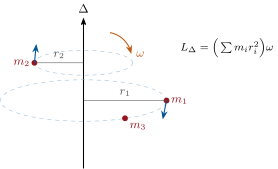
If the particles keep fixed distances ri from an axis Δ and all turn about it at the same angular velocityω (a rigid rotation),
LΔ=JΔω,JΔ=i∑miri2,Ek=21JΔω2,
JΔ being the moment of inertia about Δ, and the theorem reads JΔω˙=∑MΔ(Fext).
Proof. Each particle contributes miri2ω to LΔ and 21mi(riω)2 to Ek. Chapter 19 extends this to continuous solids. ∎
Example 15.10(The skater)
Arms out, a skater’s body has J≈4kgm2 plus two 3kg arms at 0.8m: J1=4+2×3×0.64=7.8kgm2. Arms in (0.2m): J2=4.2kgm2. The ice’s reaction and the weight have no moment about the vertical axis: Jω is conserved and the spin rate rises by J1/J2=1.85 — from 2 to 3.7 turns per second — while the kinetic energy rises by the same factor, paid by the muscles pulling the arms in.
Particles rigidly rotating about an axis: each turns on its own circle at the common ω, contributing miri2ω to the angular momentum about the axis. Mass far from the axis counts as the square of its distance — the skater’s outstretched arms.
Remark 15.11(Statics)
A solid at rest has LO=0 constant: the external forces must have zero resultant and zero total moment about any point. The second condition is the lever law of the balance, the seesaw and the crowbar: a small force far from the pivot balances a large one close to it.
15.4 Exercises
Exercise 15.1★
A 50N force on a wrench 0.30m from the nut: moment when the force is perpendicular to the handle; at 60∘ to it; along it.
Solution
Solution of Exercise 15.1.
Fd=50×0.30=15Nm; Fdsin60∘=13Nm; along the handle the line of action passes through the nut: 0.
Exercise 15.2★
Angular momentum of the Earth about the Sun (circular orbit, r=1.50×10¹¹m, v=29.8km/s, m=5.97×1024kg), and its areal velocity.
A conical pendulum (string 1.0m, 30∘ from the vertical, Exercise 12.9). Compute L about the vertical axis through the pivot per unit mass, and explain why it is conserved although the string’s tension and the weight act.
Solution
Solution of Exercise 15.3.
r=ℓsin30∘=0.50m, ω=3.4rad/s: Lz/m=r2ω=0.84m2/s. The tension’s line of action passes through the pivot (zero moment about any axis through it); the weight is parallel to the vertical axis (zero moment about it): Lz is conserved.
Exercise 15.4★
A skater’s trunk has J=4.0kgm2 about the spin axis; each arm (3.0kg) is treated as a point at 0.80m, then at 0.20m. Spin rate after pulling the arms in, starting from 2.0 turns per second; ratio of kinetic energies; where does the extra energy come from?
Solution
Solution of Exercise 15.4.
J1=4.0+2×3.0×0.64=7.8kgm2, J2=4.0+2×3.0×0.04=4.2kgm2; ω2=ω1J1/J2=1.85ω1: 3.7 turns per second. Ek=L2/2J: ratio J1/J2=1.85; the muscles, pulling the arms inward against the centrifugal tendency, do the work.
Exercise 15.5★★
Derive the pendulum equation ℓθ¨+gsinθ=0 from the angular momentum theorem about the pivot axis, and give the moment of each force.
Solution
Solution of Exercise 15.5.
LΔ=mℓ2θ˙; tension: zero moment (meets the axis); weight: −mgℓsinθ (lever armℓsinθ, restoring). mℓ2θ¨=−mgℓsinθ.
Exercise 15.6★★
The Earth’s distance to the Sun varies from 1.471×10¹¹m (perihelion) to 1.521×10¹¹m (aphelion). Using the law of areas, find the ratio of its speeds at these points; with a mean speed of 29.8km/s, give both speeds.
Solution
Solution of Exercise 15.6.
rpvp=rava: vp/va=ra/rp=1.034; with (vp+va)/2≈29.8km/s: vp=30.3km/s, va=29.3km/s.
Exercise 15.7★★
A 0.20kg puck circles at 2.0m/s on a 0.50m string through a hole; the string is pulled until the radius is 0.25m. New speed and angular velocity; kinetic energies before and after; work done by the pull. Why is the tension able to do work here?
Solution
Solution of Exercise 15.7.
L=mrv conserved: v2=v1r1/r2=4.0m/s, ω2=v2/r2=16rad/s (from 4rad/s). E1=0.40J, E2=1.6J: the pull does 1.2J. The tension is radial, but the puck’s displacement now has a radial component (it spirals in): the work T⋅dℓ is no longer zero.
Exercise 15.8★★
A uniform plank of mass 20kg and length 4.0m rests on a pivot 1.5m from its left end; a child of 30kg sits at the left end. Where must a 45kg child sit for balance? What does the pivot support?
Solution
Solution of Exercise 15.8.
Moments about the pivot (lengths from the pivot): child 30×1.5=45 (left); plank’s weight at its center, 0.5 to the right: 20×0.5=10 (right); second child at x to the right: 45x. Balance: 45=10+45x, x=0.78m. The pivot supports the total weight, 95×9.81=932N.
Exercise 15.9★★
An Atwood machine (m1=2.0kg, m2=1.0kg) hangs over a pulley of radius 0.10m and moment of inertia0.010kgm2 on which the string does not slip. Using the angular momentum theorem for the pulley and Newton’s law for the masses, find the acceleration and the two tensions. Compare with the massless pulley.
Solution
Solution of Exercise 15.9.
Masses: m1a=m1g−T1, m2a=T2−m2g; pulley: Jω˙=(T1−T2)R with a=Rω˙. Adding: a=(m1−m2)g/(m1+m2+J/R2)=9.81/(3.0+1.0)=2.5m/s2 (against 3.3m/s2); T1=m1(g−a)=14.7N, T2=m2(g+a)=12.3N — unequal, as the pulley needs a net moment.
Exercise 15.10★★★
A comet passes its perihelion at 0.50AU from the Sun at 40km/s. When it is 10AU away, what is the component of its velocity perpendicular to the radius vector? Can the law of areas give its full speed?
Solution
Solution of Exercise 15.10.
r1v1=r2v⊥2: v⊥2=40×0.5/10=2.0km/s. The law of areas gives only the perpendicular component; the radial one needs energy conservation (Chapter 16).
Exercise 15.11★★★
A star like the Sun (R=7.0×10⁸m, rotation period 25d) collapses into a neutron star of radius 10km, keeping its mass and angular momentum (J∝MR2). New period? Equatorial speed? What does the latter tell you about the assumption?
Solution
Solution of Exercise 15.11.
Jω constant with J∝R2: T′=T(R′/R)2=25×86400×(104/7×108)2=4.4×10−4s. Equatorial speed 2πR′/T′=1.4×108m/s, half the speed of light: the collapse cannot keep all the angular momentum — much is shed (and relativity enters).
Exercise 15.12★★★
A bead slides without friction along a straight rod rotating in a horizontal plane at constant ω about a vertical axis through one end. Write Lz of the bead; show that it is not conserved and compute the moment the rod must exert; deduce the transverse reaction of the rod on the bead.
Solution
Solution of Exercise 15.12.
Lz=mr2ω, and r changes: dLz/dt=2mrr˙ω=0. This must be the moment of the rod’s transverse reaction N: rN=2mrr˙ω, so N=2mr˙ω — the rod pushes the bead sideways as it slides out (the Coriolis term of Chapter 18).
15.5 Problem: Why the Moon is leaving
Problem 15.1
Weekend problem — the tides the Moon raises on the Earth pull it forward and the Earth back: how angular momentum flows from our days into the Moon’s orbit, centimeter by centimeter, and where the energy goes
Data: G=6.67×10⁻¹¹SI; Earth M=5.97×1024kg, R=6.37×10⁶m, spin Ω=2π/(86164s), moment of inertiaJ=0.33MR2; Moon m=7.35×10²²kg, orbit treated as circular, r=3.84×10⁸m; lunar laser ranging measures dr/dt=3.8cm/yr; the day lengthens by 2.3ms per century; 1 century =3.16×10⁹s.
Part I — The angular momenta.
Compute the orbital angular velocityω of the Moon from Newton’s law (circular orbit), and check it against the 27.3d sidereal month.
Show that for a circular orbit Lorb=mGMr, and deduce dLorb/dr=Lorb/2r.
Compute the Earth’s spin angular momentumLspin=JΩ and compare with Lorb.
The Moon spins once per month: estimate its spin angular momentum (Jm≈0.4mRm2, Rm=1.74×10⁶m) and justify neglecting it.
What external moments act on the Earth–Moon system about its center of mass? Argue that, to a good approximation, the total L=Lspin+Lorb is conserved.
Part II — The tidal torque. The Moon raises two bulges of water on the Earth; because the Earth spins faster than the Moon orbits, friction drags the bulges ahead of the Earth–Moon line by a small angle.
Sketch the Earth, the leading bulge and the Moon. In which direction does the Moon’s attraction on the nearer bulge act, relative to the Earth’s spin?
Deduce the sign of the moment on the Earth’s spin: does the day lengthen or shorten?
From question 3, does r grow or shrink? And the Moon’s orbital speed v=GM/r?
Resolve the apparent paradox: the Moon is pushed forward, yet ends up moving more slowly.
Toward what final state does the exchange tend?
Part III — The numbers.
From the lengthening of the day, compute the relative change ΔΩ/Ω per century.
Deduce the change of Lspin per century.
Deduce the change of Lorb per century.
Using question 3, convert it into a change of r per century and per year. Compare with the laser-ranging value.
By what fraction, and by how many seconds, does the sidereal month lengthen per century (T∝r3/2)?
Compute the change of the Earth’s rotational kinetic energy per century (ΔE=LspinΔΩ to first order).
Compute the change of the Moon’s orbital mechanical energy, Eorb=−GMm/2r, per century.
Part IV — The energy.
Show that the Earth loses more energy than the Moon gains, and compute the difference per century and the corresponding power. Where does it go?
Compare that power with humanity’s consumption, about 18TW, and with the Earth’s internal heat flow, about 47TW.
In the final state of question 12, day and month are equal: Ω=ω=GM/r3. Writing the conservation of Lspin+Lorb, check that r≈5.5×10⁸m satisfies it, and give the common period in days.
Why will that state in fact never be reached? (Think of the Sun’s tides.)
The Moon already shows the Earth one face. Explain with the same mechanism, and say why it happened to the Moon first.
Summarize in three lines: what is conserved, what is exchanged, what is dissipated.
Solution
Solution of Problem 15.1.
1.mω2r=GMm/r2: ω=GM/r3=3.98×1014/5.66×1025=2.65×10−6rad/s, period 2π/ω=2.37×106s=27.4d.
4.J=0.33×5.97×1024×4.06×1013=8.0×1037kgm2; Ω=7.29×10⁻⁵rad/s; Lspin=5.8×1033kgm2/s, a fifth of Lorb.
5.Jm≈0.4×7.35×1022×3.0×1012=8.9×1034kgm2, times ω: 2.4×1029kgm2/s, 10−5 of the orbit’s: negligible.
6. The Sun’s attraction acts on the system’s center of mass (no moment about it to first order); its tidal effect on the pair is small: the total L is conserved to the accuracy needed here.
7. The nearer bulge, ahead of the Earth–Moon line, is pulled by the Moon with a force whose tangential component opposes the Earth’s spin.
8. Negative moment on the spin: the Earth slows, the day lengthens.
9. The bulge pulls the Moon forward: positive moment on the orbit, Lorb grows.
10.Lorb∝r grows, so r grows; v∝1/r decreases.
11. The forward pull does positive work, raising the Moon’s energy; a higher orbit is a slower orbit: the energy goes into height (potential), more than the kinetic energy lost.
12. Tidal locking of the Earth: day equal to month, no leading bulge, no torque.
13.ΔΩ/Ω=−2.3×10−3s/86164s=−2.7×10−8 per century.
14.ΔLspin=LspinΔΩ/Ω=−1.55×1026kgm2/s per century.
15.ΔLorb=+1.55×1026kgm2/s per century.
16.Δr=2rΔL/L=2×3.84×108×1.55×1026/2.9×1034=4.1m per century, 4.1cm/yr: close to the measured 3.8cm/yr (the day’s lengthening also has a non-tidal part).
17.ΔT/T=23Δr/r=1.6×10−8: 2.37×106×1.6×10−8=0.04s per century.
18.ΔErot=LspinΔΩ=5.8×1033×7.29×10−5×(−2.7×10⁻⁸)=−1.1×10²²J per century.
19.ΔEorb=GMmΔr/2r2=2.93×1037×4.1/(2×1.475×1017)=+4.1×1020J per century.
20. Net −1.1×10²²+4×10²⁰≈−1.06×10²²J per century: 3.4×10¹²W, dissipated as heat by tidal friction in the oceans and the solid Earth.
21. A fifth of humanity’s power, a fourteenth of the geothermal flow — a small but permanent heater.
22.Ltot=3.5×1034. At r=5.5×10⁸: ω=GM/r3=1.55×10−6rad/s, Jω=1.2×1032, mGMr=7.35×1022×4.68×1011=3.44×1034; sum 3.45×1034: consistent. Period 2π/ω=4.1×106s=47d.
23. The Sun’s tides keep slowing the Earth below the Moon’s orbital rate, so the Earth–Moon torque would then reverse; besides, the Sun will have evolved long before (the time scale is tens of billions of years).
24. The Earth raised tides on the Moon, which braked its spin until one face stayed toward us; being lighter and closer to a heavier partner, the Moon’s locking was far faster.
25. Conserved: the total angular momentum. Exchanged: angular momentum from the Earth’s spin to the Moon’s orbit, about 1.6×1026SI per century. Dissipated: mechanical energy, a few terawatts, as tidal heat.