University Physics — Year 1 · Bachelor Year 1
12Newton’s Laws of Dynamics
A skydiver steps out of the plane and, within a dozen seconds, stops accelerating: at two hundred kilometers per hour the air pushes back exactly as hard as the Earth pulls. A car takes a bend too fast and the tires give way; a truck on a mountain road crawls in low gear, held by the same friction that lets it stop on the flat. Kinematics described motions; dynamics explains them, from a single law linking the acceleration of a body to the forces acting on it. This chapter states Newton’s three laws, catalogues the forces one meets at the level of this volume — weight, springs, strings, contacts, friction dry and fluid — and shows how to go from a drawing of the forces to a differential equation and its solution.
12.1 Mass, momentum, and the three laws
Definition 12.1 (Mass, momentum, force)
A point particle has an inertial mass (kilograms), a measure of its resistance to changes of velocity, independent of the frame. Its momentum in a frame is
A force (newtons) is the action of another body on the particle; forces add as vectors, and the resultant is their sum .
Theorem 12.2 (Newton’s laws)
- Principle of inertia. There exist frames, called inertial (or Galilean), in which a particle subject to no force, or to forces of zero resultant, moves in a straight line at constant velocity. Any frame in uniform rectilinear translation with respect to an inertial frame is inertial.
Law of momentum. In an inertial frame,
- Action and reaction. If body exerts on body , then exerts on , along the line joining them.
Proof. Admitted at this level. ∎
Remark 12.3 (What the laws say)
The first law is not a special case of the second: it defines the frames in which the second holds. In practice a laboratory on the Earth is inertial to excellent accuracy for experiments lasting minutes (Chapter 18 quantifies the error); a frame attached to the Sun and the distant stars is better still. The second law is a vector equation: three scalar equations, one per axis, and the choice of axes (Chapter 11) is the first decision of every problem. The third law holds at each instant for the contact and gravitational forces of this volume.
Definition 12.4 (Closed system; momentum conservation)
A closed system exchanges no matter with the outside. For a system of particles, the internal forces cancel in pairs (third law), and the total momentum obeys : it is conserved when the external forces vanish (Chapter 19 develops this).
12.2 The usual forces
Proposition 12.5 (Weight and gravitation)
Near the Earth’s surface a body of mass is pulled by its weight , with the local gravitational field, , directed downward (toward the center, very nearly). More generally a mass at distance attracts with (Chapter 16); at the surface of a sphere of radius , . Note the unit: and are the same, which is why all bodies fall alike.
Proof. Newton’s law of gravitation is admitted and explored in Chapter 16; . ∎
Proposition 12.6 (Spring; string)
An ideal spring of stiffness and natural length , stretched to length along the unit vector pointing from its fixed end to the body, exerts on the body the restoring force
toward its natural length. An ideal string (massless, inextensible) exerts a tension along itself, pulling, of the same magnitude at both ends and all along it (even over a massless, frictionless pulley).
Proof. Hooke’s law is an empirical model valid for small deformations. The string: a massless element obeys from Newton’s second law, so the tension is transmitted unchanged. ∎
Proposition 12.7 (Contact forces: normal reaction and dry friction)
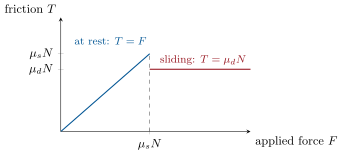
A solid surface exerts on a body touching it a normal reaction , perpendicular to the surface and repulsive (: a surface cannot pull), and a tangential friction force . Coulomb’s laws: if the body does not slide, (static friction adjusts to what is needed, up to that limit); if it slides at velocity relative to the surface, (kinetic friction, opposing the sliding), with coefficients of order to depending on the materials, independent of the contact area and of the speed.
Proof. Admitted at this level. ∎
Proposition 12.8 (Fluid friction)
A body moving at velocity through a fluid at rest feels a drag opposite to : at low speed (small size, viscous fluid) it is linear, — for a sphere of radius in a fluid of viscosity , (Stokes); at high speed (large, fast bodies in air or water) it is quadratic,
with the fluid’s density, the body’s cross-section facing the flow and a dimensionless drag coefficient ( for a sphere, for a car, for a flat disk). The Reynolds number (Remark 1.10) decides: linear below , quadratic above about .
Proof. Admitted at this level. ∎
Remark 12.9 (Other forces)
Buoyancy (Archimedes) is a resultant of pressure forces, derived in Chapter 21; the electric and magnetic forces on a charge are the subject of Chapter 17. All the forces of this chapter are models of contact or field interactions, valid within stated limits — Hooke’s spring breaks, Coulomb’s friction fails at high pressure, Stokes’s drag fails at high speed. Part of every solution is checking that the model used applies.
12.3 Solving a problem of dynamics
Method 12.10 (From the situation to the equation)
- System: name the body treated as a point.
- Frame: name it and check it is inertial (or treat it as such to the accuracy required).
- Forces: list every body touching or attracting the system, and draw each force on a diagram (the free-body diagram); nothing else enters.
- Coordinates: choose axes adapted to the motion (Method 11.18) and express .
- Project on the axes; use the constraints (a body on a surface stays on it: ; a string of fixed length: equal speeds at both ends).
- Solve and check: dimensions, limiting cases, signs (, if at rest).
Example 12.11 (Block on an incline)
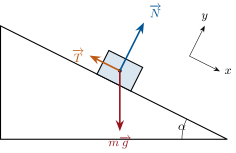
Block of mass on a plane inclined at , coefficients , . Axes: down the slope, along the normal. Weight , reaction , friction if sliding down. Along : . At rest along : , i.e. : the block holds up to the angle — a measurement of needing no balance. Sliding: , so , independent of : for , .
Example 12.12 (The simple pendulum)
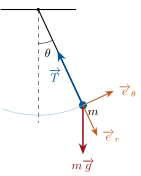
Mass on a string of length , angle from the downward vertical. Polar coordinates at the suspension point: ; forces: weight and tension . Along : ,
which for small angles () is the harmonic equation with : period , the that Example 1.8 could not supply. Along : — the string pulls hardest at the bottom, where the speed is greatest.
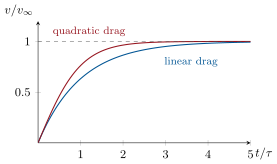
Proposition 12.13 (Fall with drag; terminal velocity)
A body of mass falling from rest under its weight and a drag force reaches a terminal velocity at which the two balance. Linear drag: , with , . Quadratic drag: , with
Proof. Linear: a first-order equation, (Theorem 7.2). Quadratic: with , ; separating variables, (the rational fraction integrates to ), so . ∎
Example 12.14 (Two terminal velocities)
A skydiver, , belly down, in air (): , reached (to ) in about . A fog droplet, , in Stokes’s regime (): — which is why fog hangs in the air.
12.4 Motion on a circle: constraint forces
Proposition 12.15 (Centripetal requirement)
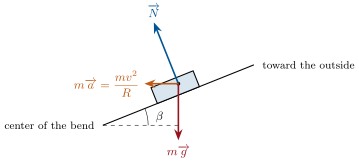
A particle moving on a circle of radius at speed must receive from the resultant of the forces a component directed toward the center. Whatever provides it — a string’s tension, friction, a banked road’s reaction, gravity — sets the maximum speed or the minimum speed at which the motion is possible.
Proof. Newton’s second law with the Frenet acceleration: the normal component of equals . ∎
Example 12.16 (Three circles)
Flat bend: friction must supply , so : for , . Banked bend at angle , no friction: the reaction is normal to the road; vertically , horizontally , so — the one speed at which the bend is taken without any friction. Loop: at the top, with pointing down toward the center, , and requires : below that, the car leaves the track (Problem 11.1 again, now explained).
12.5 Exercises
Exercise 12.1 ★
A person of mass stands on a scale in an elevator. What does the scale read (in newtons and in “kilograms”) when the elevator accelerates upward at , downward at , moves at constant velocity, and falls freely?
Solution
Solution of Exercise 12.1.
Scale reading with the upward acceleration: up, (“”); down, (“”); constant velocity, (); free fall, .
Exercise 12.2 ★
A block on a frictionless table is tied by a string over a frictionless pulley to a hanging mass . Find the acceleration and the tension.
Solution
Solution of Exercise 12.2.
Same acceleration for both (inextensible string): , , so , .
Exercise 12.3 ★
A block slides down a incline with . Compute its acceleration and its speed after from rest. Does the answer depend on its mass?
Exercise 12.4 ★
A mass hangs from a spring of stiffness . Find the static elongation; then the angular frequency and period of its vertical oscillations about equilibrium (show the equation of motion is harmonic).
Solution
Solution of Exercise 12.4.
: . With the displacement from equilibrium, (the weight and the static stretch cancel): , .
Exercise 12.5 ★★
A crate sits on a tilting platform; it starts to slide at . Find . A car on a flat road with : maximum speed in a bend of radius , and on a wet road with .
Solution
Solution of Exercise 12.5.
. Bend: : (); wet, ().
Exercise 12.6 ★★
Terminal velocities: a skydiver (, , ); a fog droplet of radius in air (), using Stokes’s law. Check with a Reynolds number that each regime is the right one.
Solution
Solution of Exercise 12.6.
Skydiver: ; : quadratic. Droplet: , ; : linear.
Exercise 12.7 ★★
A pendulum of length is released from rest at . Given that its speed at the bottom is (energy, next chapter), find the string tension at the bottom in units of , and at the release point.
Solution
Solution of Exercise 12.7.
Bottom: ; . Release point: , .
Exercise 12.8 ★★
A bend of radius is banked at . At what speed can it be taken with no friction at all? What must friction do at lower and at higher speeds?
Solution
Solution of Exercise 12.8.
(). Slower: the car tends to slide down the bank, friction must point up-slope; faster: friction points down-slope to add centripetal force.
Exercise 12.9 ★★
A conical pendulum: a mass on a string of length describes a horizontal circle, the string making with the vertical. Find the angular velocity, the period and the tension (in units of ).
Solution
Solution of Exercise 12.9.
, : , period ; .
Exercise 12.10 ★★★
A car reaches from rest in with constant acceleration. Find the resultant force, and the minimum friction coefficient between driving tires and road if the driving wheels carry the whole weight. What limits a sports car on a wet road?
Solution
Solution of Exercise 12.10.
, ; gives . On a wet road caps the acceleration near whatever the engine: grip, not power.
Exercise 12.11 ★★★
A body falls from rest with linear drag, . Write and derive the distance fallen ; compute , and after ; compare with free fall.
Solution
Solution of Exercise 12.11.
, ; . At : , against in vacuum.
Exercise 12.12 ★★★
A car of mass runs on the inside of a vertical circular loop of radius (Problem 11.1). Express the track’s normal reaction as a function of the angle from the bottom and of the speed ; deduce the minimum speed at the top; using , find the minimum entry speed and the reaction at the bottom in that case.
Solution
Solution of Exercise 12.12.
Radial projection (toward the center): , so . Top (): iff . With the speed law, : ; then at the bottom .

12.6 Problem: The parachutist
Problem 12.1
Weekend problem — from the door of the plane to the ground: free fall, the air that pushes back, a canopy that opens too fast, and the landing — one law of motion, two drag laws
A parachutist with gear has mass . Air: , . Falling belly down, ; under the open canopy, . ; is counted downward from the jump point.
Part I — Without air.
- Write Newton’s second law and give and ; compute both at .
- Compute the weight.
- The parachutist feels “weightless” during this phase although gravity acts fully. Explain with the forces (what is missing compared with standing on the ground).
- Is the Earth’s frame inertial enough for this problem? Name what is neglected.
Part II — Falling through air.
- Write the drag force for belly-down fall as a function of .
- Write the equation of motion for .
- Find the terminal velocity (in and ).
- With and , show that ; compute .
- Solve by separation of variables and show that .
- After how long is ? ?
- Show that and compute the distance fallen at ; compare with Part I.
- Estimate the Reynolds number at with and justify the quadratic law.
Part III — The canopy opens.
- Compute the new terminal velocity under the open canopy.
- If the canopy opened instantaneously at , what would the deceleration be, in and in ? Why is this unacceptable?
- Real canopies open over about . Estimate the mean deceleration and the mean force of the harness on the parachutist.
- Once the canopy is fully open the speed decays toward the new : what is the new time constant , and what does it mean for the approach to steady descent?
- In steady descent, what is the harness force? Justify with the second law.
- Explain why the terminal velocity varies as : by what factor would a canopy of half the area raise it?
- A heavier jumper () under the same canopy: terminal velocity?
Part IV — Landing.
- The landing speed is the canopy’s . From what height would one have to jump, with no air, to hit the ground at that speed?
- A stiff-legged landing stops the body over ; a roll over . Estimate the mean deceleration (in ) and the mean force on the legs in each case, and conclude.
- Just before touching down the parachutist pulls both toggles, which briefly increases the canopy’s drag. Explain qualitatively the effect on the speed.
Part V — Small things fall differently.
- A raindrop of radius (): compute its terminal velocity with the quadratic law, and check the Reynolds number.
- A fog droplet of radius : use Stokes’s law for and check that the Reynolds number is indeed small.
- Summarize: one equation of motion, two drag regimes, and the three numbers () that decide whether something falls like a stone, like a leaf or not at all.
Solution
Solution of Problem 12.1.
1. : , ; at : , .
2. .
3. On the ground the floor pushes up with — that push is what one feels as weight. In free fall there is no contact force: gravity acts on every part alike and nothing presses.
4. Yes to a fraction of a percent over a minute; neglected: the Earth’s rotation (centrifugal and Coriolis terms, Chapter 18) and the wind.
5. (SI).
6. .
7. .
8. Divide by : ; .
9. , so .
10. ; : .
11. ; at : , against .
12. : far above , quadratic.
13. .
14. Drag ; : the harness would break, or the jumper.
15. Mean ; harness force .
16. : within a few seconds of full opening the descent is steady.
17. : harness force .
18. Balance gives : half the area, times the speed ().
19. : .
20. : a jump from a first floor.
21. : () over , force ; () over , . Roll.
22. A larger drag (and some lift) momentarily exceeds the weight: the jumper decelerates and touches down below .
23. , : ; : quadratic (roughly).
24. (Exercise 12.6); : Stokes applies, consistently.
25. ; drag linear in for small, slow things, quadratic for large, fast ones. The numbers: for a falling body, under a canopy (or a raindrop), for fog — the same law spanning four orders of magnitude.