A cyclist stops pedaling at the top of a hill and arrives at the bottom at a speed that depends on the drop, not on the shape of the road. A bungee jumper falls sixty meters and stops, for an instant, exactly where the cord’s pull has eaten all the speed the fall had given. A hydrogen atom bound to a chlorine atom vibrates in a well whose depth is the energy it costs to tear the molecule apart. In each case a single number is exchanged between forms — motion, height, stretch, bond — and summed, it does not change. This chapter builds that bookkeeping from Newton’s second law: work and power, the kinetic energy theorem, potential energies for the forces that allow one, and the conservation of mechanical energy that turns many dynamical problems into one-line algebra and explains, through the shape of a potential well, which positions are stable.
The lecturer’s pendulum: released from the nose, the bowling ball returns to the nose and no further — mechanical energy is conserved, and never exceeded.
13.1 Power and work
Definition 13.1(Power and work of a force)
The power of a force F acting on a point moving at velocity v is
P=F⋅v(watts),
and its work between times t1 and t2 (positions A and B) is the accumulated power,
WA→B=∫t1t2F⋅vdt=∫ABF⋅dℓ(joules),
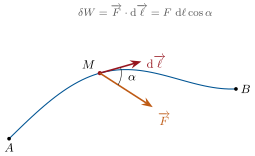
the sum of the elementary worksδW=F⋅dℓ along the elementary displacements dℓ=vdt of the trajectory. Work is positive if the force pushes along the motion (motive), negative if against it (resistive), zero if perpendicular.
Proposition 13.2(Works one meets)
Constant force: WA→B=F⋅AB, whatever the path. Weight: W=mg(zA−zB), z counted upward.
Spring of stiffness k, from elongation xA to xB: W=21k(xA2−xB2).
Normal reaction of a fixed surface, string tension on a body moving perpendicular to it: W=0 (force ⊥ displacement).
Kinetic friction and drag: W<0 always (the force opposes the relative motion), and depends on the path length.
Proof. Constant F: ∫F⋅dℓ=F⋅∫dℓ=F⋅AB; with F=−mgez, F⋅AB=−mg(zB−zA). Spring: F⋅dℓ=−kxdx, and ∫xAxB−kxdx=21k(xA2−xB2). Friction: T=−μNv/v, so T⋅v=−μNv<0. ∎
The elementary work of a force along a small displacement of its point of application: only the component of F along the motion works. Summed along the path from A to B, it gives WA→B.
the change of kinetic energy between two positions equals the total work of all the forces applied along the way.
Proof. Dot Newton’s second law with v: ma⋅v=dtd(21mv⋅v)=dEk/dt, while (∑Fi)⋅v=∑Pi. Integrate over time. ∎
Example 13.4(Braking distance)
A 1000kg car at 100km/h (Ek=386kJ) braked by a constant 7.0kN force stops after d=Ek/F=55m: the distance grows as the square of the speed. Since the maximal braking force is μsmg (Chapter 12), the shortest stopping distance is v2/2μsg whatever the car’s mass — and it doubles on a wet road where μs halves.
A force is conservative if its work between two points does not depend on the path followed. Equivalently, there exists a function of position, the potential energyEp, such that
WA→B=Ep(A)−Ep(B)=−ΔEp,δW=−dEp,
Ep being defined up to an additive constant (a choice of origin).
and in one dimension Fx=−dEp/dx: the force points toward decreasing potential energy, “downhill” on the graph of Ep.
Proof.δW=Fxdx+Fydy+Fzdz=−dEp=−(∂xEpdx+∂yEpdy+∂zEpdz) for every displacement: identify the coefficients (the differential of a function of several variables, from the mathematics course). ∎
Proposition 13.7(The usual potential energies)
Weight: Ep=mgz+const (z upward).
Spring: Ep=21k(ℓ−ℓ0)2+const.
Newtonian gravitation of a mass M: Ep=−GMm/r+const, the constant usually chosen so that Ep→0 at infinity.
Electrostatic force on a charge q in a potential V: Ep=qV (Chapter 27).
Kinetic friction and fluid drag are notconservative (their work depends on the path, and is always negative).
Proof. Each is read off the works of Proposition 13.2: W=−ΔEp. For gravitation, F=−GMm/r2er and δW=−GMmdr/r2=−d(−GMm/r). ∎
the total work of the non-conservative forces. If those do no work (no friction, or constraint forces perpendicular to the motion), Em is conserved: the motion is conservative.
Proof.ΔEk=Wc+Wnc=−ΔEp+Wnc. ∎
Method 13.9(Using energy)
When a problem asks for a speed at a position (not a time, not a force), try energy first:
write Em at the two positions, with a clear origin for Ep;
equate them (adding Wnc if friction acts) and solve for the unknown speed or position.
Energy never gives the time or the constraint forces; for those, go back to Newton’s law — often with the speed that energy just provided.
Example 13.10(The loop’s speed law)
On the frictionless loop of Problem 11.1 the track’s reaction is normal to the motion and works not: Em is conserved. With z=R(1−cosθ) above the bottom, 21mv2+mgR(1−cosθ)=21mv02: the speed law v2=v02−2gR(1−cosθ) used there, now derived in one line. The minimum entry speed 5gR then follows from the top condition v2≥gR of Example 12.16.
Example 13.11(Energy lost to friction)
A block slides down a slope of angle α and height h with kinetic friction μd: Wnc=−μdmgcosα×h/sinα=−μdmghcotα, so 21mv2=mgh(1−μdcotα). For h=2.0m, α=30∘, μd=0.20: v=5.1m/s instead of 6.3m/s; a third of the potential energy became heat.
13.5 Equilibrium, stability, and phase portraits
Proposition 13.12(Equilibrium and stability in one dimension)
is in equilibrium at x0 iff F(x0)=−Ep′(x0)=0: the extrema of Ep;
the equilibrium is stable if Ep has a local minimum there (Ep′′(x0)>0): a small displacement produces a restoring force; unstable at a maximum;
near a stable equilibrium, small motions are harmonic, with
ω02=mEp′′(x0).
Proof. Taylor’s formula (mathematics course): Ep(x)≈Ep(x0)+21Ep′′(x0)(x−x0)2, so F≈−Ep′′(x0)(x−x0) and mx¨=−Ep′′(x0)(x−x0) — a spring of stiffness Ep′′(x0). For Ep′′<0 the “stiffness” is negative: exponential departure. ∎
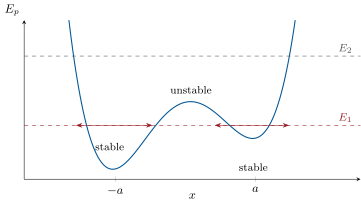
A one-dimensional potential landscape: minima are stable equilibria, the maximum an unstable one. A particle of energy E1 below the barrier is trapped in one well between two turning points (where Ep=E1, arrows) and oscillates; with E2 above the barrier it passes freely from one well to the other.
Definition 13.13(Turning points; bound and free motion)
For a conservative one-dimensional motion of energy Em, the particle can only be where Ep(x)≤Em (since Ek≥0); the points where Ep=Em are turning points, where the velocity vanishes and reverses. Trapped between two turning points in a potential well, the motion is bound and periodic; able to reach infinity, it is free; a potential barrier higher than Em cannot be crossed.
Definition 13.14(Phase portrait)
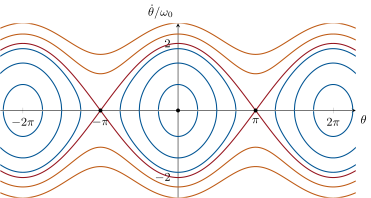
The phase portrait of a one-dimensional motion is the family of curves traced by the point (x,x˙) in the phase plane. For a conservative system each curve is a level line 21mx˙2+Ep(x)=Em: closed curves around stable equilibria (oscillations), open curves for free motion, and, through unstable equilibria, the separatrices that divide the two. Curves are traversed clockwise (x˙>0 means x increasing) and never cross.
Phase portrait of the simple pendulum, 21θ˙2+ω02(1−cosθ)=const. Closed curves (blue): swings about the stable equilibrium θ=0; open curves (orange): full rotations; between them the separatrix (red) through the unstable equilibria θ=±π, the motion that just reaches the top.
Example 13.15(The pendulum’s landscape)
Ep=−mgℓcosθ: minimum at θ=0, Ep′′=mgℓ, so ω02=gℓ/(mℓ2)=g/ℓ — the small-oscillation result of Example 12.12 read off the well’s curvature; maximum at θ=π, the inverted pendulum, unstable. Energy Em<mgℓ: oscillation between ±θmax; Em>mgℓ: it goes over the top and rotates; Em=mgℓ: the separatrix, an infinitely slow approach to the top.
13.6 Exercises
Exercise 13.1★
A 20kg crate is lifted 3.0m at constant speed in 5.0s. Work of the lifting force, of the weight, and power supplied. The same crate pushed 3.0m along a floor with μd=0.30: work of friction.
Solution
Solution of Exercise 13.1.
Lifting force +mgh=20×9.81×3.0=589J; weight −589J; power 589/5.0=118W. Friction: −μdmgd=−0.30×196×3.0=−177J.
Exercise 13.2★
Kinetic energy of a 1000kg car at 100km/h; stopping distance with a constant 7.0kN braking force; what happens to the distance if the speed is doubled?
Solution
Solution of Exercise 13.2.
Ek=21×1000×27.82=386kJ; d=Ek/F=55m; doubling v quadruples Ek and d: 220m.
Exercise 13.3★
A spring of stiffness 500N/m is compressed by 10cm and released against a 50g ball on a frictionless horizontal track. Energy stored; speed of the ball.
Solution
Solution of Exercise 13.3.
Ep=21×500×0.102=2.5J; v=2×2.5/0.050=10m/s.
Exercise 13.4★
A pendulum of length 1.0m is released from rest at 60∘: speed at the bottom by energy; then, with Newton’s law, the tension there (in units of mg).
A block slides from rest down a 30∘ slope of height 2.0m, μd=0.20. Speed at the bottom by the energy theorem; fraction of the initial potential energy lost to friction.
Using Ep=−GMm/r, show that the speed needed to escape the Earth’s attraction from its surface is ve=2GM/R, and compute it (M=5.97×1024kg, R=6.37×10⁶m). What is the escape speed from a body with the same density but twice the radius?
Solution
Solution of Exercise 13.6.
Em=21mv2−GMm/R≥0 for the body to reach infinity (where Ep=0 and v→0): ve=2GM/R, i.e.
ve=6.37×1062×6.67×10−11×5.97×1024=11.2km/s.
Same density, M∝R3: ve∝R, so 22.4km/s.
Exercise 13.7★★
Bungee: a 70kg jumper, cord of natural length 20m and stiffness 50N/m, jumps from rest. Find the maximal stretch of the cord, the total drop, and the maximal tension (in units of the weight). Where is the speed greatest?
Solution
Solution of Exercise 13.7.
Lowest point: mg(ℓ0+x)=21kx2, 25x2−687x−13734=0, x=41m; total drop 61m; Tmax=kx=2.0kN=3.0mg (net 2g upward). Speed is greatest where the net force vanishes, kx=mg: x=14m, 34m below the jump.
Exercise 13.8★★
A cyclist (80kg with bike) climbs a 5% slope at 5.0m/s against a drag 21ρCxSv2 with CxS=0.50m2. Power against gravity, against drag, total.
Solution
Solution of Exercise 13.8.
Gravity: mgvsinα=80×9.81×5.0×0.05=196W; drag: 21ρCxSv3=0.5×1.2×0.50×125=38W; total 234W.
Exercise 13.9★★
A particle of mass m has Ep(x)=E0[(x/a)4−2(x/a)2]. Find the equilibria and their stability, the depth of the wells, and the angular frequency of small oscillations about a stable one.
Solution
Solution of Exercise 13.9.
Ep′=4E0(x3/a4−x/a2)=0: x=0,±a. Ep′′=E0(12x2/a4−4/a2): −4E0/a2 at 0 (unstable maximum, Ep=0), +8E0/a2 at ±a (stable minima, Ep=−E0): wells of depth E0; ω02=8E0/ma2.
Exercise 13.10★★★
For the harmonic oscillator Ep=21kx2, show that the phase curves are ellipses, give their semi-axes for energy E, and explain why all are traversed in the same time.
Solution
Solution of Exercise 13.10.
21mx˙2+21kx2=E: an ellipse of semi-axes xmax=2E/k and x˙max=2E/m. The motion is harmonic with period 2πm/k whatever the amplitude (isochronism), so every ellipse takes the same time.
Exercise 13.11★★★
A small object slides from rest at the top of a frictionless hemisphere of radius R. Using energy and Newton’s law, find the angle from the vertical at which it leaves the surface, the height, and its speed then.
Solution
Solution of Exercise 13.11.
Energy: v2=2gR(1−cosθ). Radial: mgcosθ−N=mv2/R, so N=mg(3cosθ−2), zero at cosθ=2/3 (θ=48∘): height 2R/3, speed 2gR/3.
Exercise 13.12★★★
A car at 90km/h skids to rest in 80m with locked wheels. Find μd from energy. Where did the energy go? Why does an anti-lock system (wheels kept rolling) stop shorter?
Solution
Solution of Exercise 13.12.
21mv2=μdmgd: μd=625/(2×9.81×80)=0.40. Heat in the tire–road contact (and a skid mark). Rolling wheels use static friction, μs>μd: a larger braking force, a shorter distance, and steering kept.
13.7 Problem: The energy well of a chemical bond
Problem 13.1
Weekend problem — two atoms, one curve: the potential energy of a bond read as a landscape — its floor, its walls, the small vibrations at the bottom, and the energy it takes to climb out
The interaction of the two atoms of a diatomic molecule is modeled by the potential energy
Ep(r)=ϵ[(rσ)12−2(rσ)6],
r the distance between the nuclei. For hydrogen chloride take ϵ=4.4eV, σ=0.127nm, and let the light hydrogen atom (m=1.67×10⁻²⁷kg) move while the heavy chlorine stays put. 1eV=1.60×10⁻¹⁹J; kB=1.38×10⁻²³J/K; NA=6.02×10²³.
Part I — The landscape.
Give the limits of Ep as r→0 and r→∞, and sketch the curve.
Show that Ep has a single minimum, at r=σ, of value −ϵ.
With u=(σ/r)6, show that Ep=ϵ(u2−2u): a parabola in u. Recover the minimum from it.
Express the force F(r) (positive if repulsive) and give its sign on each side of σ.
Compute Ep and F at r=1.2σ (in eV and in nN).
What is the dissociation energy of the molecule, in eV and in kJ/mol? (Measured bond energy of HCl: 431kJ/mol.)
Check the stability criterion at r=σ: compute Ep′′(σ).
Part II — Small vibrations.
Write the second-order Taylor expansion of Ep around σ and identify an effective stiffness k.
Compute k (in N/m).
Deduce the angular frequency, the frequency and the wavelength of the vibration, and its wavenumber 1/λ in cm−1.
The measured vibration of HCl is at 2990cm−1. Comment on the agreement and on what the model gets right.
At 300K the mean vibrational energy is of order kBT. Estimate the amplitude of vibration and compare with σ.
Deduce the maximal speed of the hydrogen atom in that vibration.
Part III — Large oscillations and the way out.
Describe the phase portrait: which energies give closed curves, which open ones, and what separates them?
For Em=−ϵ/2, find the two turning points (in units of σ).
Show that their midpoint lies beyond σ, and explain why heating (raising the vibrational energy) makes the mean bond length grow — the origin of thermal expansion.
Is the period of large oscillations longer or shorter than 2π/ω0? Argue from the shape of the walls.
From Em=−ϵ/2, what energy must be supplied to dissociate the molecule? If given as kinetic energy of the hydrogen atom at r=σ, what speed is that?
Two atoms approaching from far apart with positive total energy cannot form a bound molecule by themselves. Why? What is needed?
Compute the work of the bond force when r goes from 2σ to σ. Is the force motive or resistive there?
Compute the work an external agent must do to stretch the bond from σ to 1.5σ at vanishing speed.
Compute F at r=0.9σ and compare with r=1.2σ: what does the asymmetry tell about compressing versus stretching?
At what temperature would kBT equal ϵ? Why do molecules dissociate at far lower temperatures in practice?
A better model (Morse) changes the shape of the walls but keeps a minimum at the bond length. Which of the results above survive unchanged in method, and which numbers would change?
Summarize the three ways energy methods were used: to find equilibrium, to find the vibration frequency, and to find what is needed to escape.
Solution
Solution of Problem 13.1.
1.r→0: +∞ (the r−12 term); r→∞: 0−. A steep wall, a well, a long tail.
11. A factor 2.4 too high: the model’s walls are too steep (the r−12 core is a crude stand-in for a covalent bond), but the order of magnitude — an infrared vibration at 1014 Hz — is right, and the method (curvature of the well) is exactly the one used with better potentials.
12.21kA2≈kBT: A=2kBT/k=8.3×10−21/3.1×103=1.6×10−12m=0.013σ: the bond barely shivers.
13.vmax=Aω0=1.6×10−12×1.4×1015=2.2km/s.
14.−ϵ<Em<0: closed curves around (σ,0) — vibration, bound; Em>0: open curves — the atoms separate; Em=0: the separatrix, an atom just able to reach infinity.
15.u2−2u=−21 with u=(σ/r)6: u=1±1/2=1.71 or 0.293; r=σu−1/6: 0.915σ and 1.23σ.
16. Midpoint 1.07σ>σ: the outer wall is softer than the inner one, so the atom spends more room outside; the time-averaged distance grows with energy — heated bonds lengthen, solids expand.
17. Longer: the restoring force on the soft outer side is weaker than the harmonic approximation assumes, so the return takes more time.
18.ϵ/2=2.2eV=3.5×10−19J; as kinetic energy at σ: v=2×3.5×10−19/1.67×10−27=2.0×104m/s.
19. Energy conservation: Em>0 stays >0, the curve is open, the atoms fly apart after one encounter. A third body (another molecule, a wall, a photon) must carry the excess away.
20.W=Ep(2σ)−Ep(σ)=ϵ(2−12−2×2−6)+ϵ=0.97ϵ=4.3eV, positive: the attraction pulls the atom in, motive.
22.(1/0.9)13=3.93, (1/0.9)7=2.09: F=+22ϵ/σ=+120nN, ten times the attraction at 1.2σ: compressing a bond by 10% costs far more than stretching it by 20%.
23.T=ϵ/kB=7.0×10−19/1.38×10−23=5.1×104K. Real gases dissociate well below because energies are distributed: a fraction of molecules carries many times kBT (Chapter 20).
24. Survive: equilibrium at the minimum, k=Ep′′ at the minimum, dissociation energy = depth, turning points from Ep=Em, asymmetry ⇒ expansion. Change: the values of k, of the frequency and of the turning points.
25. Equilibrium: Ep′=0; vibration: ω02=Ep′′/m; escape: Em compared with the well’s rim.