 Coach
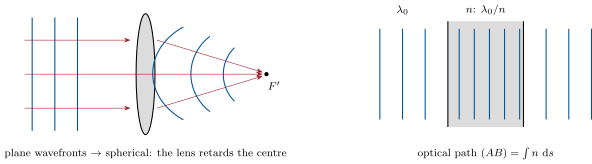
CoachIn a medium of index the wave travels at and its wavelength is . The optical path along a curve from to is
and the phase accumulated by a monochromatic wave travelling along a ray from to is
being the travel time. A wavefront is a surface of equal phase; in an isotropic medium the rays of geometrical optics are perpendicular to the wavefronts (Malus–Dupin theorem), and the optical path between two wavefronts is the same along every ray.
Examples
Example 18.3 (Stigmatism; the lens as a phase plate)
A point source imaged by a perfect (stigmatic) instrument at : all the rays from to have the same optical path — the waves arriving along every ray are in phase at , which is why they pile up into a bright point there. For a thin lens of focal length this is a statement about phase: a plane wave arriving along the axis must leave as a spherical wave converging to the focus ; since a spherical wave centred at distance has, at distance from the axis, the phase ahead of its axial value (paraxial approximation, ), the lens must retard the wave by : it is thicker at the centre by exactly the amount that makes all optical paths to equal. A lens is a phase plate; a hologram or a liquid-crystal display that imposes the same phase map is a lens.