University Physics — Year 2 · Bachelor Year 2
18The Scalar Model of Light
Shine two torches on the same wall and the patch is simply twice as bright; shine two beams from one laser on it and the patch breaks into bright and dark fringes. The torches add their intensities, the laser beams add their amplitudes — and every interferometer, hologram and diffraction grating of the coming chapters rests on knowing when light does which. This chapter sets up the tools: light as a scalar wave with a phase, the optical path that measures that phase along a ray, the way a source emits — in short wave trains whose coherence length decides whether two waves can interfere — and the way a detector records it: an average over billions of periods that keeps only the intensity.
18.1 Light as a scalar wave
Definition 18.1 (Scalar model; monochromatic wave)
In most of wave optics the vector nature of light plays no role (the superposed waves share one polarization, or the light is unpolarized and the polarizations average out): the field is replaced by a real scalar vibration
with an amplitude and a phase at each point, both slowly varying on the scale of a wavelength. A monochromatic wave has a single : an idealization, since a real source emits over a band of frequencies. Visible light: from to in vacuum, from to Hz, periods of about .
Definition 18.2 (Optical path and phase)
In a medium of index the wave travels at and its wavelength is . The optical path along a curve from to is
and the phase accumulated by a monochromatic wave travelling along a ray from to is
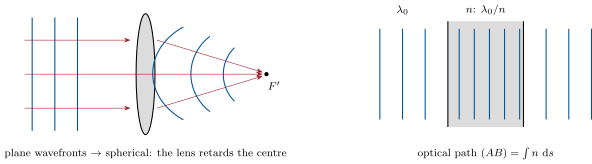
being the travel time. A wavefront is a surface of equal phase; in an isotropic medium the rays of geometrical optics are perpendicular to the wavefronts (Malus–Dupin theorem), and the optical path between two wavefronts is the same along every ray.
Justification. The phase advances by per local wavelength , i.e. by per element ; summed along the ray. The wave is a solution of the wave equation in which the energy travels along , perpendicular to the surfaces const: that is the ray, and the "optical path = same between two wavefronts" statement is the definition of a wavefront read backward. The full theorem (it survives reflections and refractions) is admitted. ∎
Example 18.3 (Stigmatism; the lens as a phase plate)
A point source imaged by a perfect (stigmatic) instrument at : all the rays from to have the same optical path — the waves arriving along every ray are in phase at , which is why they pile up into a bright point there. For a thin lens of focal length this is a statement about phase: a plane wave arriving along the axis must leave as a spherical wave converging to the focus ; since a spherical wave centred at distance has, at distance from the axis, the phase ahead of its axial value (paraxial approximation, ), the lens must retard the wave by : it is thicker at the centre by exactly the amount that makes all optical paths to equal. A lens is a phase plate; a hologram or a liquid-crystal display that imposes the same phase map is a lens.
18.2 How light is emitted: coherence
Proposition 18.4 (Wave trains; coherence time and length)
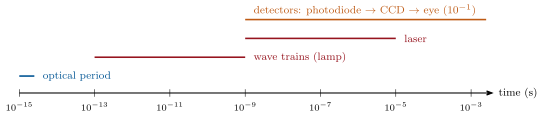
A classical source (a flame, a lamp, a star) is a collection of atoms each emitting, at random instants and with random phases, short wave trains of duration : the vibration it produces at a point keeps a steady phase only over and then jumps. A train of duration is not monochromatic: its spectrum spans a frequency band (a Fourier reciprocity, admitted: a finite sinusoid cannot have a single frequency). The coherence time and the coherence length
characterize the source: white light , ; a spectral lamp (), ; a laser, metres to kilometres. Two waves derived from the same source can interfere only if their path difference is smaller than — beyond it they belong to different trains, with unrelated phases.
Proof. and with give . The spectral width itself has physical causes: the natural width (radiation damping, Chapter 17), the Doppler broadening by the atoms’ thermal motion, collisions — each shortening the train. ∎

Remark 18.5 (Two sources, one source)
Two distinct lamps (or two distinct atoms) emit trains with independent random phases: their relative phase changes every , a million times faster than any eye or camera responds — the interference term averages to zero and the intensities add. Interference needs two waves that remember the same phase jumps: two copies of one wave, obtained by splitting it (two slits, two mirrors, the two faces of a film) and recombined with a delay shorter than . A laser, whose trains last microseconds or more, relaxes this constraint enormously; it never removes it.
18.3 Detectors and intensity
Proposition 18.6 (What a detector measures)
Every light detector — the eye (response time ), a photographic film, a CCD pixel (), a photodiode () — responds on a time long compared with the period ( s) and delivers the intensity, the time average of the squared vibration,
( a constant, often dropped; is proportional to the irradiance in ). The absolute level matters in one respect only: light arrives in photons of energy , and a detector counts on average photons per unit area and time.
Proof. over any interval much longer than . Photons: the last chapter of the Year 1 volume; this is where the scalar wave meets the quantum. ∎
Example 18.7 (Orders of magnitude)
A bulb radiating of visible light at : , photons per square metre and second, per second through a pupil — in the eye’s there is no trace of the graininess. The faintest star the eye sees sends photons per second into the pupil; a rod cell fires on a handful. Sunlight: , photons per square metre and second.
Remark 18.8 (Coherent and incoherent superposition)
Two vibrations and at a point give and
If the phase difference is stable during the detection (coherent waves): , the interference term, which the next chapter studies. If it wanders randomly (incoherent waves): and — the torches.
Method 18.9 (Setting up an optics problem)
(1) Write each wave as with from the source (or from a common wavefront). (2) Decide coherence: same source, path difference ? Then add amplitudes (complex notation is convenient: , ); otherwise add intensities. (3) For lenses and mirrors, use equal optical paths between conjugate points, or the phase-plate picture. (4) Convert to what is measured: intensity, contrast, photon counts, and check the detector’s resolution in time and space.
18.4 Exercises
Exercise 18.1 ★
A beam of crosses of glass (). Optical path; number of wavelengths inside; extra phase and extra delay compared with of air; thickness of glass that delays the wave by exactly one wavelength relative to air.
Solution
Solution of Exercise 18.1.
; wavelengths; more than air, wavelengths, , delay ; one wavelength of delay for .
Exercise 18.2 ★
Coherence time and length of: white light (–); a sodium lamp line of width at ; a red LED (, ); a multimode laser diode (); a stabilized laser (). Which could give fringes with a path difference of ? of ?
Solution
Solution of Exercise 18.2.
or , : white (); sodium (); LED (); diode (); stabilized (). : the sodium lamp, the diode and the laser; : the stabilized laser only.
Exercise 18.3 ★
A laser pointer at : photons per second; a bulb ( visible, mean ) at : photons per second through a pupil; number during the eye’s ; relative fluctuation of that number — is the light grainy?
Solution
Solution of Exercise 18.3.
per second. Bulb: , pupil : , photons per second, in , fluctuation : perfectly smooth.
Exercise 18.4 ★
A point source at from a screen, . Optical path difference between the centre of the screen and a point off axis (exactly, then with the paraxial formula ); number of wavelengths; radius of the wavefront at the screen; at what off-axis distance does the paraxial formula err by one wavelength?
Solution
Solution of Exercise 18.4.
Exact , paraxial : a hundred wavelengths; the wavefront is a sphere of radius ; the quartic term reaches at .
Exercise 18.5 ★★
The lens as a phase plate. (a) A plane wave along the axis has a uniform phase on the plane of a thin lens; after the lens the phase is relative to the centre. Show that the emerging wavefront is, in the paraxial approximation, a sphere of radius centred on . (b) A point source at distance before the lens sends a wave whose phase on the lens plane is (relative to the centre): show that after the lens the wave converges at with , the lens formula. (c) Thickness profile of a plano-convex glass lens () of focal length : ; sag at . (d) A "Fresnel lens" folds the profile back every time it exceeds : why does it still focus, and why only one colour perfectly?
Solution
Solution of Exercise 18.5.
(a) A sphere of radius centred at has, on the lens plane, the phase relative to the axis (paraxially): exactly the lens’s. (b) Total phase : a wave converging at with . (c) The glass adds : ; sag . (d) A phase defined modulo is the same phase — at the design wavelength; at others the steps are no longer whole wavelengths.
Exercise 18.6 ★★
Stigmatism of a mirror. A mirror must send a plane wave arriving along its axis to a point . (a) Write the condition "equal optical paths from a plane wavefront to for every point of the mirror" and show it defines a parabola with at its focus. (b) Why is a spherical mirror only approximately stigmatic (compare with the circle of radius near the vertex)? (c) For a mirror of , the path error of the sphere at the edge, in wavelengths of . (d) Why do radio telescopes tolerate sphericity that optical ones cannot?
Solution
Solution of Exercise 18.6.
(a) From a plane wavefront at to then to : , so , , with at the focus. (b) The circle agrees to second order only. (c) , doubled by reflection: , six wavelengths — hence parabolic mirrors. (d) At the same error is a thousandth of a wavelength.
Exercise 18.7 ★★
Fermat. The optical path from (in medium ) to (in ) through a point of the plane interface is . (a) Show that it is stationary (minimal) for the point satisfying . (b) Interpret: neighbouring paths have the same phase, so the waves along them add — this is why light "chooses" the Descartes ray. (c) Derive the law of reflection the same way. (d) Why is the path through a lens from to its image the same along every ray, and not merely stationary?
Solution
Solution of Exercise 18.7.
(a) : . (b) Near the stationary path neighbouring paths have equal phases and their waves add; elsewhere they cancel. (c) : . (d) Stigmatism means all rays from to have equal paths: a whole family of stationary paths, not one.
Exercise 18.8 ★★
Why two lamps do not interfere. Two sodium lamps illuminate a screen; at a point, their waves have amplitudes and a relative phase that jumps randomly every . (a) Intensity at that point as a function of ; its maximum and minimum. (b) The detector averages over : how many independent values of ? Mean intensity; relative size of the residual fluctuation of the interference term (). (c) A photodiode with : what would it see? (d) How did the first experiment showing interference between two independent lasers (1963) manage it?
Solution
Solution of Exercise 18.8.
(a) : and . (b) : mean , residual of it. (c) During the phase is frozen: it would see fringes, jumping every . (d) Lasers with and a detector faster than that: the fringes exist for a microsecond and were photographed.
Exercise 18.9 ★★
Apparent depth. A coin lies at depth in water (). (a) Using the optical path (or Descartes’ law at small angles), show that an eye above sees it at depth . (b) : apparent depth; by how much does the optical path from the coin to the eye exceed its geometric length? (c) A fish at depth sees a fly above the surface at what apparent height? (d) Why does a pool look shallower still when viewed obliquely?
Solution
Solution of Exercise 18.9.
(a) Small angles: , the rays appear to come from . (b) ; the optical path is , more. (c) . (d) At large angles the refraction is stronger and the apparent depth smaller.
Exercise 18.10 ★★★
Contrast and coherence. Two copies of a wave with a path difference are superposed; the source’s spectrum is spread uniformly over , each frequency interfering with itself only. (a) Intensity from one frequency: . (b) Integrate over the band and show that the total is with . (c) Define the contrast of the fringes near and show : it vanishes at . (d) Numbers for a LED ( at ): at which the contrast first vanishes.
Solution
Solution of Exercise 18.10.
(a) Two equal waves with phase difference . (b) Average over the band:
(c) : , zero at . (d) : .
Exercise 18.11 ★★★
Seeing stars. The eye detects a flash when about photons reach a rod within ; the dark-adapted pupil is ; take . (a) Minimum photon flux and irradiance at the eye. (b) The Sun gives ; a star of magnitude gives of it: irradiance of a magnitude-6 star (the naked-eye limit) and the photon rate into the pupil; consistent with (a)? (c) A telescope of aperture: gain in photons, and the magnitude it reaches. (d) Why do astronomers speak of the "photon noise" of a faint image, and how does it scale with exposure time?
Solution
Solution of Exercise 18.11.
(a) photons per second on : , J: . (b) , photons per square metre and second, per second into the pupil — well above (a): the eye’s real limit is set by background and by the spread over many rods. (c) , magnitudes: . (d) photons fluctuate by : the signal-to-noise grows as the square root of the exposure.
Exercise 18.12 ★★★
Beyond paraxial. A spherical wave from a point at distance has, at the transverse distance , the exact extra path . (a) Expand to fourth order: . (b) The quadratic (paraxial) term is kept and the quartic dropped when the latter is below : show this requires . (c) Numbers: , : maximum ; (a microscope): maximum , and the corresponding angle. (d) Comment: the "aberrations" of geometrical optics are these neglected terms.
Solution
Solution of Exercise 18.12.
(a) . (b) . (c) : for ; for , an angle of . (d) Spherical aberration is this quartic term; the other aberrations are its off-axis cousins.
18.5 Problem: A sodium lamp and a laser pointer
Problem 18.1
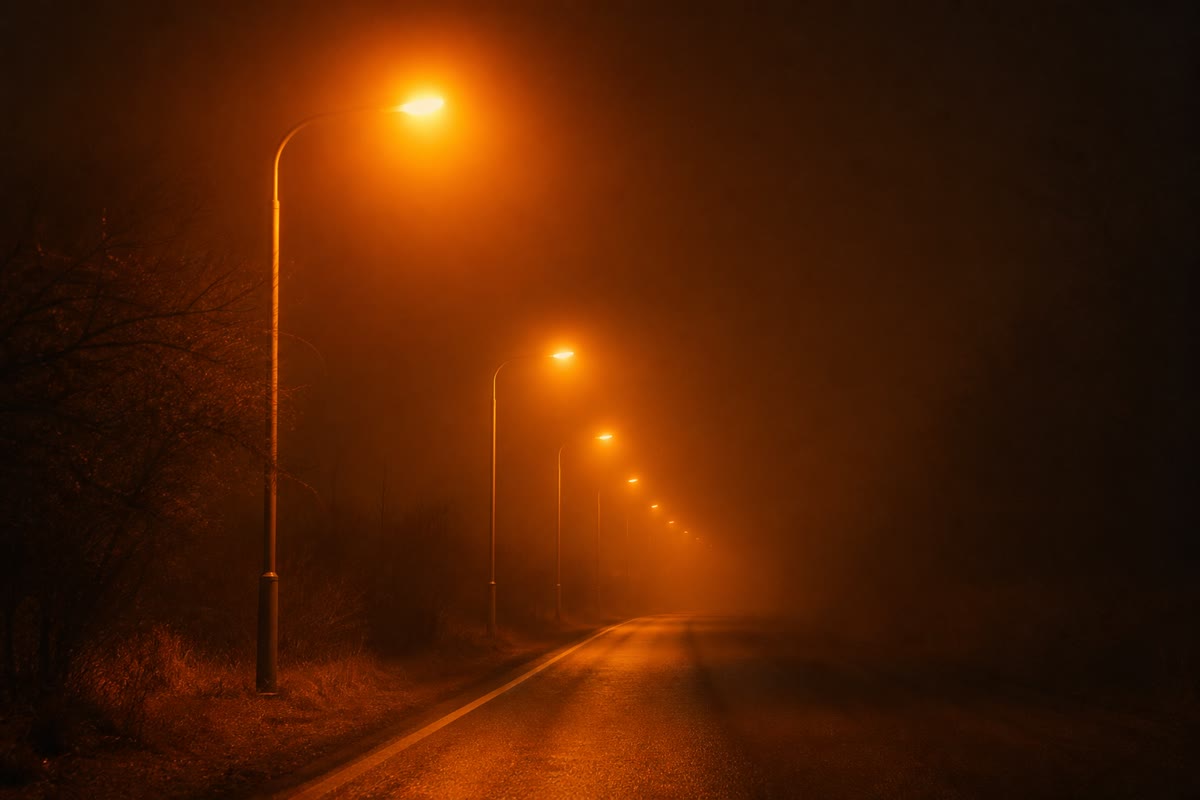
Weekend problem — two light sources taken apart: the yellow lamp of the old street, the red pointer in the lecture hall, and the one number that decides whether each can make fringes
Part I — The sodium lamp. Sodium emits its yellow doublet at and . The natural width of each line is ; in the lamp the atoms are at (sodium mass , , ).
- Frequencies of the two lines and their difference.
- Coherence length of a single line if only its natural width counted.
- Doppler broadening: an atom moving at along the line of sight emits at ; with the thermal rms speed along one axis, estimate and compare with the natural width.
- Coherence length of one Doppler-broadened line; in a real high-pressure lamp collisions broaden the line a further ten times: coherence length then.
- The two lines together: over what path difference do their fringe systems go from coincidence to opposition and back (the "beat length" )? How many fringes is that?
- A student makes a two-beam interferometer with the lamp and increases the path difference from zero: describe the contrast seen — the beats and the final extinction — with the numbers found.
- The lamp radiates of yellow light: photons per second; energy of one photon in eV, and why the light is yellow.
- Two sodium lamps side by side: can their lights interfere? Why is the question different for the two lines of one lamp?
Part II — The laser pointer. A red diode laser at emits, when cheap, several longitudinal modes spread over ; a stabilized single-mode one has .
- Coherence lengths of the two pointers.
- Photons emitted per second; mean spacing between photons along the beam (in metres); compare with the coherence length — what does that say about "photons interfering"?
- Convert the spread into a frequency width; the diode’s cavity is long with : spacing of its longitudinal modes () and the number of modes in the spread.
- The beam ( diameter) falls on a photodiode whose every photon yields an electron: current.
- The cheap pointer is used in a two-beam interferometer with a path difference: fringes or not? And the stabilized one with ?
- The diode’s output is in fact switched on and off in pulses: can the pulses from two successive periods interfere with each other? What sets the coherence here, the pulse length or the line width?
- Why does a laser’s light look "speckled" on a wall, and why does the lamp’s not?
- A red LED at has : coherence length; why do some projectors prefer LEDs to lasers?
Part III — Optical paths and detectors.
- A glass slide () is inserted in one arm of the interferometer: extra optical path, and the number of fringes that shift past a mark.
- The slide is tilted by : extra path (use for the length in the glass, minus the air it replaces, to first approximation — or simply estimate with the longer geometric path); order of magnitude of the fringe shift.
- The detector is a camera with pixels; the fringes are apart: how many pixels per fringe, and what happens to the measured contrast if the spacing falls to ?
- Exposure at on a pixel: photons per pixel; relative photon noise.
- Two equal coherent waves of intensity meet with a path difference : write the intensity and the period of the fringes in .
- The fringes drift past a point at (a vibrating mirror): what does the eye see, what does the photodiode see?
- The interferometer’s arms run through of air (): optical path in excess of vacuum, in fringes; what a change of air pressure does to the pattern.
- The lamp and the pointer give the same : which gives more photons per second, and why does it not matter for the fringes?
- Sum up: for each source, the coherence length, what limits it, and the interferometer path difference it allows.
Solution
Solution of Problem 18.1.
1. , : .
2. .
3. : , a hundred times the natural width.
4. ; with collisions, about .
5. nm : coincidence to opposition every ; about fringes per beat.
6. The contrast oscillates with a period of in path difference (zero at , , , …) inside an envelope that fades over a few centimetres: some fifty beats, then nothing.
7. photons per second; , the yellow of the spectrum.
8. No: independent atoms, random phases. The two lines of one lamp come from different atoms too and do not interfere with each other: the beats are two fringe systems adding in intensity.
9. ; .
10. per second, spaced along the beam: ten thousand photons within a coherence length. Interference is not photons meeting: each photon interferes with itself.
11. ; mode spacing : about eight modes.
12. .
13. : no fringes; : fringes.
14. A nanosecond pulse is long, far longer than the coherence length: the line width, not the pulse, sets the coherence; successive pulses interfere only if the laser’s phase survives the off period — it does not.
15. Coherent light scattered by the rough wall interferes at the retina with random path differences: speckle. The lamp’s micrometre-scale coherence averages all that out.
16. : far too short for speckle on a rough wall — no speckle, a smoother image.
17. : fringes.
18. ; extra path , more than untilted: some twenty fringes more.
19. Five pixels per fringe; at one pixel per fringe the pixel integrates a whole period and the contrast collapses.
20. on the pixel : photons, noise .
21. : one fringe per wavelength of path difference.
22. The eye averages the kilohertz motion into a uniform field; the photodiode follows it.
23. : fringes; a change of pressure moves them by fringes — the interferometer is a barometer unless evacuated.
24. Nearly the same photon rate ( against ); the fringes depend on amplitudes and phases, the photon count only on the noise.
25. Lamp: centimetres, limited by Doppler and collision broadening, fringes up to about ; cheap pointer: , limited by its several modes; stabilized laser: , limited by its line width.