
Physics · Glossary

What is Order of magnitude?

Definition 1.11 High School Physics · Chapter 1 — Orders of Magnitude: Measuring the Universe

The order of magnitude of a quantity is the power of ten closest to it: write the quantity as a×10na \times 10^{n} with 1a<101 \leq a < 10 and take 10n10^{n} if a<5a < 5, 10n+110^{n+1} if a5a \geq 5. (The exact boundary convention never matters: an order-of-magnitude statement is only ever meant to within a factor of ten.)
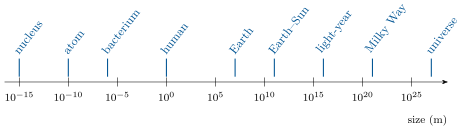
The ladder of the universe, in metres: 42 powers of ten separate the atomic nucleus from the observable universe, and a human stands ten rungs from the atom but twenty-seven from the top.
The ladder of the universe, in metres: 4242 powers of ten separate the atomic nucleus from the observable universe, and a human stands ten rungs from the atom but twenty-seven from the top.

Examples

Example 1.12 (Orders of magnitude)

A human life lasts about 8080 years, i.e. 80×3.16×107s2.5×109s80 \times 3.16 \times 10^{7}\,\mathrm{s} \approx 2.5 \times 10^{9}\,\mathrm{s}: order of magnitude 109s10^{9}\,\mathrm{s} — a few billion seconds, spend them well. A human is 1.7m1.7\,\mathrm{m} tall: order 100m10^{0}\,\mathrm{m}. Mount Everest, 8848m8848\,\mathrm{m}: order 104m10^{4}\,\mathrm{m}, since 8.84858.848 \geq 5.

Read in context →
Definition 1.11 University Physics — Year 1 · Chapter 1 — Units, Dimensions, and Measurement

The order of magnitude of a quantity is the power of ten nearest to it: 6.4×10⁶m6.4 \times 10^{6}\,\mathrm{m} (the Earth’s radius) has order of magnitude 10710^7; 3×10³m3 \times 10^{3}\,\mathrm{m} has order 10310^3; 3.2×10³m3.2 \times 10^{3}\,\mathrm{m} is closer to 10310^3 than to 10410^4 on a logarithmic scale (the boundary is 103.16\sqrt{10} \approx 3.16). Two quantities are “of the same order” when their ratio is below about 33.

Read in context →