
Physics · Glossary

What is Standing wave?

Also known as: node · antinode

Definition 21.16 High School Physics · Chapter 21 — Sound and Acoustics

A wave confined between the fixed ends of a string can settle into a standing wave: an oscillation in place, motionless points — nodes — alternating with points of maximal swing — antinodes. Nothing travels any more; the string vibrates in a fixed pattern.
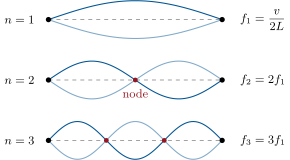
The first three modes of a string fixed at both ends: n half-wavelengths fit in L, so _n = 2L/n and f_n = nf_1.
The first three modes of a string fixed at both ends: nn half-wavelengths fit in LL, so λn=2L/n\lambda_n = 2L/n and fn=nf1f_n = nf_1.

Examples

Example 21.19 (A violin’s A string)

A violin’s A string has L=32.8cmL = 32.8\,\mathrm{cm} and sounds f1=440Hzf_1 = 440\,\mathrm{Hz}: waves run along it at v=2Lf1=2×0.328×440289m/sv = 2Lf_1 = 2 \times 0.328 \times 440 \approx 289\,\mathrm{m}/\mathrm{s} — set by tension and mass, tuned by the peg. Pressing a finger shortens LL and raises every fnf_n at once: the spectrum slides up.

Read in context →