 Coach
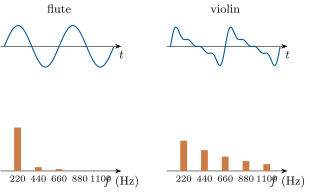
CoachThe spectrum of a sound is the bar chart of its harmonics: one bar per , the height that harmonic’s strength. The ear hears as the pitch and the mix of strengths as the timbre — the sound’s color: instruments playing the same note share , differing only in their spectra.
Examples
Example 21.15 (Why you recognize the caller)
A flute’s A is nearly a pure tone; a violin bowing the same adds strong harmonics at . Same pitch and loudness, yet no one confuses them: a voice, too, is a spectrum you know by heart.
Example 21.19 (A violin’s A string)
A violin’s A string has and sounds : waves run along it at — set by tension and mass, tuned by the peg. Pressing a finger shortens and raises every at once: the spectrum slides up.