
Physics · Glossary

What is The three historic radiations?

Also known as: alpha radiation · beta radiation · gamma radiation · attenuation

Definition 19.7 High School Physics · Chapter 19 — The Nucleus and Radioactivity

Three radiations, named before anyone knew what they were:

  • alpha (α\alpha): a helium nucleus 24He{}^{4}_{2}\mathrm{He} ejected whole — heavy, doubly charged, stopped by a sheet of paper or centimetres of air;
  • beta (β\beta^-): an electron 1  0e{}^{\;0}_{-1}\mathrm{e} created in the nucleus and ejected — light, fast, stopped by millimetres of aluminium;
  • gamma (γ\gamma): electromagnetic radiation, far more energetic than light — never quite stopped, only attenuated: a centimetre of lead absorbs half.
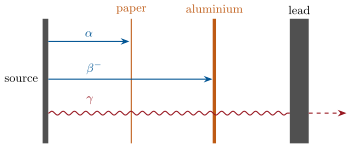
dies in paper, - in millimetres of aluminium;  is only thinned, even by lead.
α\alpha dies in paper, β\beta^- in millimetres of aluminium; γ\gamma is only thinned, even by lead.

Examples

Example 19.11 (An alpha decay)

Radium-226, the Curies’ radium, is an α\alpha emitter: 88226RaZAY+24He{}^{226}_{88}\mathrm{Ra} \to {}^{A}_{Z}\mathrm{Y} + {}^{4}_{2}\mathrm{He} forces A=2264=222A = 226 - 4 = 222 and Z=882=86Z = 88 - 2 = 86; element 8686 is radon, so 88226Ra86222Rn+24He{}^{226}_{88}\mathrm{Ra} \to {}^{222}_{86}\mathrm{Rn} + {}^{4}_{2}\mathrm{He} — the radioactive gas of unventilated cellars.

Example 19.12 (A beta-minus decay)

Carbon-14 sits above the band (88 neutrons against 66 protons): 614C714N+1  0e{}^{14}_{6}\mathrm{C} \to {}^{14}_{7}\mathrm{N} + {}^{\;0}_{-1}\mathrm{e}. Check: 14=14+014 = 14 + 0, 6=716 = 7 - 1; a neutron became a proton plus the ejected electron — the weak interaction at work.

Read in context →