High School Physics · Grades 10–12
19The Nucleus and Radioactivity
Right now, some eight thousand atomic nuclei explode inside your body every second. Nothing attacks them: certain nuclei are born unstable, and each sooner or later transforms itself, hurling out a fragment at a good fraction of the speed of light. This chapter returns to the -metre floor of Chapter 13 to see which nuclei are fragile, how they break, and how their regular impatience dates caves and guards ceilings.
19.1 Nuclei, nucleons and isotopes
Definition 19.1 (Nuclear notation)
A nucleus contains protons (charge each) and neutrons (no charge), nucleons in all; it is written , where is the chemical symbol, the atomic number and the mass number. A species specified by and is a nuclide; nuclides with the same but different are isotopes of one element: same chemistry (the electron cloud sees only ), different nuclei and stability.
Example 19.2 (Hydrogen and carbon)
Hydrogen has three isotopes: (a lone proton), (deuterium: one proton, one neutron), unstable (tritium: two neutrons). Natural carbon: mostly ( protons, neutrons), of , and one atom in of unstable ( neutrons), hero of Example 19.17.
19.2 Stable and unstable nuclei
Proposition 19.3 (The valley of stability)
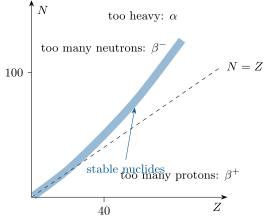
Stable nuclides occupy a narrow band in the plane: for light nuclei, then a growing neutron excess, up to . Every nuclide off the band — too many neutrons, too many protons, or too big (beyond lead, , no nuclide is truly stable) — transforms sooner or later.
Proof. Admitted at this level. ∎
Remark 19.4
Locating the band exactly is quantum mechanics — the university volumes. The pattern is the ledger of Chapter 13: strong glue binds only neighbours, Coulomb repulsion spans the whole nucleus, so heavy nuclei need extra neutron glue; yet an excess of neutrons is unstable too (the weak interaction sees to it).
Definition 19.5 (Radioactivity)
Radioactivity is the spontaneous transformation of an unstable nucleus into another nuclide, with emission of radiation. It is random: nothing announces which nucleus decays next, and no pressure, temperature or chemistry can hasten or delay it; only large populations are predictable (Definition 19.14).
Remark 19.6 (Becquerel and the Curies)
In 1896 Henri Becquerel found that uranium salts fog a photographic plate through black paper, in a closed drawer, with no energy supplied. Marie and Pierre Curie showed the effect is atomic, measured it, and isolated polonium and radium, a million times more active. The word radioactivity is Marie Curie’s; so are two Nobel prizes.
19.3 Alpha, beta, gamma
Definition 19.7 (The three historic radiations)
Three radiations, named before anyone knew what they were:
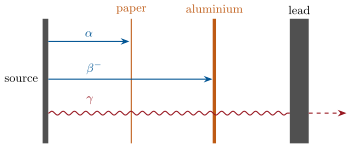
- alpha (): a helium nucleus ejected whole — heavy, doubly charged, stopped by a sheet of paper or centimetres of air;
- beta (): an electron created in the nucleus and ejected — light, fast, stopped by millimetres of aluminium;
- gamma (): electromagnetic radiation, far more energetic than light — never quite stopped, only attenuated: a centimetre of lead absorbs half.
Proposition 19.8 (Conservation in nuclear equations)
In every nuclear transformation, the total mass number and the total charge — the sum of the lower indices, counting for an emitted electron — are the same before and after.
Proof. Admitted at this level. ∎
Remark 19.9
Charge conservation already ruled Chapter 13; conservation of says nucleons are only converted, never created or destroyed — honest bookkeeping for the university volumes.
Method 19.10 (Balancing a decay equation)
- Write every actor with both labels: , , ; a carries .
- Equate the sums of the ’s, then of the ’s (Proposition 19.8); solve, and read the daughter element off its in the periodic table.
Example 19.11 (An alpha decay)
Radium-226, the Curies’ radium, is an emitter: forces and ; element is radon, so — the radioactive gas of unventilated cellars.
Example 19.12 (A beta-minus decay)
Carbon-14 sits above the band ( neutrons against protons): . Check: , ; a neutron became a proton plus the ejected electron — the weak interaction at work.
Remark 19.13 (Beta-plus and gamma)
Below the band, the mirror decay turns a proton into a neutron plus a positron , the electron’s antiparticle: , workhorse of PET scanners. And after most decays the daughter, born shaking, settles by emitting a on top.

19.4 Half-life and activity
Definition 19.14 (Half-life)
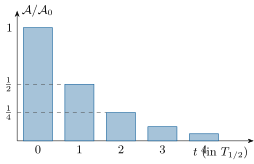
The half-life of a nuclide is the time after which half of any large sample has decayed. Each further half-life halves what remains: of nuclei, are left at , at , at , after half-lives.
Remark 19.15
Randomness for one nucleus, clockwork for : a vast crowd of coin-flippers, unpredictable one by one, half eliminated each round. Interpolating between whole half-lives takes the exponential function — next year, with the mathematics volume.
Example 19.16 (Twenty powers of ten)
| polonium-214 | radium chain link | ||
| technetium-99m | hours | medical imaging | |
| americium-241 | years | smoke detectors | |
| carbon-14 | years | archaeology | |
| potassium-40 | years | in every banana | |
| uranium-238 | years | Earth’s inner heat |
Example 19.17 (Carbon-14 dating)
Living matter exchanges carbon with the atmosphere, so it holds the atmospheric proportion of carbon-14; at death the intake stops and the proportion halves every years. Charcoal from a painted cave shows one quarter of the living proportion: a quarter is half of a half, so the fire burned two half-lives, years, ago.
Definition 19.18 (Activity)
The activity of a sample is its number of decays per second, measured in becquerels: decay per second. Fewer surviving nuclei means fewer decays, so activity also halves at each half-life.
Example 19.19 (Orders of magnitude)
Everything is slightly radioactive. A banana: about (potassium-40). A human body: about — this chapter’s hook, some five hundred bananas’ worth. A cubic metre of granite: around (uranium and its chain, whence cellar radon). One technetium injection: about , gone within days.
19.5 Servants and dangers
Example 19.20 (Three careers of an unstable nucleus)
Medicine: technetium-99m, a pure emitter with hours, is fixed to a molecule the target organ absorbs; a camera films the s from outside, and by the next day the tracer has mostly vanished — while radiotherapy reverses the logic, focusing beams to destroy a tumour. Dating: carbon-14 for wood, bone and cloth back some years; uranium-238 for rocks — and the Earth, at years. Smoke detectors: a speck of americium-241 ionizes the air of a small chamber, letting a tiny current flow; smoke chokes the current and the alarm fires — the s die in centimetres of air.
Remark 19.21 (Dose and the sievert)
Radiation tears electrons off molecules and can damage DNA. The biological harm is tracked by the dose, in sieverts (), which weighs the energy deposited per kilogram of tissue by how damaging each radiation is. Three rules: distance, shielding (: skin suffices — unless the emitter is inhaled, radon’s crime; : aluminium; : lead), and time. Dosimetry proper is university material.
19.6 Exercises
Exercise 19.1 ★
Give the number of protons and of neutrons in , , , and .
Solution
Solution of Exercise 19.1.
: p, n; : p, n; : p, n; : p, n; : p, n. ( each time.)
Exercise 19.2 ★
Among , , , and , which are isotopes of one another? Why are and not isotopes, despite equal mass numbers?
Exercise 19.3 ★
Polonium-210, , is an emitter. Write the decay equation and name the daughter (: thallium, : lead, : bismuth).
Solution
Solution of Exercise 19.3.
, : — the daughter is lead-206.
Exercise 19.4 ★
Write the decay equations of cobalt-60 () and of iodine-131 (); daughters: nickel, xenon.
Solution
Solution of Exercise 19.4.
and : unchanged, up by one.
Exercise 19.5 ★
An iodine-131 source ( days) has activity today. What is its activity after days? After days?
Solution
Solution of Exercise 19.5.
days : . days : .
Exercise 19.6 ★★
Four radiations cross a strong magnetic field, then screens. Identify each: (a) stopped by paper, barely deflected by the field; (b) crosses paper, stopped by of aluminium, strongly deflected; (c) crosses both, only attenuated by lead, undeflected; (d) like (b), deflected the other way.
Solution
Solution of Exercise 19.6.
(a) (heavy, hence barely deflected); (b) ; (c) (neutral, penetrating); (d) (positron: as light as (b), opposite charge).
Exercise 19.7 ★★
Radon-222 () opens a fast chain: an decay, then another , then a . Write the three equations (: lead, : bismuth, : polonium).
Solution
Solution of Exercise 19.7.
; ; .
Exercise 19.8 ★★
Fluorine-18, , is the tracer of PET scanners; stable fluorine is . Which side of the stability band is it on? Predict its decay mode and write the equation (: oxygen).
Solution
Solution of Exercise 19.8.
Fluorine-18 has neutrons where stable fluorine-19 has : neutron-poor, below the band, so : .
Exercise 19.9 ★★
A patient receives of technetium-99m ( hours) at 08:00. What is the activity at 08:00 the next morning? After how many hours does it first drop below ?
Solution
Solution of Exercise 19.9.
hours : . Since , nine half-lives bring : after .
Exercise 19.10 ★★
A bone from a peat bog shows a carbon-14 proportion one eighth of a living bone’s ( years). How old is the bone? And why is carbon-14 useless for dating dinosaur bones (age about years)?
Exercise 19.11 ★★
Using the valley of stability, predict the decay mode (, or ) of , and , justifying each in one line (stable carbon: , ).
Solution
Solution of Exercise 19.11.
: neutrons against – in stable carbon, above the band, . : neutrons, neutron-poor, . : , too heavy, .
Exercise 19.12 ★★★
The uranium-238 chain ends, many steps later, at stable ; every step is an or a . Using conservation of alone, find the number of steps; then, with conservation of , the number of steps.
Solution
Solution of Exercise 19.12.
Only changes : , so alphas. They remove from : gives beta-minus decays.
Exercise 19.13 ★★★
A hospital’s cobalt-60 source ( years) has activity ; regulations allow disposal below . After how many years may it be disposed of?
Solution
Solution of Exercise 19.13.
: six half-lives, years in shielded storage.
Exercise 19.14 ★★★
Your body’s activity is about . How many of your nuclei decay per day? Over an -year life? A banana adds about while you digest it: comment, in a sentence, on headlines that fear every becquerel.
Solution
Solution of Exercise 19.14.
Per day: decays. Over years: . Life has always run on this background — one becquerel is one atom per second out of the body’s ; the unit is tiny, and a scary-sounding count of becquerels may be a few bananas’ worth.
Exercise 19.15 ★★★
A smoke detector holds of americium-241 ( years), of activity about . How many decays is that per day? After ten years of service, has the americium decayed by much less than half, about half, or much more — and is source exhaustion why detectors are replaced? Finally, why is this source harmless on the ceiling, yet dangerous if the capsule is ground up and the dust inhaled?
Solution
Solution of Exercise 19.15.
decays per day. Ten years is of a half-life: far less than half has decayed, so the electronics and dust, not the source, force replacement. Outside, the s die in the chamber’s air and casing; inhaled dust parks the emitter in the lungs, where every dumps its energy into living tissue — a large dose (sieverts) from a modest activity.
19.7 Problem: The mummy, the reactor and the smoke detector
Problem 19.1
Weekend problem — three careers of an unstable nucleus: a mummy dated by halvings, uranium’s family tree balanced, a smoke detector audited, and why the stars had to be mortal
Three unstable nuclei, three jobs: carbon-14 timestamps every dead plant and animal, uranium-238 heats a planet from inside, americium-241 watches ceilings. Data: years (C-14), years (U-238), years (Am-241); living carbon shows decays per minute per gram; atomic numbers: N , O , Pb , Bi , Po , Rn , Ra , Th , Pa , U , Np , Am .
Part I — The mummy.
- Give the composition (protons, neutrons) of and . Why identical chemistry in a body?
- Why is the proportion of carbon-14 constant in a living body, and why does it start dropping at death?
- Write the decay equation of carbon-14. Would its radiation escape through the mummy’s linen wrappings?
- A gram of carbon from the linen shows decays per minute. What fraction of the living rate is that? Date the mummy.
- A second “mummy”, the prize of a private collection, shows decays per minute per gram. Verdict?
- Estimate the rate from a sample ten half-lives old, and explain why carbon dating fades out beyond roughly years.
Part II — The reactor under the meadow.
- Give the composition of . Why do heavy nuclei need such a neutron surplus?
- Write its decay equation.
- The daughter then decays , and the granddaughter again. Write both equations. Which element reappears?
- The chain ends at . Count its steps, then its steps.
- The Earth formed years ago. What fraction of its primordial uranium-238 remains today? And in billion more years?
- In one sentence: what does this buried decay heat power at the surface? (Think volcanoes and drifting continents.)
Part III — The smoke detector.
- Write the decay equation of .
- Its activity is : how many decays per second? Per day?
- Explain the detector: what do the particles do to the air of the chamber, and what does smoke change?
- Why is an emitter the right choice here — and a emitter of equal activity the worst one?
- After one half-life ( years!) the activity would be ; the manual asks for replacement after ten years. Is the source the weak link?
Part IV — Why the stars had to be mortal.
- Dying stars forged and scattered every element heavier than helium. What fraction of uranium-238 forged years ago survives today? Why does Earth’s remaining abundance make the planet far younger than the oldest stars?
- Earth’s radioactive inner heat drives volcanism and plate tectonics, and keeps the core churning out the magnetic shield of Chapter 15. What would a planet of only stable atoms be like?
- One line, as poetry and as bookkeeping: where were your atoms forged, and what still warms the ground under your feet?
Solution
Solution of Problem 19.1.
1. : p, n; : p, n. Chemistry sees only the electron cloud, fixed by : identical behaviour.
2. Eating and breathing constantly renew a living body’s carbon at the atmospheric proportion; at death the intake stops and decay runs unopposed.
3. (). These s are soft: metres of wrapped linen stop them, so little escapes the mummy — which is why one measures a small carbon sample taken from the object itself.
4. : one half-life. The mummy is about years old.
5. : the linen is essentially modern — at most a few centuries old. A forgery.
6. decays per minute — one count every minutes per gram, drowned in natural background. Ten half-lives, about years, is the practical horizon.
7. protons, neutrons. Coulomb repulsion acts between all proton pairs across the nucleus while strong glue binds only neighbours: heavy nuclei survive only with surplus neutrons, glue without repulsion.
8. .
9. , then : uranium reappears, as uranium-234.
10. : , so steps; : , so steps.
11. years is one half-life: remains. Five billion more years one further half-life: about .
12. It drives volcanoes, plate tectonics (drifting continents, earthquakes) and geothermal heat: the surface geology of a planet warmed from within.
13. .
14. decays per second; per day.
15. Each ionizes the air it crosses; the ions carry a tiny current between the chamber’s electrodes. Smoke particles capture the ions, the current drops, the alarm fires.
16. The s spend all their energy inside the chamber and none escapes the casing: maximal ionization, zero leakage. A source of equal activity would ionize the chamber’s air barely at all and irradiate the whole room instead.
17. Ten years is of a half-life: the activity is essentially unchanged. The weak links are dust, insects and electronics — the nucleus outlives the gadget.
18. years half-lives: survives. Earth’s uranium is still abundant, so it was forged at most a few half-lives ago — the planet condensed from fresh star ash, billions of years after the first stars.
19. Geologically dead: a cold interior, no volcanism or plate tectonics to recycle air and rock, and no churning core — hence no magnetic shield against the solar wind.
20. Every atom of you beyond helium was forged in a dying star, and the unstable leftovers of that forge still warm the ground you stand on: stardust, kept alive by its own half-life.