
সব বই

পেশাদার

1 Markets I: The Ecosystem and Exchange-Traded Marketsবাজার অনলাইন 2 Markets II: Rates, FX and Creditবাজার অনলাইন 3 Markets III: Commodities, Energy and Cryptoবাজার অনলাইন 4 Quantitative Methodsপদ্ধতি অনলাইন 5 Derivatives and Volatilityডেরিভেটিভস অনলাইন 6 Rates, Credit, XVA and Riskসুদহার, ঋণ ও ঝুঁকি অনলাইন 7 Research Craft: Predictors, Backtests, Measurement, Portfoliosগবেষণা অনলাইন 8 Strategies I: Equities and Futuresকৌশল অনলাইন 9 Strategies II: Volatility, Relative Value, Macro and the Bank Desksকৌশল অনলাইন 10 Microstructure and Executionএক্সিকিউশন অনলাইন 11 Market Making and High-Frequency Tradingমার্কেট মেকিং অনলাইন 12 Machine Learning for Marketsমেশিন লার্নিং অনলাইন 13 Low-Latency Softwareপ্রযুক্তি অনলাইন 14 Networks, Hardware and Trading Infrastructureপ্রযুক্তি অনলাইন 15 Research, Data and Risk Platformsপ্রযুক্তি অনলাইন 16 The Desk and the Firmপ্রতিষ্ঠান অনলাইন 17 The Industry: Firms, Roles and Careersক্যারিয়ার অনলাইন 18 Interviews I: Maths, Probability and Speedক্যারিয়ার অনলাইন 19 Interviews II: Markets, Trading Games and the Final Roundক্যারিয়ার অনলাইন 20 Interviews III: Codeক্যারিয়ার অনলাইন
অ্যাপ পরিচিতি Coach সাইন ইন পড়া শুরু করো

বইগুলো এখনো বাংলা ভাষায় পাওয়া যায় না — ইংরেজি সংস্করণ দেখানো হচ্ছে।

Physics · পরিভাষা

Thermodynamic machine কী?

Definition 24.1 University Physics — Year 1 · অধ্যায় 24 — Heat Engines and Machines

A thermodynamic machine is a closed system (the working fluid) taken round a cycle, so that it returns periodically to the same state, while exchanging work WW with the outside and heat QiQ_i with sources at temperatures TiT_i — thermostats, whose temperature the exchange does not change. A ditherm machine uses two thermostats, the hot source at ThT_h and the cold source at Tc<ThT_c < T_h. It is an engine if it delivers work (W<0W < 0), a refrigerator if it is driven (W>0W > 0) to take heat from the cold source, a heat pump if it is driven to give heat to the hot one. All quantities are reckoned over one cycle, algebraically, as received by the fluid.
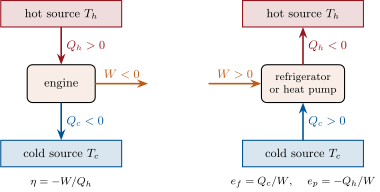
The two ways round a ditherm cycle. Left: the engine takes heat from the hot source, rejects part of it to the cold one and delivers the difference as work. Right: the same machine driven backward pumps heat from cold to hot; it is a refrigerator if one wants Q_c, a heat pump if one wants |Q_h|.
The two ways round a ditherm cycle. Left: the engine takes heat from the hot source, rejects part of it to the cold one and delivers the difference as work. Right: the same machine driven backward pumps heat from cold to hot; it is a refrigerator if one wants QcQ_c, a heat pump if one wants ∣Qh∣|Q_h|.

উদাহরণ

Example 24.6 (Three numbers)

A steam turbine between Th=800 KT_h = 800\,\mathrm{K} and a river at Tc=300 KT_c = 300\,\mathrm{K}: ηC=0.625\eta_C = 0.625; real plants reach about 0.400.40. A domestic refrigerator between 275 K275\,\mathrm{K} inside and a kitchen at 298 K298\,\mathrm{K}: ef≤275/23=12e_f \leq 275/23 = 12; real machines give 22 to 44. A heat pump warming a house at 293 K293\,\mathrm{K} from air at 273 K273\,\mathrm{K}: ep≤293/20=14.7e_p \leq 293/20 = 14.7; real pumps give 33 to 55 — still three to five times what the same electricity would give in a resistor (Problem 24.1).

Example 24.18 (Heat pump or resistor?)

A house losing 6 kW6\,\mathrm{kW} at −5∘C-5{}^{\circ}\mathrm{C} outdoors needs 6 kW6\,\mathrm{kW} of electricity with resistors; an ideal heat pump from 268 K268\,\mathrm{K} to 293 K293\,\mathrm{K} would need 6/11.7=0.51 kW6/11.7 = 0.51\,\mathrm{kW}; a real one with exchanger temperatures 260 K260\,\mathrm{K} and 313 K313\,\mathrm{K} and a 0.550.55 quality factor, ep=0.55×313/53=3.2e_p = 0.55 \times 313/53 = 3.2, needs 1.9 kW1.9\,\mathrm{kW}. The weekend problem works the season through, entropy included.

প্রসঙ্গসহ পড়ো →