
Biology · Glossary

What is Body plan?

Also known as: vertebrate · cephalisation · coelom · diaphragm

Definition 6.1 High School Biology · Chapter 6 — Body Plans and Common Ancestry

The body plan of a group of organisms is the common arrangement of their parts: the axes of symmetry and the relative positions of the main organs, independently of size, shape or way of life. The vertebrates — fish, amphibians, reptiles, birds, mammals — share one plan: a body symmetric about a vertical plane, with a front end carrying the head and a back end; an internal skeleton whose axis is a column of vertebrae protecting a dorsal nerve cord; the digestive tube running ventrally, mouth in front, and the heart beneath it.
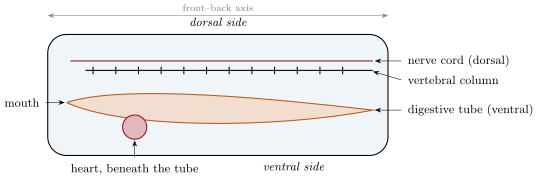
The vertebrate body plan, in side view. Whatever the species, the nerve cord runs along the back above the vertebral column, the digestive tube along the belly, the heart beneath it near the front. Insects and earthworms have the nerve cord on the ventral side: a different plan.

Examples

Example 6.2 (Same plan, different animals)

A trout, a frog, a lizard, a pigeon and a mouse dissected side by side show the plan in every case: the spinal cord in the back, protected by vertebrae; the gut below it with a liver beside the stomach; the heart in front, under the gut; paired limbs (or fins) attached to girdles of bone. The differences — gills or lungs, fins or legs, scales, feathers or fur — are all variations built on the same arrangement.

Example 6.8 (Cytochrome c)

Cytochrome c is a protein of about 104 amino acids used in respiration by every eukaryote. Compared with the human sequence, the chimpanzee’s differs at 0 positions, the mouse’s at 9, the chicken’s at 13, the frog’s at 18, the tuna’s at 21, and yeast’s at 45. Ranked by differences, the species fall into exactly the boxes of the previous figure: mammal, then amniote, then tetrapod, then vertebrate, then eukaryote.
Read in context →
Definition 2.1 University Biology — Year 1 · Chapter 2 — Functional Organization of a Mammal

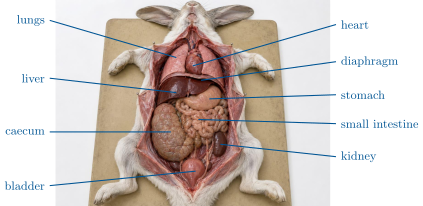
The body plan of an animal is the arrangement of its axes, cavities and organs that is shared by all members of its group. The mammalian body plan is that of a vertebrate: bilateral symmetry with a head end carrying the brain and the main sense organs (cephalisation), a dorsal axis of vertebrae enclosing the spinal cord, four limbs, and a ventral body cavity — the coelom — containing the viscera. What is specifically mammalian: the coelom is divided by the muscular diaphragm into a thoracic cavity (heart, lungs) and an abdominal cavity (digestive organs, kidneys, gonads); the body is covered in hair; the young are fed on milk; the temperature is regulated.

A rabbit opened from the ventral side. The diaphragm separates the thoracic cavity (lungs, heart) from the abdominal cavity (liver, stomach, intestine, caecum, kidneys, bladder). Every organ lies in a fixed place, wrapped in a membrane and supplied by its own vessels.
Read in context →