High School Biology · Grades 10–12
6Body Plans and Common Ancestry
Hold your arm out and count: one bone from shoulder to elbow, two from elbow to wrist, a cluster of small bones in the wrist, five fingers. Now look at the skeleton of a bat’s wing, a whale’s flipper, a horse’s foreleg, a frog’s arm: the same one bone, two bones, cluster, and digits, stretched, fused or shortened but never rearranged. Nobody designing a wing from scratch would start from an arm. The resemblance is the mark of something inherited, and this chapter is about reading such marks — in skeletons, in embryos, in molecules — to reconstruct the kinship of living things.
6.1 The vertebrate body plan
Definition 6.1 (Body plan)
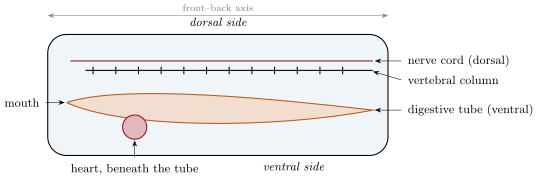
The body plan of a group of organisms is the common arrangement of their parts: the axes of symmetry and the relative positions of the main organs, independently of size, shape or way of life. The vertebrates — fish, amphibians, reptiles, birds, mammals — share one plan: a body symmetric about a vertical plane, with a front end carrying the head and a back end; an internal skeleton whose axis is a column of vertebrae protecting a dorsal nerve cord; the digestive tube running ventrally, mouth in front, and the heart beneath it.
Example 6.2 (Same plan, different animals)
A trout, a frog, a lizard, a pigeon and a mouse dissected side by side show the plan in every case: the spinal cord in the back, protected by vertebrae; the gut below it with a liver beside the stomach; the heart in front, under the gut; paired limbs (or fins) attached to girdles of bone. The differences — gills or lungs, fins or legs, scales, feathers or fur — are all variations built on the same arrangement.
6.2 Homologous organs
Definition 6.3 (Homology)
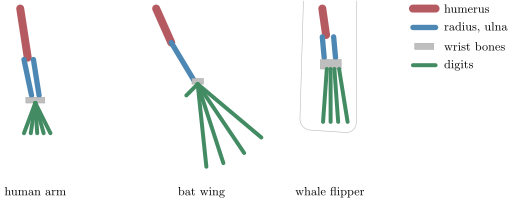
Two organs of two species are homologous when they have the same structure and the same position in the body plan — built of the same parts in the same relations — whatever their present function. The forelimbs of tetrapods are the standard example: one bone (humerus), two bones (radius and ulna), a cluster of wrist bones, then the digits. Organs that perform the same function with a different structure — the wing of a bird and the wing of a fly — are merely analogous, and say nothing about kinship.
Proposition 6.4 (Homology reveals kinship)
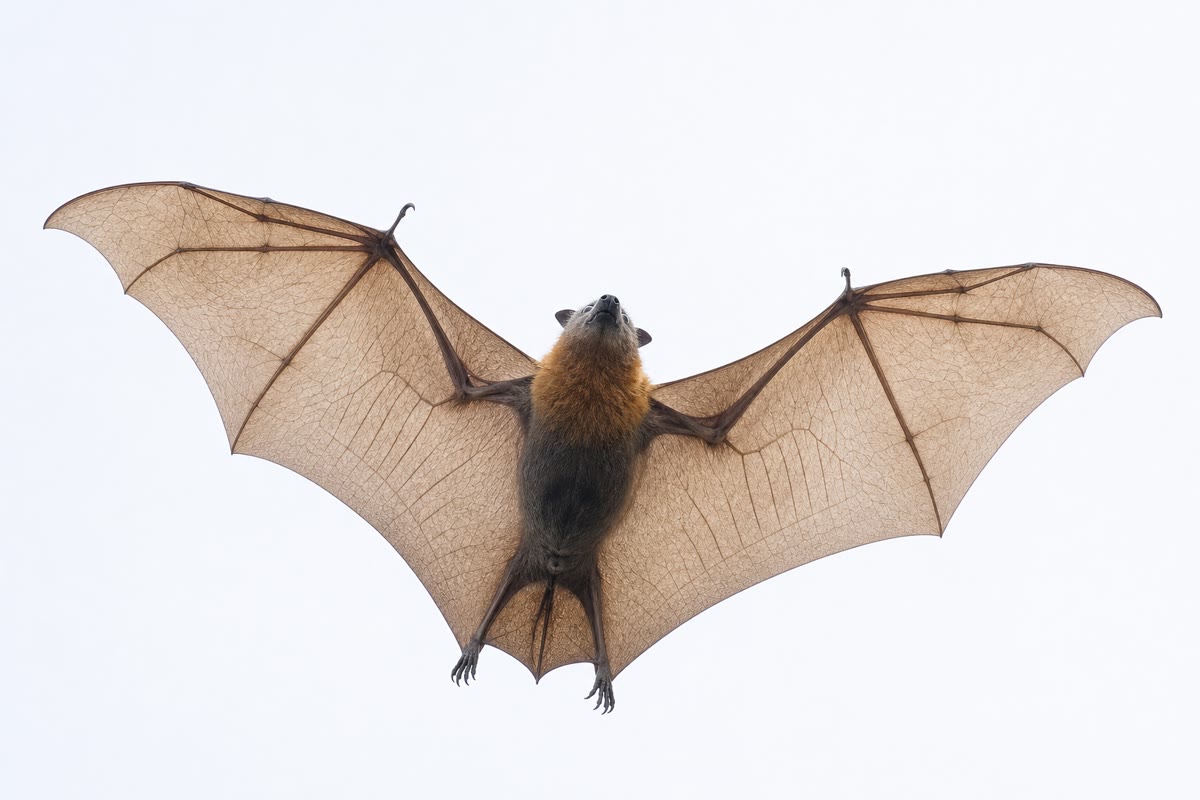
Shared homologous structures are inherited from a common ancestor that possessed them; the more such structures two species share, the closer their kinship. The tetrapod limb is found in every land vertebrate because all descend from one ancestral lineage that had it; a bat’s wing is a modified arm because bats descend from mammals with arms, not from birds.
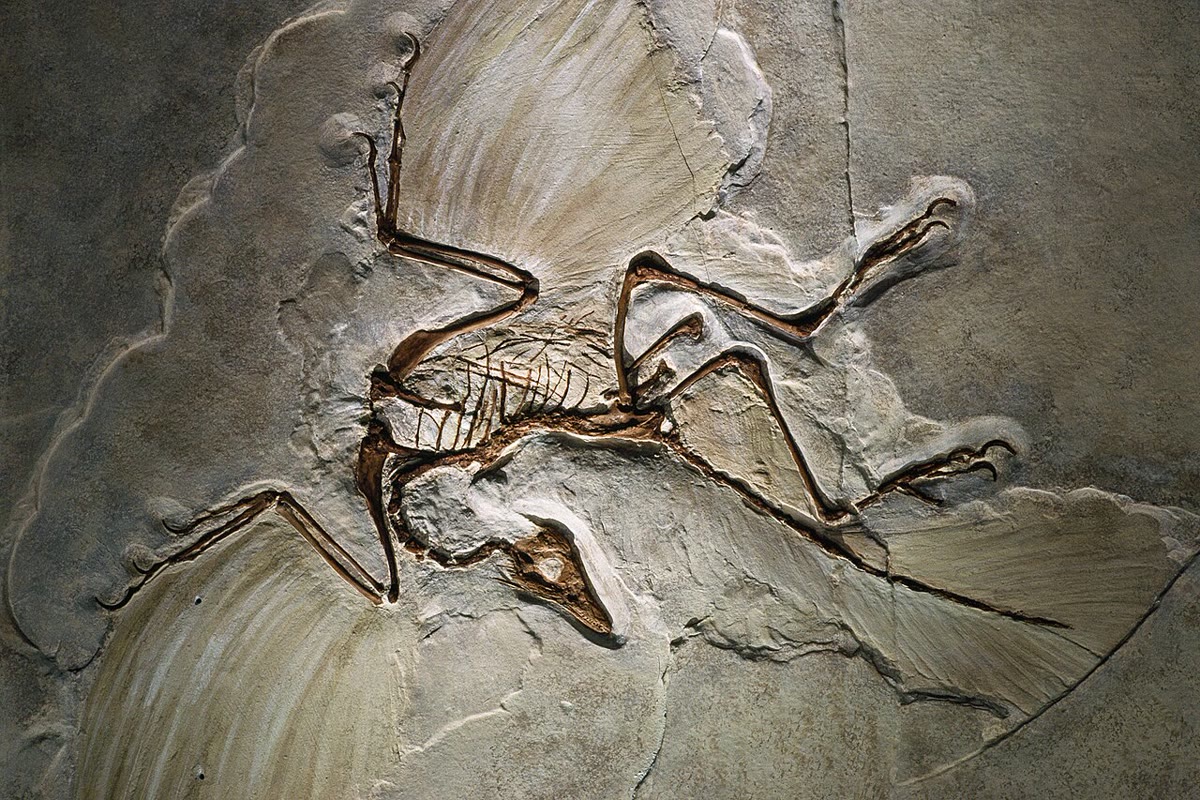
Evidence. Three independent lines converge. Fossils: the sequence of dated rocks contains forms with intermediate combinations of characters — fish with limb-like fins and a neck 375 million years ago, then four-legged animals with fish-like tails; Archaeopteryx, 150 million years old, with feathers and wings but also teeth, clawed fingers and a long bony tail. Embryos: all vertebrate embryos pass through a stage with gill pouches, a tail and a notochord — structures kept in the adult fish, reworked or lost in the others. Molecules: as Chapter 3 showed, all share DNA and the same genes, and the differences between the versions of one gene rank species exactly as the anatomy does. ∎
6.3 Nested groups
Method 6.5 (Grouping by shared characters)
Kinship groups are built by shared derived characters — features that appeared once in an ancestor and were inherited by all its descendants.
- List the species and a set of characters (vertebral column; four limbs; egg with a shell or its equivalent, the amniotic egg; feathers; hair and milk; and so on).
- For each character, note which species possess it.
- A character shared by a subset defines a group: all species with four limbs are the tetrapods; among them, all with an amniotic egg are the amniotes; among those, all with hair are the mammals.
- Draw the groups as nested boxes, or as a tree in which each node is the common ancestor in which the character appeared. A group must contain all the descendants of that ancestor: "fish" or "reptiles" in the everyday sense are not such groups.
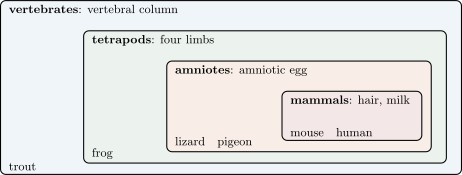
Example 6.6 (Reading the boxes)
Which is the mouse’s closest relative among trout, frog, lizard and pigeon? The smallest box containing the mouse and another species is "amniotes", which holds the lizard and the pigeon: they are equally close, both nearer to the mouse than the frog is, and the frog nearer than the trout. That a lizard is closer to a pigeon than to a frog surprises most people; the shelled egg, a character no frog has, settles it.
6.4 Kinship in the molecules
Proposition 6.7 (Molecular kinship)
Since all living things descend from common ancestors, a gene present in two species is a modified copy of the ancestral gene, and the number of differences between the two copies grows with the time since the species separated. Comparing the sequence of one gene, or of the protein it codes for, across species therefore measures kinship, and the resulting groupings agree with those drawn from anatomy.
Proof. Admitted at this level. ∎
Example 6.8 (Cytochrome c)
Cytochrome c is a protein of about 104 amino acids used in respiration by every eukaryote. Compared with the human sequence, the chimpanzee’s differs at 0 positions, the mouse’s at 9, the chicken’s at 13, the frog’s at 18, the tuna’s at 21, and yeast’s at 45. Ranked by differences, the species fall into exactly the boxes of the previous figure: mammal, then amniote, then tetrapod, then vertebrate, then eukaryote.
Remark 6.9 (Unity and kinship)
The unity of composition (Chapter 1), of the cell (Chapter 2), of the genetic molecule (Chapter 3) and now of body plans and gene sequences is one fact seen four times: living things resemble each other because they are related, and they are related because they descend from common ancestors. The diversity of Chapter 5 is the outcome of that descent with modification, over the time the fossil record measures. How the modifications arise and spread is the subject of the final year.
6.5 Exercises
Exercise 6.1 ★
List four features of the vertebrate body plan.
Solution
Solution of Exercise 6.1.
Bilateral symmetry with a front and a back end; an internal skeleton with a vertebral column; a dorsal nerve cord above it; a ventral digestive tube with the heart beneath it near the front (and paired limbs or fins).
Exercise 6.2 ★
Define homologous organs and give the standard example.
Solution
Solution of Exercise 6.2.
Organs with the same structure and position in the body plan, whatever their function. The tetrapod forelimb: humerus, radius and ulna, wrist bones, digits — in an arm, a wing, a flipper.
Exercise 6.3 ★
Are the wing of a bird and the wing of a butterfly homologous or analogous? Justify.
Solution
Solution of Exercise 6.3.
Analogous: same function (flight), entirely different structure — bones, muscles and skin in the bird, a membrane of the external skeleton in the butterfly. They say nothing about kinship.
Exercise 6.4 ★
Using the nested-boxes figure, say which is closer to the frog: the trout or the lizard.
Solution
Solution of Exercise 6.4.
The lizard: the smallest box containing frog and lizard is "tetrapods"; the trout is only in the larger "vertebrates" box.
Exercise 6.5 ★
Which three lines of evidence support the idea that shared homologies come from a common ancestor?
Solution
Solution of Exercise 6.5.
Fossils with intermediate combinations of characters; the shared stages of vertebrate embryos; the agreement of molecular sequence comparisons with anatomical groupings.
Exercise 6.6 ★★
A whale has a flipper with the tetrapod bone pattern, breathes air, suckles its young, and has tiny hip bones unattached to any leg. Which box of the figure does it belong to? What do the hip bones suggest?
Solution
Solution of Exercise 6.6.
Mammals (hair traces, milk; tetrapod limb; air breathing and, in mammals, an amniotic development). The hip bones are the remnant of hind limbs: whales descend from four-legged land mammals.
Exercise 6.7 ★★
Add the crocodile (four limbs, amniotic egg, scales, no hair) and the salamander (four limbs, egg laid in water without shell) to the nested boxes.
Solution
Solution of Exercise 6.7.
The crocodile goes into "amniotes" with lizard and pigeon (not into "mammals"); the salamander into "tetrapods" outside "amniotes", with the frog.
Exercise 6.8 ★★
Explain why "fish" (trout, shark, lungfish…) is not a kinship group in the sense of Method 6.5, knowing that the lungfish is closer to the frog than to the trout.
Solution
Solution of Exercise 6.8.
A kinship group must contain all the descendants of its common ancestor. The ancestor common to trout and lungfish is also the ancestor of the frog and of every tetrapod; a group holding trout and lungfish but excluding the frog leaves out some descendants. "Fish" names a way of life, not a lineage.
Exercise 6.9 ★★
Using the cytochrome c data, rank the human’s relatives from closest to most distant and check the ranking against the anatomical boxes.
Solution
Solution of Exercise 6.9.
Chimpanzee (0), mouse (9), chicken (13), frog (18), tuna (21), yeast (45): mammal, amniote, tetrapod, vertebrate, eukaryote — the boxes in order.
Exercise 6.10 ★★
Human embryos of four weeks have gill pouches in the neck and a tail, both of which disappear later. What does this observation contribute to the argument of the chapter?
Solution
Solution of Exercise 6.10.
Structures kept in adult fish appear transiently in our embryos and are reworked: the gill pouches become parts of the ear, throat and glands, the tail is resorbed. An embryo running through an ancestral stage is what inheritance from a common ancestor predicts and what design for a purpose does not.
Exercise 6.11 ★★
Archaeopteryx has feathers and a long bony tail. Explain why a fossil with a mixture of characters is expected under common ancestry and would be puzzling without it.
Solution
Solution of Exercise 6.11.
If birds descend from reptile-like ancestors, some ancestor must have had reptile characters and the first bird characters at once; finding one dated between the two groups is a confirmed prediction. Without common ancestry, a creature mixing the traits of two separate kinds has no reason to exist.
Exercise 6.12 ★★★
The eyes of an octopus and of a human are both cameras with a lens and a retina, yet they develop from different tissues and the octopus retina is wired the other way round. Homologous or analogous? What would each answer imply about their common ancestor?
Solution
Solution of Exercise 6.12.
Analogous: same function and similar general design, but different embryonic origin and reversed structure. Homology would imply the common ancestor of molluscs and vertebrates already had a camera eye; analogy implies it had at most a simple light-sensitive patch, and the two lineages built cameras separately.
Exercise 6.13 ★★★
Cytochrome c differs between human and mouse at 9 positions, between human and chicken at 13, and between mouse and chicken at 13 as well. Explain why the last two numbers are expected to be equal (or nearly) if differences accumulate steadily with time.
Solution
Solution of Exercise 6.13.
Human and mouse share a common ancestor more recent than either shares with the chicken; both lineages have been separate from the chicken’s for the same length of time, so both have accumulated about the same number of changes relative to it. The human–chicken and mouse–chicken distances measure the same interval.
Exercise 6.14 ★★★
Snakes have no limbs, yet they are placed among the tetrapods. On what evidence, and what does "tetrapod" then mean?
Solution
Solution of Exercise 6.14.
Snakes have the amniotic egg, the skeleton and skull of lizards, and some (boas, pythons) keep vestiges of hind limbs and a pelvis; fossil snakes with small legs exist. "Tetrapod" means descended from the four-limbed ancestor, whether or not the limbs are kept.
Exercise 6.15 ★★★
A friend argues that similar animals simply live in similar ways, and that is why they look alike. Use the forelimb, the embryo and the molecule to explain what that argument cannot account for.
Solution
Solution of Exercise 6.15.
Way of life explains a flipper’s shape, not why a whale’s flipper contains the bones of an arm arranged like a bat’s — a flat paddle does not need a wrist. It does not explain gill pouches in a human embryo, which has no use for them. And it does not explain why a respiratory protein, invisible to the environment, differs between species by exactly the amounts the skeletons predict. Only inheritance from common ancestors accounts for all three.
6.6 Problem: One Tree, Two Kinds of Evidence
Problem 6.1
Weekend problem — five vertebrates, their skeletons and one of their proteins: kinship built from anatomy, rebuilt from molecules, and the two compared
The class studies five species: a trout, a frog, a lizard, a pigeon and a mouse. Character table (1 = present, 0 = absent):
| trout | frog | lizard | pigeon | mouse | |
|---|---|---|---|---|---|
| vertebral column | 1 | 1 | 1 | 1 | 1 |
| four limbs | 0 | 1 | 1 | 1 | 1 |
| amniotic egg | 0 | 0 | 1 | 1 | 1 |
| feathers | 0 | 0 | 0 | 1 | 0 |
| hair and milk | 0 | 0 | 0 | 0 | 1 |
Number of differences in cytochrome c (rounded):
| frog | lizard | pigeon | mouse | |
|---|---|---|---|---|
| trout | 19 | 20 | 21 | 21 |
| frog | 16 | 17 | 18 | |
| lizard | 12 | 14 | ||
| pigeon | 13 |
Part I — The skeletons.
- Which character is shared by all five? Which group does it define?
- Which characters define a group of four, a group of three? Name the groups.
- Feathers and hair are each found in one species. Can such a character define a kinship group among these five? What is it useful for?
- Draw the nested boxes for the five species, or the corresponding tree.
- The frog’s forelimb has the humerus, radius–ulna, wrist and digit pattern; the trout’s pectoral fin has rays of bone fanning from a small base. Which is homologous to your arm? Which character of the table does this correspond to?
Part II — The molecule.
- From the second table, which two species are the closest pair? Which species is most distant from all the others?
- Rank the mouse’s relatives from closest to most distant using the molecule alone.
- Do the same for the frog. Is the ranking consistent with the boxes of Part I?
- The lizard–pigeon distance (12) is smaller than the lizard–mouse distance (14). What does this suggest about the branching order within the amniotes, and does the character table say anything about it?
- Explain why the trout’s distances to the four others are all about equal (19–21).
Part III — Comparing the two.
- List the groupings both kinds of evidence agree on.
- Why is agreement between an anatomical and a molecular ranking strong evidence, when either alone could be questioned?
- Suppose a sixth species, a bat, were added: forelimb with the tetrapod pattern, amniotic egg, hair and milk, cytochrome c differing from the mouse at 8 positions and from the pigeon at 13. Where does it go? Why does its wing not put it with the pigeon?
- The cytochrome c of a chimpanzee is identical to the human one, yet the two species differ visibly. What does this say about which genes cytochrome c comparisons can and cannot inform us about?
- A yeast’s cytochrome c differs from all five at about 45 positions. What box, larger than "vertebrates", does the yeast share with them?
Part IV — Time and the tree. The fossil record dates the separation of the mouse and pigeon lineages to about 320 million years ago.
- If differences accumulate steadily in both lineages, how many differences appear per 100 million years along one lineage? (Use the mouse–pigeon distance, remembering that both lineages have been changing.)
- Use that rate to estimate the age of the separation of the frog lineage from the amniotes, from the frog–mouse and frog–pigeon distances.
- Estimate likewise the separation of the trout lineage.
- Fossils place the first tetrapods at about 370 million years ago and the first vertebrates with jaws well over 420. Compare with your estimates and comment on the agreement.
- State the result in one sentence: what the two kinds of evidence, taken together, establish about the five species, and what the molecule adds that the skeleton cannot.
Solution
Solution of Problem 6.1.
1. The vertebral column: the vertebrates.
2. Four limbs defines frog, lizard, pigeon, mouse: the tetrapods. The amniotic egg defines lizard, pigeon, mouse: the amniotes.
3. No: a character present in one species groups nothing. It identifies the species (and would define a group if more relatives — other birds, other mammals — were added).
4. Vertebrates tetrapods amniotes, with the trout outside the second box and the frog outside the third; the lizard, pigeon and mouse inside the third.
5. The frog’s: same bones, same order. It corresponds to the "four limbs" character, which the fin lacks.
6. Lizard and pigeon (12). The trout (19–21 from all).
7. Pigeon (13), lizard (14), frog (18), trout (21).
8. Lizard (16), pigeon (17), mouse (18), trout (19): the amniotes at about equal distance, the trout beyond — consistent with the boxes (the frog is closer to every amniote than to the trout).
9. That lizard and pigeon separated from each other after their lineage had separated from the mouse’s: within the amniotes, lizard and pigeon are closer kin. The table cannot tell: no character in it is shared by lizard and pigeon alone.
10. The trout’s lineage separated from the common lineage of the four others before those separated from one another: each has been apart from the trout for the same time, so each has accumulated about the same number of differences.
11. Trout outside all the others; the four tetrapods together; the three amniotes together within them.
12. Anatomy and a respiratory protein have no reason to agree unless both record the same history. Two independent witnesses telling the same story make an accidental resemblance implausible.
13. Into "mammals", beside the mouse (hair, milk, and the smallest molecular distance). Its wing is a modified tetrapod forelimb, analogous to the pigeon’s, not homologous with feathered flight; the molecule (13 from the pigeon, 8 from the mouse) confirms.
14. Cytochrome c changes too slowly to separate close relatives, and it is not the gene responsible for visible differences. It informs about deep kinship, not about the genes that make a species what it is.
15. The eukaryotes: cells with a nucleus and mitochondria, sharing this respiratory protein.
16. The 13 differences were accumulated by two lineages over 320 million years: per lineage, i.e. about 2 per 100 million years along one lineage.
17. Frog–mouse 18, frog–pigeon 17: average 17.5, i.e. 8.75 per lineage; at 2 per 100 million years, about 430 million years.
18. Trout average about 20: 10 per lineage, about 500 million years.
19. The estimates (430, 500) are older than the fossil dates (370, over 420) but of the right order and in the right sequence; the rate is not exactly constant and the counts are rounded, so agreement within 20% is as good as the method allows.
20. Both establish the same nested kinship — trout, then frog, then the three amniotes — while the molecule adds a clock: an estimate of how long ago each branch separated.