 Coach
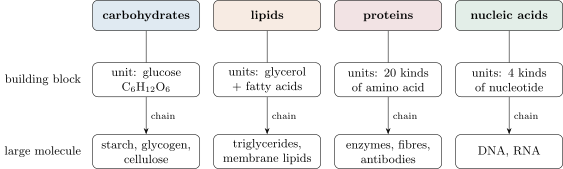
CoachOrganic molecules belong to four families.
- Carbohydrates (sugars) contain carbon, hydrogen and oxygen only. The simple sugars are single units, such as glucose ; the complex carbohydrates are chains of hundreds or thousands of glucose units — starch and cellulose in plants, glycogen in animals.
- Lipids (fats and oils) also contain only C, H and O, but with much less oxygen, and they do not dissolve in water. The commonest are the triglycerides, each made of one glycerol molecule joined to three long fatty-acid chains.
- Proteins are chains of amino acids: twenty kinds of amino acid, all containing nitrogen, linked in a precise order into chains of fifty to several thousand units that fold into a definite shape.
- Nucleic acids (DNA and RNA) are chains of nucleotides, containing phosphorus as well as C, H, O and N; they store and transmit genetic information, and are the subject of Chapter 3.
Examples
Example 1.11 (Reading a food label)
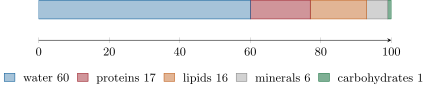
A label on wholemeal bread reads, per : carbohydrates (of which sugars ), fat , protein , fibre , salt . The rest — about — is water. "Carbohydrates" here is mostly starch, "sugars" the simple ones, "fibre" is cellulose (a carbohydrate we cannot digest), "fat" the lipids, "salt" a mineral salt. A label is a chemical analysis, rounded.
Example 1.15 (Analysing a potato)
A raw potato slice: cobalt chloride paper turns pink (water); iodine turns blue-black at once (starch, abundant); Fehling’s gives only a faint orange tinge (little free sugar); biuret gives a pale violet (some protein, about 2% of the fresh mass); no translucent spot (almost no lipid). Drying leaves 22% of the mass; burning that leaves 1% of ash. The potato is a starch store wrapped in water — exactly what a plant needs to survive the winter underground.