 Coach
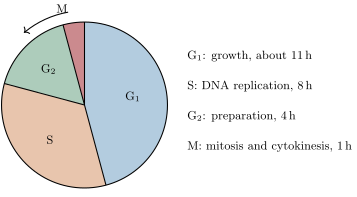
CoachThe cell cycle is the sequence of events from the birth of a cell, by division, to its own division into two. It comprises the interphase, during which the cell grows and copies its DNA, and the M phase, during which the nucleus divides (mitosis) and then the cytoplasm (cytokinesis). Interphase has three parts: (growth), S (DNA replication, Chapter 11) and (preparation for division).
Examples
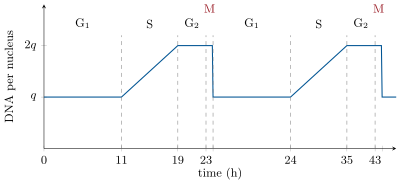
Example 12.3 (Reading the curve)
A cell measured at may be in or in early mitosis; at it is certainly in S, half-way through replication; at it is in — or has left the cycle for good, like a neuron or a muscle fibre, which stay at for life. A tissue in which every cell is at is a tissue that has stopped dividing.
Example 12.6 (Counting in the root tip)
Of 600 cells counted in a root tip, 540 are in interphase and 60 in mitosis: a mitotic index of 10%. If the cycle lasts 20 hours, mitosis lasts about ; and if 36 of the 60 dividing cells are in prophase, prophase takes of those two hours, some 72 minutes, while anaphase, seen in only 4 cells, takes about 8 minutes. The rarest stage is the fastest.