High School Biology · Grades 10–12
11DNA Replication
Every day your bone marrow produces two hundred billion new red blood cells, your gut lining replaces itself every few days, and each of those new cells receives a complete copy of the two metres of DNA that the previous chapters described as the text of the cell. Copying three billion letters, without a template to consult, in a few hours, with fewer errors than a professional typist makes in a page: how is it done? The answer was guessed from the structure of the molecule itself in 1953, and proved by one of the most elegant experiments in biology five years later.
11.1 The problem of copying
Definition 11.1 (Replication)
DNA replication is the process by which a cell makes, from one double-stranded DNA molecule, two molecules identical to it and to each other, before dividing. It takes place in a defined period of the cell cycle, the S phase (Chapter 12), during which the amount of DNA in the nucleus doubles.
Proposition 11.2 (The template principle)
Because the two strands of a DNA molecule are complementary — A facing T, G facing C — each strand carries all the information needed to rebuild the other. Replication therefore proceeds by separating the two strands and using each as a template on which a new complementary strand is assembled, nucleotide by nucleotide.
Proof. Admitted at this level. ∎
Example 11.3 (Three conceivable outcomes)
Given the template principle, three ways of distributing old and new strands were proposed in the 1950s:
- semi-conservative: each daughter molecule keeps one old strand and gets one new one;
- conservative: the original molecule is kept whole and an entirely new double strand is built beside it;
- dispersive: old and new segments alternate along each strand of both daughters.
The three cannot be told apart by looking; they can by weighing.
11.2 The Meselson–Stahl experiment
Proposition 11.4 (Replication is semi-conservative)
Each daughter DNA molecule contains one strand of the parent molecule and one newly synthesised strand.
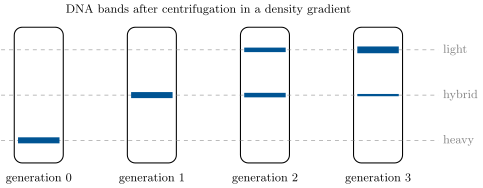
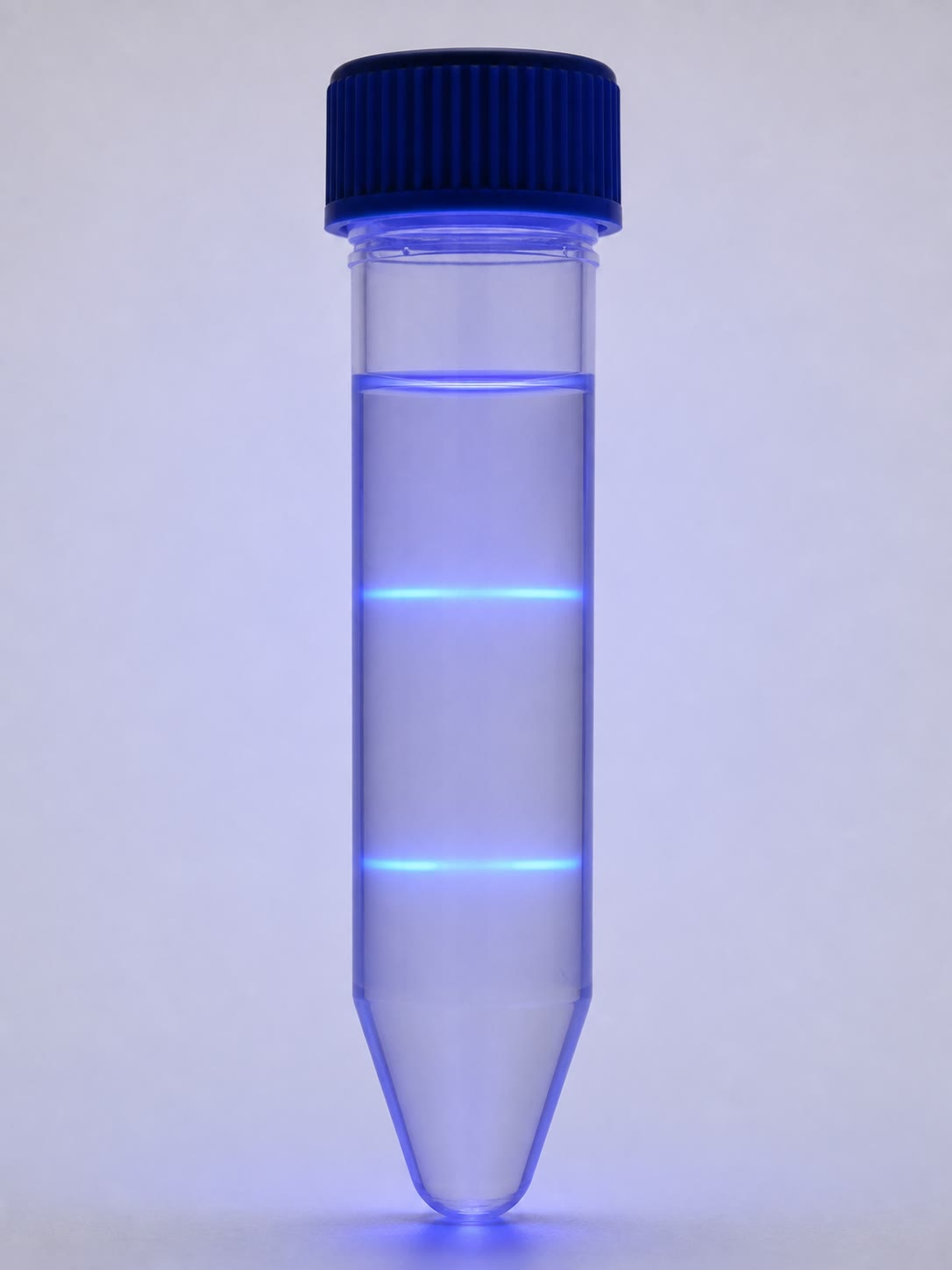
Evidence. Meselson and Stahl (1958) grew bacteria for many generations in a medium whose only nitrogen was the heavy isotope N, so that all their DNA was heavy. They then transferred the bacteria to ordinary N medium and sampled the culture after each generation (every twenty minutes). DNA extracted from each sample was spun for many hours in a dense salt solution, where a molecule floats at the level matching its own density, and photographed under ultraviolet light: heavy and light DNA form bands a measurable distance apart. Results: before transfer, one heavy band; after one generation, a single band exactly half-way between heavy and light — every molecule hybrid; after two generations, two bands of equal intensity, one hybrid and one light; after three, the light band three times the hybrid one. The conservative model predicts a heavy and a light band at generation one, never a hybrid; the dispersive model predicts a single band that drifts lighter every generation, never splitting into two. Only the semi-conservative model gives one hybrid band, then hybrid plus light in the proportions observed. ∎
Example 11.5 (Predicting the fourth generation)
After generations in light medium, the two original heavy strands are still there, one in each of two hybrid molecules; every other molecule is fully light. Out of molecules, 2 are hybrid and light: at generation 4, 2 hybrid for 14 light — a light band seven times the hybrid one, and the hybrid band never disappears, only fades. The two original strands are, in effect, immortal.
11.3 The machinery
Proposition 11.6 (Replication forks)
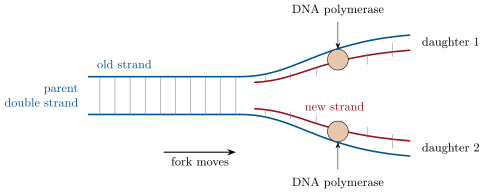
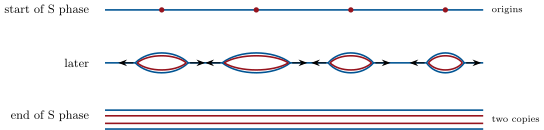
Replication starts at defined sites, the origins, where the two strands are pulled apart into a bubble. At each edge of the bubble a replication fork advances: an enzyme, DNA polymerase, moves along each opened strand and adds, one at a time, the nucleotides complementary to it, chaining them into the new strand. The two forks of a bubble travel in opposite directions until they meet the forks of neighbouring bubbles; the bacterial chromosome, a single circle, has one origin and two forks; a human chromosome has thousands of origins working at once.
Proof. Admitted at this level. ∎
Example 11.7 (Speed and scale)
A bacterial fork adds about 1000 nucleotides per second; a human fork, about 50. The E. coli chromosome, base pairs, copied by two forks from one origin, takes , some 40 minutes — the length of the bacterium’s cell cycle in rich medium. A human cell, with base pairs to copy in an S phase of about 8 hours, needs its thousands of origins: a single fork would take over two years.
Proposition 11.8 (Fidelity)
DNA polymerase pairs the wrong nucleotide about once in ; it checks each nucleotide as it adds it and removes most mismatches at once, and other enzymes correct most of the remaining ones just behind the fork. The final error rate is about one per nucleotides: a human cell, copying nucleotides, makes on average some half-dozen errors per division. Those that escape are mutations, the subject of Chapter 13.
Proof. Admitted at this level. ∎
Method 11.9 (Replication calculations)
- Time: length to copy (base pairs) divided by the total speed of all the forks at work (forks nucleotides per second per fork).
- Origins needed: total length divided by what one origin (two forks) can copy in the time available.
- Errors: nucleotides copied error rate; remember that a cell copies both strands, i.e. twice the number of base pairs.
- Isotope experiments: track the two original strands; after generations they sit in 2 hybrid molecules out of .
Remark 11.10 (Why the structure and the mechanism fit)
Watson and Crick ended their 1953 paper by noting that the pairing "immediately suggests a possible copying mechanism". Meselson and Stahl showed it was the actual mechanism; the enzymology that followed showed how. It is one of the rare cases in biology where a molecule’s shape, seen once, dictated the process that uses it.
11.4 Exercises
Exercise 11.1 ★
State the template principle and explain why it depends on complementarity.
Solution
Solution of Exercise 11.1.
Each strand serves as a template on which a new complementary strand is built. It works only because A pairs with T and G with C: the sequence of one strand fixes that of the other, so a strand alone carries the whole information.
Exercise 11.2 ★
Define semi-conservative replication and contrast it with the conservative model.
Solution
Solution of Exercise 11.2.
Semi-conservative: each daughter molecule keeps one parent strand and gains one new strand. Conservative: the parent molecule stays whole and a completely new double strand is built beside it.
Exercise 11.3 ★
In which phase of the cell cycle does replication take place, and what happens to the amount of DNA per nucleus during it?
Exercise 11.4 ★
What does DNA polymerase do? What is a replication fork?
Solution
Solution of Exercise 11.4.
DNA polymerase adds to a growing strand the nucleotides complementary to the template, one at a time. A replication fork is the moving point where the parent strands are separated and the two new strands are being built.
Exercise 11.5 ★
A strand reads GATTACAGGC. Write the new strand a polymerase builds on it.
Solution
Solution of Exercise 11.5.
CTAATGTCCG, base under base.
Exercise 11.6 ★★
In the Meselson–Stahl experiment, what would the conservative model predict at generation 1, and the dispersive model at generation 2? Why does each fail?
Solution
Solution of Exercise 11.6.
Conservative, generation 1: a heavy band and a light band, no hybrid — but only a hybrid band was seen. Dispersive, generation 2: a single band a quarter of the way from light to heavy — but two distinct bands were seen. Each model predicts bands that were not observed.
Exercise 11.7 ★★
Predict the bands and their relative intensities at generation 5.
Solution
Solution of Exercise 11.7.
molecules, 2 hybrid and 30 light: a light band fifteen times the hybrid one, no heavy band.
Exercise 11.8 ★★
Bacteria grown in light medium are transferred to heavy medium. Describe the bands at generations 0, 1 and 2.
Solution
Solution of Exercise 11.8.
Generation 0: one light band. Generation 1: one hybrid band. Generation 2: hybrid and heavy bands of equal intensity — the mirror image of the original experiment.
Exercise 11.9 ★★
Compute the time for a single human fork at 50 nucleotides per second to copy a chromosome of base pairs. Compare with an S phase of 8 hours and conclude.
Solution
Solution of Exercise 11.9.
, about 58 days — far longer than 8 hours. The chromosome must be copied from many origins at once, each opening two forks.
Exercise 11.10 ★★
How many nucleotides does a human cell join together during one S phase? At one error per , how many errors does it make?
Solution
Solution of Exercise 11.10.
Both strands of base pairs, twice: base pairs, i.e. new nucleotides joined (one per base pair copied). At per nucleotide, about 6 errors.
Exercise 11.11 ★★
Why must the two forks of a bubble move in opposite directions? What happens when two neighbouring bubbles meet?
Solution
Solution of Exercise 11.11.
Opening a bubble exposes template on both sides of the origin; each fork copies away from the origin, so the two go in opposite directions and together cover the whole region. When two bubbles meet, their forks fuse and the daughter strands join end to end into continuous molecules.
Exercise 11.12 ★★★
A chemical blocks DNA polymerase. Predict its effect on a bacterial culture, on a wound that is healing, and on a nerve cell that no longer divides. Which effect suggests a use in medicine?
Solution
Solution of Exercise 11.12.
The bacteria stop dividing (no replication, no division). The wound stops healing, since its repair needs cell divisions. The nerve cell is unaffected: it no longer replicates its DNA. A drug that stops rapidly dividing cells while sparing non-dividing ones suggests a treatment against bacteria or against dividing cancer cells.
Exercise 11.13 ★★★
In the Meselson–Stahl experiment the hybrid band never disappears. Explain, and compute the fraction of molecules that are hybrid after 10 generations.
Solution
Solution of Exercise 11.13.
The two original strands are never destroyed: at every generation each is again paired with a new light strand, so exactly two hybrid molecules always exist. After 10 generations: — present but too faint to see.
Exercise 11.14 ★★★
A polymerase without its checking activity makes one error in . Compute the errors per human cell division without checking, and explain why such a cell line would not survive many divisions.
Exercise 11.15 ★★★
Explain why a bacterium in rich medium can divide every 20 minutes even though copying its chromosome takes 40 minutes. (Hint: think about when the next round of replication can begin.)
Solution
Solution of Exercise 11.15.
A new round of replication starts at the origin before the previous round has finished: the chromosome carries several nested pairs of forks at once. Each division then receives a chromosome already partly copied for the next, and divisions can follow one another faster than a single copying takes.
11.5 Problem: Weighing a Molecule to Watch It Copy
Problem 11.1
Weekend problem — the Meselson–Stahl experiment reconstructed: the isotopes, the three models and their predictions, the bands that decided, and the forks that copy a chromosome in forty minutes
Ordinary nitrogen is N; the heavy isotope N is 7% heavier per atom. Nitrogen is about 16% of the mass of DNA. Bacteria grown for fourteen generations in N medium are transferred to N medium at time zero and divide every 20 minutes.
Part I — Heavy and light.
- By what fraction is fully heavy DNA denser than light DNA? (Assume density follows mass.) Why is such a small difference enough to separate bands?
- Why were the bacteria grown for fourteen generations in heavy medium before the transfer, rather than one or two?
- A hybrid molecule has one heavy and one light strand. Where does it float relative to the heavy and light bands?
- Explain why the DNA must be extracted from a large number of bacteria for the bands to be visible.
- How could the experimenters be sure that the transfer to light medium did not itself alter the bacteria’s DNA?
Part II — Three predictions. For each model, give the bands (position and relative amount) expected after one and after two generations.
- Semi-conservative model.
- Conservative model.
- Dispersive model.
- After one generation a single band appears half-way between heavy and light. Which model is eliminated at once, and which two remain?
- After two generations there are two bands, hybrid and light, of equal intensity. Which model survives, and why does the other fail?
Part III — Counting strands.
- After generations, how many DNA molecules descend from one original molecule, and how many of them contain an original heavy strand?
- Compute the ratio light : hybrid at generations 3, 4 and 6.
- At which generation does the hybrid band fall below 5% of the DNA?
- The experimenters heated the hybrid DNA to separate its two strands and centrifuged the single strands. Predict the bands. Which model does this test?
- Explain how the same experiment, done in the reverse direction (light to heavy), would confirm the conclusion.
Part IV — The forks. The bacterial chromosome is a circle of base pairs with one origin; each fork adds 1000 nucleotides per second.
- Compute the time needed to copy the chromosome with its two forks.
- With one fork only, how long would it take? Why is one origin with two forks the minimum for a circle?
- A human cell copies base pairs in 8 hours with forks of 50 nucleotides per second. What is the minimum number of origins that must fire, if all start at once?
- At one error per nucleotides, how many errors does the bacterium make per replication, and the human cell? Why is the human figure not proportionally worse for the organism?
- State the result: what the two-generation bands proved, and the time the two forks need to copy the bacterial chromosome — compared with the bacterium’s generation time.
Solution
Solution of Problem 11.1.
1. Nitrogen is 16% of the mass and is 7% heavier: . The gradient method separates densities differing by a fraction of a per cent, so 1% gives well-separated bands.
2. So that essentially all the DNA, not just half or three quarters, was heavy: after 14 generations less than one part in of the original light strands remains.
3. Exactly half-way between the two bands: its density is the average.
4. A single bacterium holds a few femtograms of DNA; the photograph needs micrograms, hence billions of cells.
5. By keeping a culture in heavy medium as a control and checking that its band stayed heavy, and by checking the light band of bacteria grown in light medium throughout.
6. Semi-conservative: generation 1, one hybrid band; generation 2, hybrid and light bands, equal.
7. Conservative: generation 1, heavy and light bands, equal; generation 2, one heavy for three light.
8. Dispersive: generation 1, one band at the hybrid position; generation 2, one band a quarter of the way from light to heavy.
9. The conservative model, which predicted no hybrid band, is eliminated. Semi-conservative and dispersive both predict the single hybrid band and remain.
10. Semi-conservative survives: it alone predicts two separate bands. The dispersive model predicts a single band drifting lighter, never splitting.
11. molecules, of which exactly 2 carry an original strand.
12. Light : hybrid : generation 3, ; generation 4, ; generation 6, .
13. Hybrid fraction when : from generation 6 ().
14. Two bands, one heavy and one light, of equal amount: a hybrid molecule is one heavy strand plus one light strand. This tests the dispersive model, which predicts every single strand to be of intermediate density, and eliminates it independently.
15. Starting light, one generation in heavy medium gives one hybrid band and two generations hybrid plus heavy: the same pattern mirrored, showing the result does not depend on which isotope is "old".
16. , about 38 minutes.
17. 77 minutes. On a circle the two strands are exposed on both sides of any opening; two forks leaving one origin in opposite directions is the simplest way to cover the whole circle.
18. One origin copies base pairs in 8 hours; origins at the very least (in reality tens of thousands, firing at different times).
19. Bacterium: error per replication; human cell: about 6. Most of the human genome is not genes, so most errors fall where they change nothing, and the cell has two copies of every gene.
20. The two bands at generation two — hybrid and light in equal amounts — proved replication semi-conservative; the two forks copy the bacterial chromosome in about 38 minutes, roughly the bacterium’s generation time, so copying paces division.