সব বই

পেশাদার

1 Markets I: The Ecosystem and Exchange-Traded Marketsবাজার অনলাইন 2 Markets II: Rates, FX and Creditবাজার অনলাইন 3 Markets III: Commodities, Energy and Cryptoবাজার অনলাইন 4 Quantitative Methodsপদ্ধতি অনলাইন 5 Derivatives and Volatilityডেরিভেটিভস অনলাইন 6 Rates, Credit, XVA and Riskসুদহার, ঋণ ও ঝুঁকি অনলাইন 7 Research Craft: Predictors, Backtests, Measurement, Portfoliosগবেষণা অনলাইন 8 Strategies I: Equities and Futuresকৌশল অনলাইন 9 Strategies II: Volatility, Relative Value, Macro and the Bank Desksকৌশল অনলাইন 10 Microstructure and Executionএক্সিকিউশন অনলাইন 11 Market Making and High-Frequency Tradingমার্কেট মেকিং অনলাইন 12 Machine Learning for Marketsমেশিন লার্নিং অনলাইন 13 Low-Latency Softwareপ্রযুক্তি অনলাইন 14 Networks, Hardware and Trading Infrastructureপ্রযুক্তি অনলাইন 15 Research, Data and Risk Platformsপ্রযুক্তি অনলাইন 16 The Desk and the Firmপ্রতিষ্ঠান অনলাইন 17 The Industry: Firms, Roles and Careersক্যারিয়ার অনলাইন 18 Interviews I: Maths, Probability and Speedক্যারিয়ার অনলাইন 19 Interviews II: Markets, Trading Games and the Final Roundক্যারিয়ার অনলাইন 20 Interviews III: Codeক্যারিয়ার অনলাইন
অ্যাপ পরিচিতি Coach সাইন ইন পড়া শুরু করো

বইগুলো এখনো বাংলা ভাষায় পাওয়া যায় না — ইংরেজি সংস্করণ দেখানো হচ্ছে।

Biology · পরিভাষা

Cell cycle কী?

অন্য নাম: mitosis

Definition 12.1 High School Biology · অধ্যায় 12 — The Cell Cycle and Mitosis

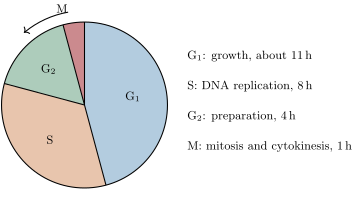
The cell cycle is the sequence of events from the birth of a cell, by division, to its own division into two. It comprises the interphase, during which the cell grows and copies its DNA, and the M phase, during which the nucleus divides (mitosis) and then the cytoplasm (cytokinesis). Interphase has three parts: G1\mathrm{G_1} (growth), S (DNA replication, Chapter 11) and G2\mathrm{G_2} (preparation for division).

The cell cycle of a typical dividing human cell, about 24 hours. Interphase (G_1, S, G_2) takes 23 of them; the division itself, one. Many cells leave the cycle after G_1 and never divide again.
The cell cycle of a typical dividing human cell, about 24 hours. Interphase (G1\mathrm{G_1}, S, G2\mathrm{G_2}) takes 23 of them; the division itself, one. Many cells leave the cycle after G1\mathrm{G_1} and never divide again.
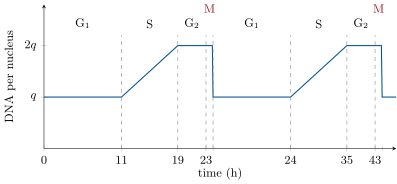
Amount of DNA in one nucleus over two successive cycles of 24 hours. It doubles during S and halves at the end of mitosis; a daughter cell always starts with q.
Amount of DNA in one nucleus over two successive cycles of 24 hours. It doubles during S and halves at the end of mitosis; a daughter cell always starts with qq.

উদাহরণ

Example 12.3 (Reading the curve)

A cell measured at 2q2q may be in G2\mathrm{G_2} or in early mitosis; at 1.5q1.5q it is certainly in S, half-way through replication; at qq it is in G1\mathrm{G_1} — or has left the cycle for good, like a neuron or a muscle fibre, which stay at qq for life. A tissue in which every cell is at qq is a tissue that has stopped dividing.

Example 12.6 (Counting in the root tip)

Of 600 cells counted in a root tip, 540 are in interphase and 60 in mitosis: a mitotic index of 10%. If the cycle lasts 20 hours, mitosis lasts about 0.10×20=2 h0.10 \times 20 = 2\,\mathrm{h}; and if 36 of the 60 dividing cells are in prophase, prophase takes 36/6036/60 of those two hours, some 72 minutes, while anaphase, seen in only 4 cells, takes about 8 minutes. The rarest stage is the fastest.

প্রসঙ্গসহ পড়ো →