High School Biology · Grades 10–12
12The Cell Cycle and Mitosis
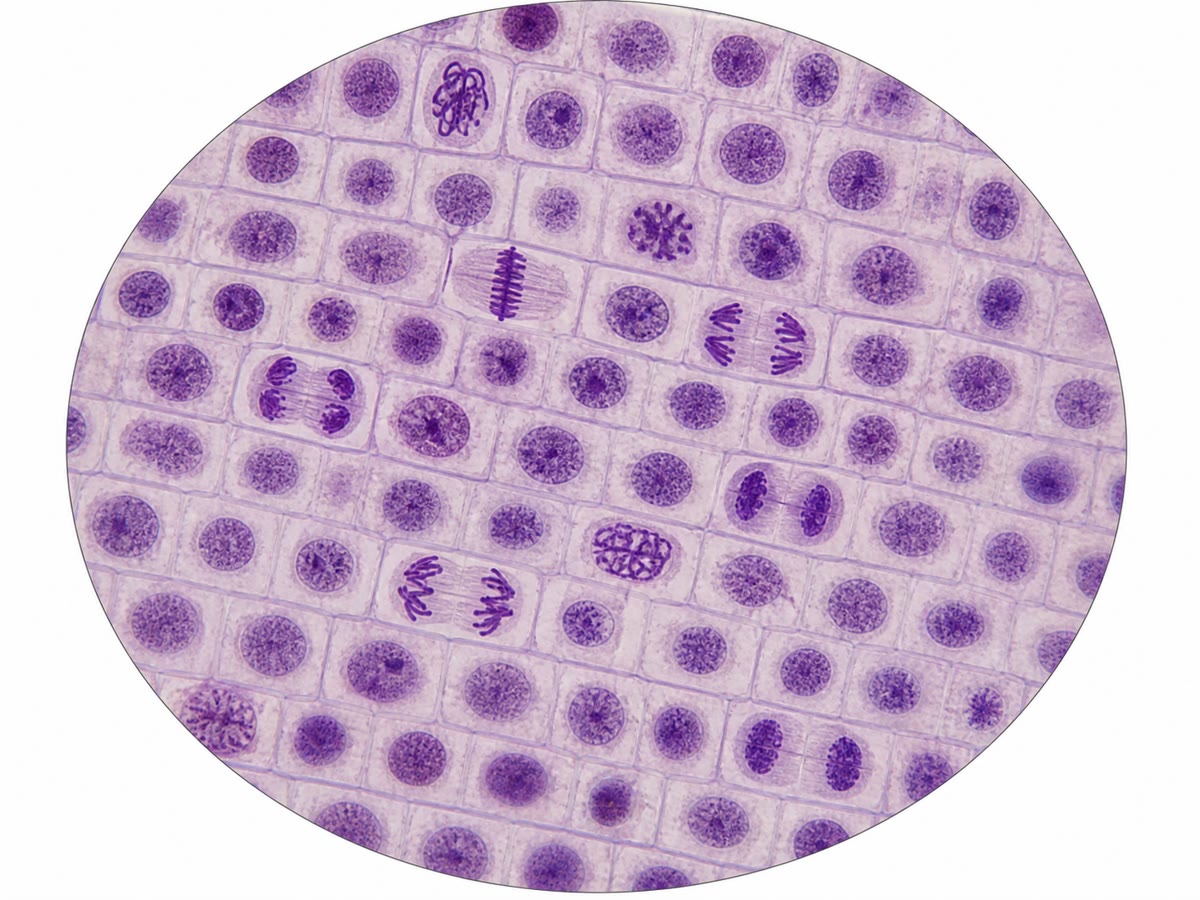
Squash the tip of an onion root under a cover slip, stain it, and look: among hundreds of quiet cells with a round nucleus, a few show something else — dark X-shaped rods gathered in the middle of the cell, or two sets of rods pulled apart towards the ends, or two small nuclei with a wall forming between them. You are watching cell division caught at different moments, in a tissue that grows a millimetre a day. Each of those divisions hands two complete, identical sets of chromosomes to two daughter cells. This chapter follows a cell through one full cycle, and looks closely at the hour in which the chromosomes are shared out.
12.1 The cell cycle
Definition 12.1 (Cell cycle)
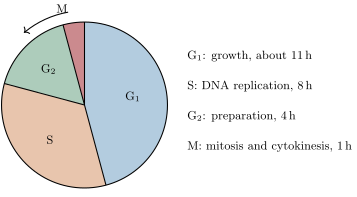
The cell cycle is the sequence of events from the birth of a cell, by division, to its own division into two. It comprises the interphase, during which the cell grows and copies its DNA, and the M phase, during which the nucleus divides (mitosis) and then the cytoplasm (cytokinesis). Interphase has three parts: (growth), S (DNA replication, Chapter 11) and (preparation for division).
Proposition 12.2 (DNA through the cycle)
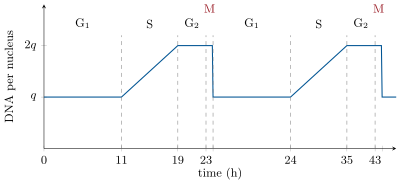
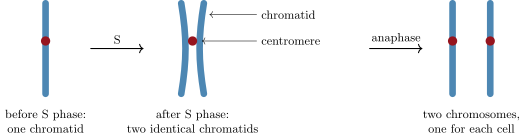
Call the amount of DNA in a nucleus just after division. It stays at through , rises steadily to during S as the chromosomes are copied, stays at through and the first part of mitosis, and falls back to in each daughter nucleus at the end of mitosis. The number of chromosomes does not change during S: each chromosome is copied into two identical chromatids held together at their centromere, and only separates into two chromosomes during mitosis.
Proof. Admitted at this level. ∎
Example 12.3 (Reading the curve)
A cell measured at may be in or in early mitosis; at it is certainly in S, half-way through replication; at it is in — or has left the cycle for good, like a neuron or a muscle fibre, which stay at for life. A tissue in which every cell is at is a tissue that has stopped dividing.
12.2 Chromosomes, seen
Definition 12.4 (Chromosome, chromatid, karyotype)
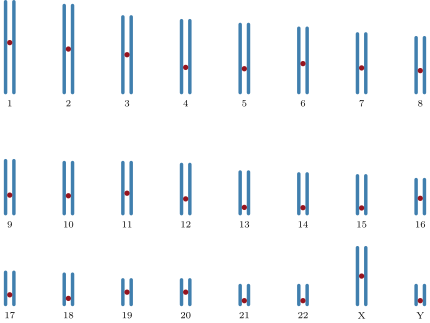
A chromosome is one DNA molecule with its packing proteins. Between divisions it is a loose, invisible thread; at the start of mitosis it coils into a compact rod visible under the light microscope. After replication each chromosome consists of two identical chromatids, joined at the centromere: the familiar X shape. The karyotype of a species is its complete set of chromosomes, photographed at metaphase and arranged in pairs by size: a human cell has 46, in 23 pairs, the members of a pair being homologous — same genes at the same positions, one from each parent.
12.3 Mitosis, step by step
Proposition 12.5 (The four stages of mitosis)
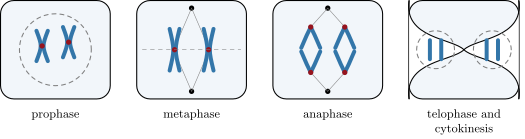
Mitosis is a continuous movement, described in four stages.
- Prophase: the chromosomes condense into visible two-chromatid rods; the nuclear envelope breaks down; a spindle of protein fibres forms between the two poles of the cell.
- Metaphase: the chromosomes, attached to spindle fibres by their centromeres, line up on the equatorial plane of the cell.
- Anaphase: the centromeres split; the two chromatids of each chromosome, now two chromosomes, are pulled to opposite poles by the shortening fibres.
- Telophase: a nuclear envelope re-forms around each set; the chromosomes uncoil. Cytokinesis then divides the cytoplasm — by pinching in animal cells, by building a new wall in plant cells.
Each daughter cell receives one chromatid of every chromosome: the same number of chromosomes as the mother, carrying the same DNA.
Proof. Admitted at this level. ∎
Example 12.6 (Counting in the root tip)
Of 600 cells counted in a root tip, 540 are in interphase and 60 in mitosis: a mitotic index of 10%. If the cycle lasts 20 hours, mitosis lasts about ; and if 36 of the 60 dividing cells are in prophase, prophase takes of those two hours, some 72 minutes, while anaphase, seen in only 4 cells, takes about 8 minutes. The rarest stage is the fastest.
Method 12.7 (Counting chromosomes and chromatids)
For a species with chromosomes:
- in : chromosomes, one chromatid each, DNA ;
- after S, through , prophase and metaphase: chromosomes, two chromatids each ( chromatids), DNA ;
- from anaphase: single-chromatid chromosomes in the cell, heading to each pole;
- in each daughter cell: chromosomes, one chromatid each, DNA .
A chromatid becomes a chromosome the moment its centromere splits.
Example 12.8 (Human numbers)
A human cell in metaphase holds 46 chromosomes and 92 chromatids; in anaphase, 92 chromosomes, 46 moving to each pole; each daughter, 46 chromosomes of one chromatid each, containing exactly the DNA the mother had at the start of its cycle.
12.4 What mitosis is for
Proposition 12.9 (Conformity and its uses)
Because replication is faithful and mitosis distributes the chromatids exactly, every cell of a multicellular body carries the same genetic information as the fertilised egg it descends from. Mitosis is the mechanism of growth (the embryo, the root tip), of renewal (skin, gut lining, blood: the bone marrow alone makes some cells a day) and of repair (wound healing); in single-celled eukaryotes it is reproduction itself. Its control — the decision to enter the cycle, the checks before S and before anaphase — is the subject of Chapter 17.
Proof. Admitted at this level. ∎
Remark 12.10 (Not everything divides)
Most neurons and heart muscle cells leave the cycle in early childhood and never re-enter it: damage to them is not repaired by division, which is why a spinal injury or a heart attack leaves lasting loss. Liver cells rest in for months but re-enter the cycle when part of the liver is removed, regrowing the organ within weeks. Which cells may divide, and when, is one of the tightest regulations of the body.
12.5 Exercises
Exercise 12.1 ★
Name the four phases of the cell cycle and say what happens in each.
Solution
Solution of Exercise 12.1.
: growth; S: DNA replication; : preparation for division; M: mitosis (division of the nucleus) and cytokinesis (division of the cytoplasm).
Exercise 12.2 ★
Define chromatid and centromere. When does a chromosome have two chromatids?
Solution
Solution of Exercise 12.2.
A chromatid is one of the two identical copies of a replicated chromosome; the centromere is the region where the two are held together. A chromosome has two chromatids from the end of S until anaphase.
Exercise 12.3 ★
List the four stages of mitosis with one key event each.
Solution
Solution of Exercise 12.3.
Prophase: chromosomes condense, nuclear envelope breaks down. Metaphase: chromosomes align on the equator. Anaphase: chromatids separate and move to the poles. Telophase: nuclear envelopes re-form, then cytokinesis.
Exercise 12.4 ★
A nucleus contains of DNA. In which phase is the cell?
Solution
Solution of Exercise 12.4.
In S phase, half-way through replication.
Exercise 12.5 ★
How many chromosomes, and how many chromatids, does a human cell have in ?
Exercise 12.6 ★★
From the DNA-quantity figure, give the duration of each phase and say in which phases a cell would be found with .
Exercise 12.7 ★★
A mouse has . Give the number of chromosomes and of chromatids in a cell at metaphase, at anaphase (whole cell), and in a daughter cell.
Solution
Solution of Exercise 12.7.
Metaphase: 40 chromosomes, 80 chromatids. Anaphase: 80 chromosomes (single chromatid), 40 to each pole. Daughter: 40 chromosomes, 40 chromatids.
Exercise 12.8 ★★
In a root tip, 800 cells are counted: 720 in interphase, 48 in prophase, 16 in metaphase, 6 in anaphase, 10 in telophase. Compute the mitotic index and, for a 24-hour cycle, the duration of each stage.
Solution
Solution of Exercise 12.8.
Mitotic index ; mitosis . Prophase ; metaphase (29 min); anaphase (11 min); telophase (18 min).
Exercise 12.9 ★★
Colchicine, a drug extracted from the autumn crocus, prevents the spindle from forming. Predict what happens to a dividing cell treated with it, and why biologists use it to prepare karyotypes.
Solution
Solution of Exercise 12.9.
Without a spindle the chromatids cannot be pulled apart: the cell is stuck in metaphase with its chromosomes condensed and fully visible, each with two chromatids. That is exactly the state in which chromosomes are photographed for a karyotype.
Exercise 12.10 ★★
Explain why the chromosomes must condense before they are moved, and why they uncoil again afterwards.
Solution
Solution of Exercise 12.10.
Two metres of tangled thread cannot be sorted; condensed into rods a few micrometres long, the 46 chromosomes can be lined up and pulled apart without breaking or knotting. They uncoil afterwards because genes can only be read from the loose form.
Exercise 12.11 ★★
A fertilised egg divides every 12 hours in the first days. How many cells are there after 5 days? Would each division need a full ?
Solution
Solution of Exercise 12.11.
Ten divisions: cells. No: the early embryo does not grow between divisions, and its cycles are almost all S and M, with hardly any .
Exercise 12.12 ★★★
At anaphase one chromosome’s two chromatids fail to separate and both go to the same pole. Describe the two daughter cells (chromosome number, DNA) and explain why such an error, in a body cell, is usually without consequence but in some cases serious.
Solution
Solution of Exercise 12.12.
One daughter has 47 chromosomes (one extra), the other 45 (one missing); their DNA is plus or minus one chromosome’s worth. In a body cell the error affects one cell among trillions, which usually dies or is eliminated; but if the cell survives and divides, and the lost or gained chromosome deregulates its growth, a tumour can start.
Exercise 12.13 ★★★
The bone marrow makes blood cells a day. If a marrow precursor cell cycles in 24 hours, estimate how many precursors are dividing at any time, and comment on what a drug that blocks mitosis would do to the blood within a week.
Solution
Solution of Exercise 12.13.
About divisions per day, i.e. cells cycling at any time (each yields one new cell per day). Blocking mitosis stops the supply; red cells live 120 days but some white cells only days, so within a week the white-cell count collapses and infections follow — the classic side effect of anti-cancer drugs.
Exercise 12.14 ★★★
Explain why a karyotype is prepared from cells arrested in metaphase rather than in interphase or anaphase.
Solution
Solution of Exercise 12.14.
In interphase the chromosomes are uncoiled and invisible; in anaphase they are moving and mixed. In metaphase they are fully condensed, separate, still made of two chromatids and lying in one plane: each can be identified by its size and shape.
Exercise 12.15 ★★★
A liver is two thirds removed; within three weeks it has regrown. Using the cell cycle, describe what its cells did, and say what the DNA content of liver cells looked like on day 3 compared with day 0.
12.6 Problem: The Root Tip’s Timetable
Problem 12.1
Weekend problem — a root tip counted cell by cell: the length of every stage of the cycle, the DNA at each moment, the cells a root makes in a day, and the eight minutes of anaphase
A class squashes and stains a garlic root tip () and counts 1000 cells in the growing zone: 900 in interphase, 60 in prophase, 18 in metaphase, 8 in anaphase, 14 in telophase. Independent measurements give the cycle of these cells as 20 hours. Take the growing zone to contain 20 000 cells.
Part I — The mitotic index.
- Compute the mitotic index of the tissue.
- Assuming that the fraction of cells in a stage equals the fraction of the cycle spent in it, compute the duration of mitosis.
- Compute the duration of each of the four stages.
- Which stage is the shortest? Suggest why it can be so quick.
- Why does the method require counting many cells, and why must they come from the growing zone only?
Part II — Chromosomes and DNA.
- How many chromosomes, and how many chromatids, does a garlic cell hold at metaphase?
- How many chromosomes are moving in an anaphase cell, and how many reach each pole?
- Calling the DNA of a daughter cell, give the DNA content of a cell in prophase, in anaphase (whole cell) and in telophase (each nucleus).
- Of the 900 interphase cells, roughly how many are in S, if , S and take 8, 7 and 4 hours?
- A student finds a cell with 32 single-chromatid chromosomes spread through the cytoplasm. What stage is it, and what has just happened?
Part III — The root’s output.
- If every cell of the growing zone cycles in 20 hours, how many new cells does the zone produce per hour?
- Each new cell, once out of the growing zone, elongates to about . In a file of cells one cell wide, how much does the root lengthen per day? Compare with the observed a day and explain the difference.
- Each daughter cell must copy chromosomes, some base pairs in all. With forks of 50 nucleotides per second, how many origins are needed to finish in the 7 hours of S?
- The root is put in the cold () for a day. Predict the change in the counts, and in the mitotic index if cold slows all phases equally.
- A herbicide blocks DNA polymerase. After a day, which stages would still be seen in the squash, and which would have disappeared? Explain.
Part IV — The verdict of the counts.
- A second class counts the same tissue and finds 4 anaphases in 1000 cells. What duration do they compute? Is the disagreement surprising for a stage seen in a handful of cells?
- Combining both classes (2000 cells, 12 anaphases), recompute the duration of anaphase.
- Human cells in culture have a mitotic index of 4% and a cycle of 24 hours. Compare the duration of their mitosis with the garlic’s.
- Explain why the mitotic index of a tumour is often several times that of the tissue it arose from, and what that means for a drug that acts on the spindle.
- State the result: the timetable of a garlic root cell’s cycle, stage by stage, and the stage whose eight minutes decide that each daughter gets sixteen chromosomes.
Solution
Solution of Problem 12.1.
1. .
2. .
3. Prophase (72 min); metaphase h (22 min); anaphase h (about 10 min); telophase h (17 min).
4. Anaphase. The chromatids are already condensed and attached; the movement is a pull of a few micrometres by fibres that shorten in minutes.
5. Rare stages are seen in few cells, and a small count gives a large error; and only the growing zone cycles — elsewhere the index would be zero and dilute the figures.
6. 16 chromosomes, 32 chromatids.
7. 32 chromosomes moving, 16 to each pole.
8. Prophase ; anaphase in the whole cell; telophase per nucleus.
9. S is of interphase: about cells.
10. Anaphase: the centromeres have just split and the 16 chromosomes’ 32 chromatids are now 32 chromosomes on their way to the poles.
11. new cells per hour.
12. 1000 cells per hour across the whole zone; in one file the zone is perhaps a hundred cells wide in each direction, so roughly –3 cells per file per day, each : a few tenths of a millimetre. The observed means the zone is narrower than assumed or the cells elongate more; the order of magnitude is right.
13. One origin copies base pairs; origins at least.
14. Every stage lasts longer, so fewer cells complete the cycle per day; if all phases slow equally the proportions, and hence the mitotic index, do not change.
15. Cells already past S would complete and mitosis in the first hours; after a day no cell can reach mitosis, so prophase to telophase have disappeared and only interphase cells remain, stuck in or at the start of S.
16. , about 5 minutes, against 10. Not surprising: with 4 or 8 cells the count is dominated by chance.
17. , about 7 minutes.
18. Human: ; garlic . Similar order, plant cells somewhat slower.
19. Tumour cells cycle continuously while most normal cells rest in , so a larger fraction is in mitosis at any time. A spindle-blocking drug therefore hits tumour cells more often than normal ones — but also the normal tissues that divide fast.
20. Cycle 20 hours: 8, S 7, 4, mitosis about 2 (prophase 72 min, metaphase 22, anaphase 7–10, telophase 17). Anaphase, the shortest, is when the centromeres split and each pole receives one chromatid of each of the sixteen chromosomes.