Coach
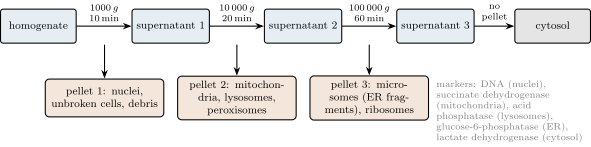
CoachCell fractionation separates the components of a cell for study. The tissue is homogenised — cells broken open in a cold, isotonic buffer by grinding or shearing, leaving the organelles intact — and the homogenate is subjected to differential centrifugation: a series of spins of increasing force and duration, each of which pellets the largest and densest particles remaining in suspension. Each fraction is identified by its appearance under the electron microscope and by marker enzymes, activities known to reside in one compartment only.