
Biology · Glossary

What is Diploid, haploid, meiosis?

Also known as: diploid · haploid · meiosis

Definition 23.1 High School Biology · Chapter 23 — Meiosis and Genetic Shuffling

A cell carrying two copies of each chromosome — one from each parent, the two forming a pair of homologous chromosomes — is diploid, written 2n2n (2n=462n = 46 in humans). A cell carrying one copy of each is haploid, written nn. Meiosis is the sequence of two divisions by which one diploid cell, after a single replication of its DNA, produces four haploid cells — the gametes, or their precursors. Fertilisation unites two haploid gametes and restores the diploid number: the alternation of meiosis and fertilisation is the cycle of every sexually reproducing species.
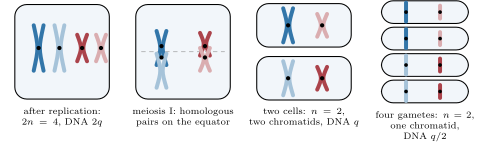
Meiosis in a cell with two pairs of chromosomes (2n = 4); dark and pale shades mark the two members of each pair, from the two parents. The first division separates the homologues, the second the chromatids. Here the dark long chromosome went with the pale short one: one of the two possible deals.
Meiosis in a cell with two pairs of chromosomes (2n=42n = 4); dark and pale shades mark the two members of each pair, from the two parents. The first division separates the homologues, the second the chromatids. Here the dark long chromosome went with the pale short one: one of the two possible deals.
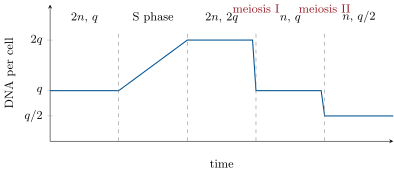
DNA per cell through meiosis. One replication, then two divisions without replication between them: the gametes hold a quarter of the DNA the mother cell held after S, and half of what a diploid cell holds at rest.

Examples

Example 23.3 (Human numbers)

A germ cell of the testis, 2n=462n = 46, replicates to 46 two-chromatid chromosomes (2q2q); after meiosis I, two cells of 23 two-chromatid chromosomes (qq); after meiosis II, four sperm cells of 23 single-chromatid chromosomes (q/2q/2). At fertilisation, 23+23=4623 + 23 = 46 and q/2+q/2=qq/2 + q/2 = q: the zygote is back to a diploid cell at rest. In the ovary, the same divisions produce one large egg cell and three tiny cells that are discarded; the arithmetic is identical.

Read in context →