High School Biology · Grades 10–12
23Meiosis and Genetic Shuffling
Two parents, each with 46 chromosomes, produce a child with 46 — not 92. Somewhere between the parents’ bodies and the child, the count is halved, and it is halved in a way that deals each child a hand no sibling has ever held: the same parents, forty years of children, and no two alike except identical twins. The halving is a special division called meiosis; the dealing is what it does with the chromosomes on the way. This chapter follows one cell through meiosis, counts the combinations it can produce, and reads the results of crosses that reveal, from the outside, what happened inside.
23.1 Halving the set
Definition 23.1 (Diploid, haploid, meiosis)
A cell carrying two copies of each chromosome — one from each parent, the two forming a pair of homologous chromosomes — is diploid, written ( in humans). A cell carrying one copy of each is haploid, written . Meiosis is the sequence of two divisions by which one diploid cell, after a single replication of its DNA, produces four haploid cells — the gametes, or their precursors. Fertilisation unites two haploid gametes and restores the diploid number: the alternation of meiosis and fertilisation is the cycle of every sexually reproducing species.
Proposition 23.2 (The two divisions)
Before meiosis the DNA is replicated: each chromosome has two chromatids. Then:
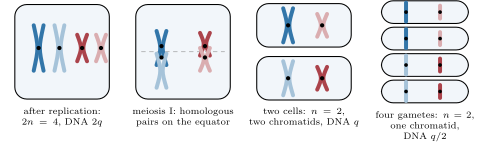
- First division (meiosis I, reductional): the homologous chromosomes pair up, two by two, on the equator; the members of each pair are pulled to opposite poles. Each daughter cell receives one chromosome of each pair, still made of two chromatids: chromosomes, DNA amount (the amount of a diploid cell before replication).
- Second division (meiosis II, equational): like a mitosis, the chromatids of each chromosome separate. Each of the four cells receives single-chromatid chromosomes, DNA amount .
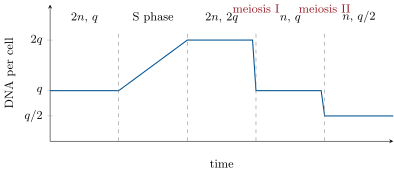
The first division halves the number of chromosomes; the second halves the amount of DNA back to one chromatid per chromosome.
Proof. Admitted at this level. ∎
Example 23.3 (Human numbers)
A germ cell of the testis, , replicates to 46 two-chromatid chromosomes (); after meiosis I, two cells of 23 two-chromatid chromosomes (); after meiosis II, four sperm cells of 23 single-chromatid chromosomes (). At fertilisation, and : the zygote is back to a diploid cell at rest. In the ovary, the same divisions produce one large egg cell and three tiny cells that are discarded; the arithmetic is identical.
23.2 The shuffle
Proposition 23.4 (Independent assortment)
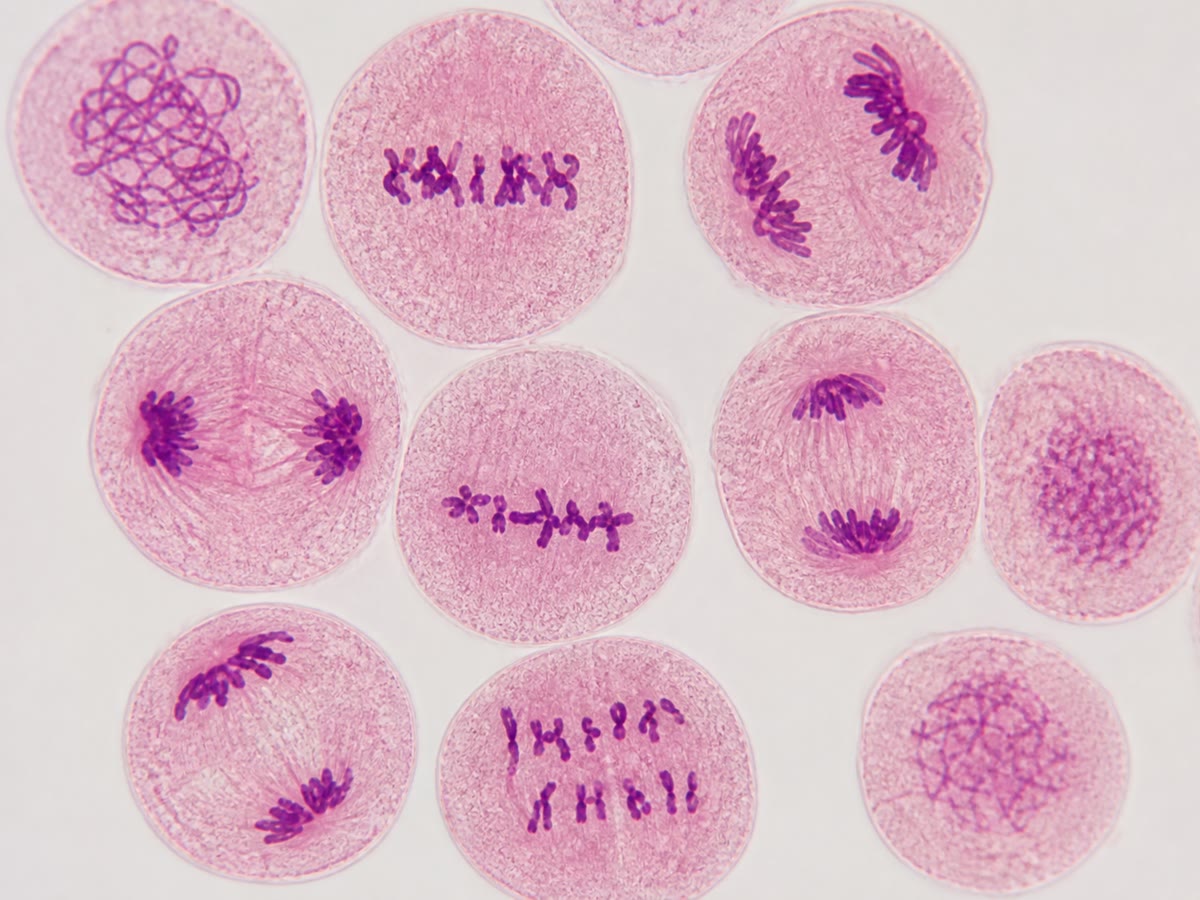
At metaphase I, each pair of homologues lines up on the equator independently of the other pairs: which member of a pair goes to which pole is decided by chance, pair by pair. A cell with pairs can therefore produce different combinations of paternal and maternal chromosomes in its gametes — in a human. Fertilisation, uniting two such gametes at random, yields combinations of chromosomes for one couple’s children, before any other source of variety is counted.
Proof. Admitted at this level. ∎
Proposition 23.5 (Crossing-over)
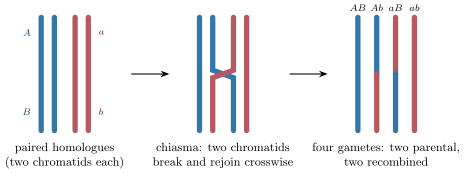
While the homologues are paired, early in meiosis I, two non-sister chromatids break at the same point and rejoin crosswise: a crossing-over. Each chromatid beyond the exchange point now carries the other homologue’s alleles. The chromosomes that reach the gametes are therefore not the parents’ chromosomes but recombined ones, mixing along their length the alleles received from the two grandparents. One to three exchanges occur on every pair at every meiosis, at variable positions: the number of possible gametes is, in practice, unlimited.
Evidence. Under the microscope, paired homologues in meiosis I show crossed points, chiasmata, where two chromatids visibly swap partners. Crosses in which two genes lie on the same chromosome give, among the offspring, a minority carrying new combinations of the two genes’ alleles — combinations neither parent carried — in a proportion that depends on the distance between the genes; genes far apart on a chromosome recombine as often as genes on different chromosomes. Molecular markers followed through families show the segments of each chromosome switching between grandparental origins at one or two points per chromosome per generation. ∎
Example 23.6 (Three sources of variety, in order)
A child of two parents is new in three ways: crossing-over rebuilt each chromosome of each gamete from the two grandparental copies; independent assortment dealt one recombined chromosome of each pair into the gamete, among deals; fertilisation joined one such gamete to another drawn from the other parent’s . Mutation, which created the alleles being shuffled, acts on a far slower timescale: the shuffle is what makes every generation new from the same deck.
23.3 Reading the shuffle in a cross
Method 23.7 (The test cross)
To see what gametes an individual makes, cross it with a partner carrying only recessive alleles (a test cross): each offspring then shows exactly the alleles the tested parent’s gamete carried. For two genes, with the tested parent and the partner :
- Count the four kinds of offspring: , , , (each also carrying from the partner).
- If the four are equally frequent (), the genes lie on different chromosomes and assort independently.
- If two kinds (the parental combinations) are much commoner than the other two (the recombinants), the genes lie on the same chromosome; the recombinants come from crossing-over, and their proportion measures the distance between the genes.
- Recombinants are always the minority and always come in two equal classes; parentals likewise.
Example 23.8 (Two crosses in the fruit fly)
Fly A, heterozygous for body colour and wing shape, test-crossed: 254 grey-normal, 248 black-vestigial, 251 grey-vestigial, 247 black-normal — four equal classes, the genes are on different chromosomes. Fly B, heterozygous for body colour and eye colour: 412 grey-red, 405 black-purple, 44 grey-purple, 39 black-red — two parental classes of about 45% each and two recombinant classes of about 5%: the genes are on the same chromosome, close together, separated by a crossing-over in 9% of meioses.

23.4 When the shuffle goes wrong
Proposition 23.9 (Errors of meiosis)
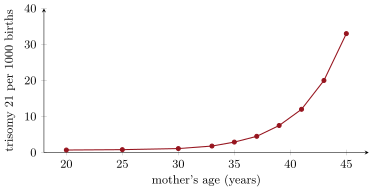
Occasionally a pair of homologues fails to separate at meiosis I, or two chromatids at meiosis II: one gamete receives two copies of a chromosome and another none. Fertilised, they give a zygote with three copies (trisomy) or one (monosomy). Most such zygotes do not develop; those that do carry a set of characteristic features. Trisomy 21 (about one birth in 700) causes intellectual disability and heart defects and is the commonest; its frequency rises steeply with the mother’s age. An unequal crossing-over — chromatids exchanging unequal segments — produces a chromosome with a duplicated gene and one with a deletion: the mechanism by which the opsin genes of Chapter 21 were multiplied, and by which new genes arise (Chapter 24).
Proof. Admitted at this level. ∎
Example 23.10 (Sex chromosomes miscounted)
A gamete with no sex chromosome fertilised by an X-bearing one gives an XO zygote: a girl of short stature whose ovaries do not develop. An XX egg fertilised by a Y sperm gives XXY: a boy whose testes stay small and make no sperm. In both, SRY decides the gonad as in Chapter 19; the number of X chromosomes decides much of the rest, which is why these are the mildest of the chromosomal errors.
Remark 23.11 (Why sex)
A bacterium copies itself; a rose can grow from a cutting. Sexual reproduction is costlier — two parents, meiosis, the search for a mate — and its product is a set of offspring each different from its parents and from each other. That difference is the point: in an environment that changes, and against parasites that evolve, a population of varied individuals is likelier to contain some that survive than a population of copies. The shuffle of this chapter is the raw material that the next two chapters’ selection will sort.
23.5 Exercises
Exercise 23.1 ★
Define diploid and haploid, and state what meiosis does to the chromosome number and to the DNA amount.
Solution
Solution of Exercise 23.1.
Diploid: two copies of each chromosome (); haploid: one (). Meiosis halves the chromosome number, from to , and reduces the DNA from (after replication) to per gamete.
Exercise 23.2 ★
What separates at meiosis I? At meiosis II? Which division is the reductional one?
Solution
Solution of Exercise 23.2.
Meiosis I separates the homologous chromosomes of each pair; meiosis II separates the two chromatids of each chromosome. The first is reductional.
Exercise 23.3 ★
A cell has and DNA at the start of meiosis. Give the chromosome number and DNA amount of the cells after meiosis I and after meiosis II.
Solution
Solution of Exercise 23.3.
After meiosis I: 4 chromosomes (two chromatids each), DNA . After meiosis II: 4 chromosomes (one chromatid each), DNA .
Exercise 23.4 ★
How many chromosome combinations can the gametes of a species with show by independent assortment alone?
Solution
Solution of Exercise 23.4.
.
Exercise 23.5 ★
What is a test cross, and what does the proportion of recombinant offspring reveal?
Solution
Solution of Exercise 23.5.
A cross with a partner carrying only recessive alleles, so that each offspring shows the tested parent’s gamete. The proportion of recombinants reveals whether two genes are on the same chromosome and, if so, how far apart.
Exercise 23.6 ★★
From the DNA figure, read the DNA per cell of a cell in meiosis I, of a cell between the two divisions, and of a gamete. Explain why there is no S phase between the divisions.
Exercise 23.7 ★★
A test cross gives 300 , 298 , 302 , 300 . Are the genes linked? What are the parent’s gametes?
Solution
Solution of Exercise 23.7.
Four equal classes: not linked, on different chromosomes. Gametes , , , , a quarter each.
Exercise 23.8 ★★
A test cross gives 460 , 455 , 42 , 43 . Are the genes linked? Which classes are recombinant, and what fraction do they make?
Solution
Solution of Exercise 23.8.
Linked: two large classes (, , parental) and two small (, , recombinant). Recombinants .
Exercise 23.9 ★★
In the crossing-over figure, which two gametes would you obtain if the exchange took place above both genes? Explain.
Exercise 23.10 ★★
From the trisomy figure, read the frequency at 25, 35 and 42 years, and compute the factor between 25 and 42.
Solution
Solution of Exercise 23.10.
About 0.8, 2.9 and 16 per 1000: a factor of 20 between 25 and 42.
Exercise 23.11 ★★
Explain how a non-disjunction at meiosis I differs from one at meiosis II in the gametes it produces (consider all four cells).
Solution
Solution of Exercise 23.11.
At meiosis I, both homologues go to one cell: two gametes with two copies and two with none. At meiosis II, both chromatids of one chromosome go to one cell: one gamete with two copies, one with none, and two normal.
Exercise 23.12 ★★★
Two genes on the same chromosome recombine in 2% of meioses; two others on the same chromosome in 48%. Explain what each figure says about their distance apart, and why the second pair behaves almost like independent genes.
Solution
Solution of Exercise 23.12.
Recombination is proportional to distance: 2% means the genes are very close, so an exchange rarely falls between them; 48% means far apart, with an exchange between them in nearly every meiosis. Since one exchange gives 50% recombinant gametes, distant linked genes recombine as freely as independent ones.
Exercise 23.13 ★★★
A plant has , one pair carrying and the other . List all the gametes of an plant with their frequencies, without crossing-over; then say what crossing-over would change.
Solution
Solution of Exercise 23.13.
, , , , a quarter each, by independent assortment of the two pairs. Crossing-over changes nothing for these genes: it recombines alleles along one chromosome, and these are on different ones.
Exercise 23.14 ★★★
Identical twins share all their alleles; ordinary siblings share half on average. Explain the "half" with meiosis and fertilisation, and why it is an average.
Solution
Solution of Exercise 23.14.
Each parent passes each child one of two alleles at every gene, chosen at random; at a given gene, two siblings received the same allele from a parent with probability . Over many genes the fraction shared averages , but for any one pair of siblings it varies around it.
Exercise 23.15 ★★★
Some plants reproduce by seeds formed without meiosis or fertilisation. Explain what their offspring are genetically, what such a plant gains, and what it loses in the long run.
Solution
Solution of Exercise 23.15.
Clones of the mother plant, genetically identical to it and to each other. The plant gains a fast, sure multiplication of a genotype that works here and now; it loses the variety that would let some descendants survive a change of environment or a new parasite.
23.6 Problem: The Geneticist’s Flies
Problem 23.1
Weekend problem — two genes followed through meiosis and a test cross: the gametes counted, linkage decided, the recombination measured, and the number of hands a couple can deal
In the fruit fly, the allele (black body) is recessive to (grey), and (vestigial wings) recessive to (normal). A grey, normal-winged female whose parents were pure grey-normal and pure black-vestigial is crossed with a black, vestigial male. Offspring: grey-normal 965, black-vestigial 944, grey-vestigial 206, black-normal 185.
Part I — The cross.
- Give the genotype of the female and of the male, gene by gene.
- What gametes does the male produce? Why does that make the cross a test cross?
- List the four gametes the female could produce, and the offspring each gives.
- Compute the percentage of each class among the 2300 offspring.
- Are the two genes on the same chromosome or on different ones? Justify from the proportions.
Part II — Inside the female’s meiosis.
- Which two classes are the parental combinations, and where do they come from in the female’s chromosomes?
- Which two are recombinant? By what event of meiosis I did they arise?
- Compute the recombination frequency (recombinants over the total). What fraction of the female’s meioses had a crossing-over between the two genes?
- Explain why the two recombinant classes are nearly equal, and why the two parental classes are.
- The same two genes, in a female whose parents were pure grey-vestigial and pure black-normal: predict the four classes and their frequencies.
Part III — A third gene. A third gene, (cinnabar eyes), is test-crossed with in another female: recombinants 9%. Test-crossed with : recombinants 8%.
- Is on the same chromosome as and ?
- Using the three recombination frequencies (17% for –, 9% for –, 8% for –), place the three genes in order along the chromosome.
- Explain why the frequencies add up (nearly), and what this says about the relation between recombination and distance.
- Two genes at opposite ends of a long chromosome give 50% recombinants. Explain why the frequency cannot exceed 50%.
- A fourth gene gives 50% recombinants with all three. What can you conclude, and what can you not?
Part IV — The size of the deck. The fruit fly has .
- How many chromosome combinations can a fly’s gametes show by independent assortment alone? And a fly couple’s offspring?
- With one crossing-over at a variable position on each pair, explain why the number of distinct gametes becomes practically unlimited.
- For a human couple, compute the number of chromosome combinations of their children by assortment alone, and compare with the number of humans who have ever lived (about ).
- Explain why two siblings are nevertheless more alike than two strangers, in terms of the alleles they can have received.
- State the result: the recombination frequency between and , what it measures, and the two mechanisms of meiosis that make every gamete of the female different.
Solution
Solution of Problem 23.1.
1. Female , , with on one chromosome and on the other (from her two pure parents). Male , .
2. Only gametes: the male contributes recessive alleles only, so each offspring’s phenotype reveals the female’s gamete.
3. (grey-normal), (black-vestigial), (grey-vestigial), (black-normal).
4. Grey-normal 42%, black-vestigial 41%, grey-vestigial 9%, black-normal 8%.
5. On the same chromosome: two large and two small classes instead of .
6. Grey-normal and black-vestigial: the combinations carried by her two homologues, inherited intact from her pure parents.
7. Grey-vestigial and black-normal, from a crossing-over between the two genes in prophase I.
8. . A crossing-over between the genes makes two of the four chromatids recombinant, so 17% recombinant gametes means an exchange in about 34% of meioses.
9. A single exchange produces the two recombinant chromatids together, one of each kind; and the two homologues go to the gametes equally, so the two parental classes match too.
10. Parental classes now grey-vestigial and black-normal, about 41.5% each; recombinants grey-normal and black-vestigial, about 8.5% each.
11. Yes: recombination well below 50% with both.
12. — — : 9 and 8 add up to 17.
13. The chance of an exchange in an interval is proportional to its length, so the frequencies of adjacent intervals add: recombination frequency measures distance along the chromosome.
14. One exchange gives two recombinant chromatids out of four: 50% at most; additional exchanges reshuffle but never raise the recombinant fraction above half.
15. It is on another chromosome or very far along the same one; the crosses cannot tell which.
16. gametes; combinations.
17. Every exchange produces chromosomes that never existed before, at a position that varies from one meiosis to the next; the number of distinct chromosomes, hence of gametes, has no practical limit.
18. : seven hundred times more combinations than the number of humans who have ever lived, and that before crossing-over.
19. Siblings draw their alleles from the same four sets (two per parent) and share, on average, half of them; strangers draw from different sets.
20. 17%, the fraction of the female’s gametes recombined between and , measures the distance between the genes; independent assortment of the pairs and crossing-over within each pair make every gamete different.