
Biology · Glossary

What is Chromosome, chromatid, karyotype?

Also known as: chromatid · centromere · karyotype

Definition 12.4 High School Biology · Chapter 12 — The Cell Cycle and Mitosis

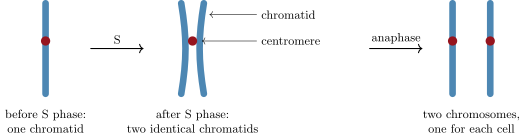
A chromosome is one DNA molecule with its packing proteins. Between divisions it is a loose, invisible thread; at the start of mitosis it coils into a compact rod visible under the light microscope. After replication each chromosome consists of two identical chromatids, joined at the centromere: the familiar X shape. The karyotype of a species is its complete set of chromosomes, photographed at metaphase and arranged in pairs by size: a human cell has 46, in 23 pairs, the members of a pair being homologous — same genes at the same positions, one from each parent.
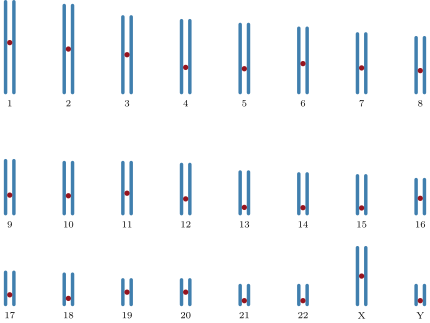
A human karyotype, schematically: the 22 pairs of ordinary chromosomes numbered by decreasing size, then the sex chromosomes — X and Y here, so a male. Each chromosome is drawn as its two chromatids, the centromere in red.
One chromosome through the cycle. Replication turns it into two chromatids joined at the centromere; anaphase separates them into two single-chromatid chromosomes, one for each daughter cell. The count of chromosomes changes only at anaphase.

Examples

Example 12.8 (Human numbers)

A human cell in metaphase holds 46 chromosomes and 92 chromatids; in anaphase, 92 chromosomes, 46 moving to each pole; each daughter, 46 chromosomes of one chromatid each, containing exactly the DNA the mother had at the start of its cycle.

Read in context →