
সব বই

পেশাদার

1 Markets I: The Ecosystem and Exchange-Traded Marketsবাজার অনলাইন 2 Markets II: Rates, FX and Creditবাজার অনলাইন 3 Markets III: Commodities, Energy and Cryptoবাজার অনলাইন 4 Quantitative Methodsপদ্ধতি অনলাইন 5 Derivatives and Volatilityডেরিভেটিভস অনলাইন 6 Rates, Credit, XVA and Riskসুদহার, ঋণ ও ঝুঁকি অনলাইন 7 Research Craft: Predictors, Backtests, Measurement, Portfoliosগবেষণা অনলাইন 8 Strategies I: Equities and Futuresকৌশল অনলাইন 9 Strategies II: Volatility, Relative Value, Macro and the Bank Desksকৌশল অনলাইন 10 Microstructure and Executionএক্সিকিউশন অনলাইন 11 Market Making and High-Frequency Tradingমার্কেট মেকিং অনলাইন 12 Machine Learning for Marketsমেশিন লার্নিং অনলাইন 13 Low-Latency Softwareপ্রযুক্তি অনলাইন 14 Networks, Hardware and Trading Infrastructureপ্রযুক্তি অনলাইন 15 Research, Data and Risk Platformsপ্রযুক্তি অনলাইন 16 The Desk and the Firmপ্রতিষ্ঠান অনলাইন 17 The Industry: Firms, Roles and Careersক্যারিয়ার অনলাইন 18 Interviews I: Maths, Probability and Speedক্যারিয়ার অনলাইন 19 Interviews II: Markets, Trading Games and the Final Roundক্যারিয়ার অনলাইন 20 Interviews III: Codeক্যারিয়ার অনলাইন
অ্যাপ পরিচিতি Coach সাইন ইন পড়া শুরু করো

বইগুলো এখনো বাংলা ভাষায় পাওয়া যায় না — ইংরেজি সংস্করণ দেখানো হচ্ছে।

Biology · পরিভাষা

Diploid, haploid, meiosis কী?

অন্য নাম: diploid · haploid · meiosis

Definition 23.1 High School Biology · অধ্যায় 23 — Meiosis and Genetic Shuffling

A cell carrying two copies of each chromosome — one from each parent, the two forming a pair of homologous chromosomes — is diploid, written 2n2n (2n=462n = 46 in humans). A cell carrying one copy of each is haploid, written nn. Meiosis is the sequence of two divisions by which one diploid cell, after a single replication of its DNA, produces four haploid cells — the gametes, or their precursors. Fertilisation unites two haploid gametes and restores the diploid number: the alternation of meiosis and fertilisation is the cycle of every sexually reproducing species.
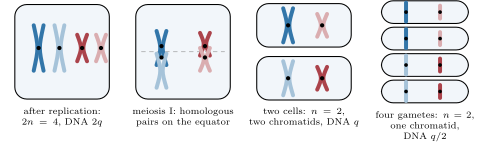
Meiosis in a cell with two pairs of chromosomes (2n = 4); dark and pale shades mark the two members of each pair, from the two parents. The first division separates the homologues, the second the chromatids. Here the dark long chromosome went with the pale short one: one of the two possible deals.
Meiosis in a cell with two pairs of chromosomes (2n=42n = 4); dark and pale shades mark the two members of each pair, from the two parents. The first division separates the homologues, the second the chromatids. Here the dark long chromosome went with the pale short one: one of the two possible deals.
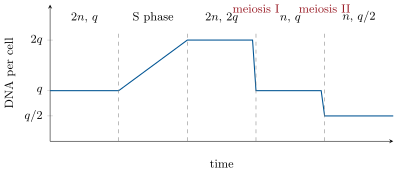
DNA per cell through meiosis. One replication, then two divisions without replication between them: the gametes hold a quarter of the DNA the mother cell held after S, and half of what a diploid cell holds at rest.

উদাহরণ

Example 23.3 (Human numbers)

A germ cell of the testis, 2n=462n = 46, replicates to 46 two-chromatid chromosomes (2q2q); after meiosis I, two cells of 23 two-chromatid chromosomes (qq); after meiosis II, four sperm cells of 23 single-chromatid chromosomes (q/2q/2). At fertilisation, 23+23=4623 + 23 = 46 and q/2+q/2=qq/2 + q/2 = q: the zygote is back to a diploid cell at rest. In the ovary, the same divisions produce one large egg cell and three tiny cells that are discarded; the arithmetic is identical.

প্রসঙ্গসহ পড়ো →