Coach
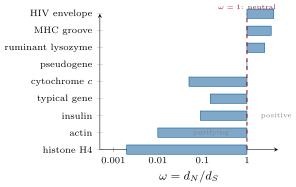
CoachIn a protein-coding gene a substitution is synonymous if it leaves the amino acid unchanged and nonsynonymous if it changes it. Because the genetic code lets most third positions and some first positions change silently, about a quarter of the possible mutations in a typical gene are synonymous. Let be the number of synonymous substitutions per synonymous site and the nonsynonymous substitutions per nonsynonymous site, each corrected for multiple hits. Synonymous changes are close to neutral, so estimates — the clock; and the ratio
measures what selection has done to the protein: if amino-acid changes are as free as silent ones (no constraint, as in a pseudogene); under purifying selection, most changes being removed — the typical gene has to , histones ; under positive selection, amino-acid changes being favoured faster than drift alone allows — the antigen-binding groove of MHC molecules, the surface proteins of viruses in an arms race with antibodies, the sperm and egg proteins of fertilisation, and the lysozyme of ruminants, which was recruited to digest bacteria in the stomach. Computed along one branch of a tree or site by site, maps where and when a protein was changed by selection rather than by chance.