Coach
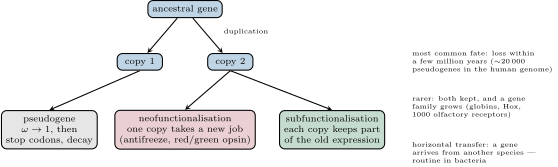
CoachMost new genes are copies of old ones. A gene duplication — by unequal crossing-over, retrotransposition, or the doubling of a whole genome, as happened twice at the origin of vertebrates and again in the ancestor of teleost fish and in many plant lineages — leaves two paralogues where there was one; genes in different species descended from a single ancestral gene are orthologues. The copy’s usual fate is decay: freed from constraint () it accumulates a stop codon or a frameshift and becomes a pseudogene, of which the human genome carries some twenty thousand. Sometimes both survive: by neofunctionalisation, one copy acquiring a new function while the other keeps the old (the antifreeze glycoprotein of icefish, from a trypsinogen gene; the red and green opsins of primates, from a duplication forty million years ago that gave the trichromatic vision the Year 1 volume described; the lens crystallins, from metabolic enzymes); or by subfunctionalisation, each copy keeping part of the ancestor’s expression or activity so that both are needed. Repeated duplication builds gene families — the globins, the Hox clusters of the development chapter, the thousand olfactory receptor genes of a mouse, a third of them pseudogenes in humans. The other source of new genes is horizontal transfer: bacteria acquire genes from unrelated bacteria by plasmids, phages and free DNA, which is how antibiotic resistance crosses species in a hospital and why a bacterium’s “species” is a core genome surrounded by a shifting cloud; in eukaryotes transfer is rarer but real — the T-DNA Agrobacterium inserts into plants, bacterial genes in bdelloid rotifers, and the ancient wholesale transfers that were the mitochondrion and the chloroplast. Where transfer is common the history of life is a network, and the tree drawn from any one gene is the tree of that gene.