Biology · Glossary

What is Electron carriers?

Definition 15.2 University Biology — Year 1 · Chapter 15 — Cellular Respiration and Fermentation

NAD+\mathrm{NAD^+} (nicotinamide adenine dinucleotide) accepts two electrons and one proton from a substrate to become NADH; FAD accepts two electrons and two protons to become FADH2\mathrm{FADH_2}. Both are coenzymes of dehydrogenases, and both are recycled: reduced by catabolism, re-oxidised by the respiratory chain. A cell holds only micromoles of them, turning over thousands of times an hour. Their redox potentials, E0=0.32VE'_0 = -0.32\,\mathrm{V} for NAD+/NADH\mathrm{NAD^+}/\mathrm{NADH}, place them far below oxygen (+0.82V+0.82\,\mathrm{V}): each pair of electrons NADH hands to oxygen releases ΔG=2FΔE=220kJ/mol\Delta G^{\circ\prime} = -2F\Delta E = -220\,\mathrm{kJ}/\mathrm{mol}, enough for more than four ATP.

The three stages of respiration. Glycolysis and the Krebs cycle strip the electrons of glucose onto NADH and FADH_2; oxidative phosphorylation cashes them in.
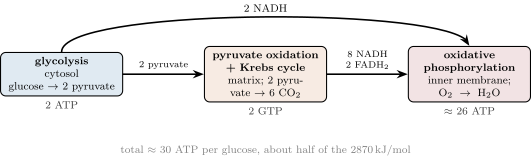
The three stages of respiration. Glycolysis and the Krebs cycle strip the electrons of glucose onto NADH and FADH2\mathrm{FADH_2}; oxidative phosphorylation cashes them in.
Read in context →