 Coach
CoachThe embryo of an animal forms two or three layers of cells, the germ layers, from which all tissues derive: the outer ectoderm (skin, nervous system), the inner endoderm (lining of the gut and its outgrowths) and, in all but the sponges and cnidarians, a middle mesoderm (muscle, skeleton, connective tissue, blood, kidneys, gonads). Cnidarians are diploblastic, the rest triploblastic. Among triploblastic animals, the mesoderm may fill the space between gut and body wall (acoelomate: flatworms), or leave a cavity between them: a coelom when the cavity is entirely lined by mesoderm (annelids, molluscs, arthropods, echinoderms, vertebrates). The coelom suspends the gut in its own compartment, lets it move independently of the body wall, and gives the soft-bodied a hydrostatic skeleton.
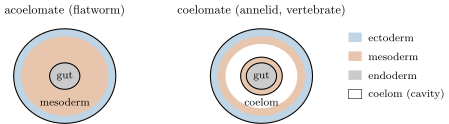
Examples
Example 4.12 (Where the tissues come from)
Epithelia derive from all three germ layers (skin from ectoderm, gut lining from endoderm, the lining of vessels and of the coelom from mesoderm); connective tissue, muscle and blood from mesoderm; nervous tissue from ectoderm. The frog’s skin is an ectodermal epithelium on mesodermal connective tissue; its gut, an endodermal epithelium wrapped in mesodermal muscle; its brain, ectoderm folded inward.