 Coach
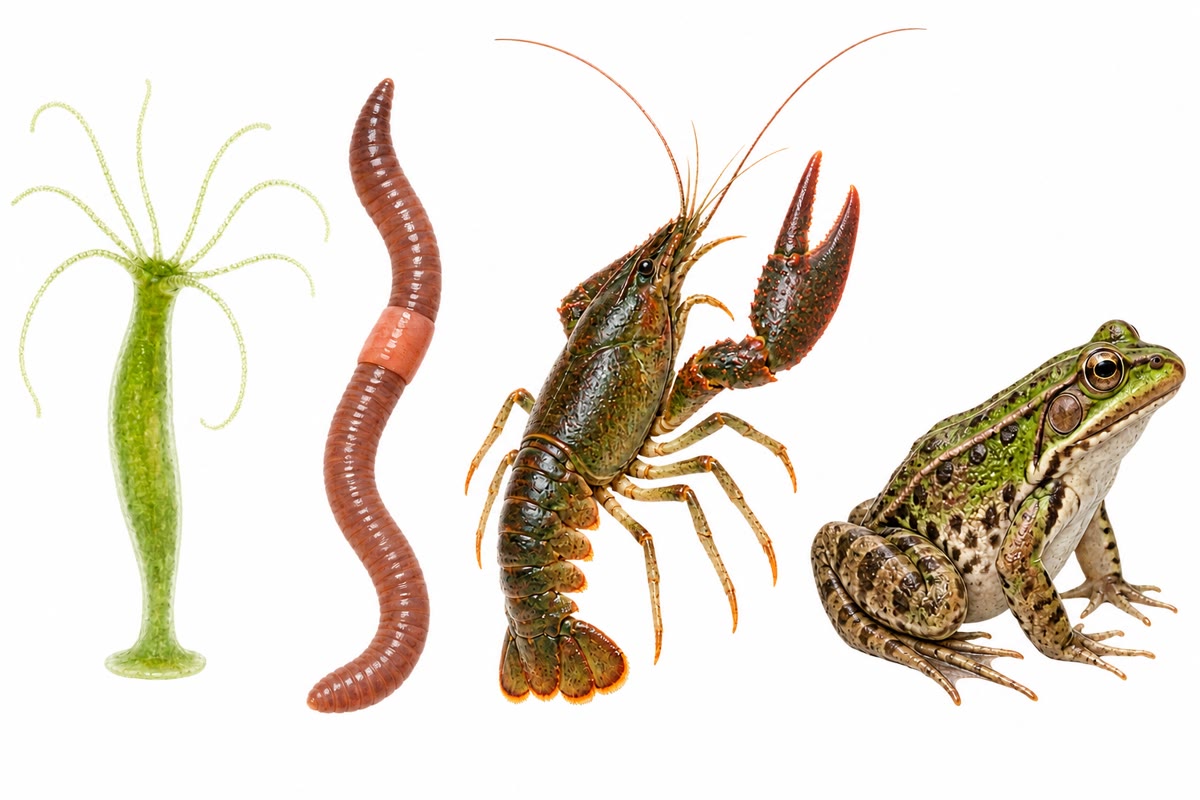
CoachA body is segmented when it is built of repeated units along its axis (the rings of an earthworm, the segments of a crayfish, the vertebrae and muscle blocks of a fish), each with its own set of muscles, nerves and often appendages. Segments may be alike or specialised into regions (head, thorax, abdomen). The skeleton, against which the muscles pull, is hydrostatic (a fluid under pressure in a coelom, as in the earthworm), an exoskeleton (a rigid cuticle outside the body, jointed, moulted to grow, as in arthropods), or an endoskeleton (cartilage or bone inside the body, growing with it, as in vertebrates).
Examples
Example 4.6 (Reading an animal from its plan)
An animal with a head end, a through gut, a body of similar rings and no hard parts: a coelomate protostome moving by a hydrostatic skeleton, each segment’s coelomic fluid pressurised by circular and longitudinal muscles in turn — an earthworm burrowing. An animal with a jointed cuticle and specialised segments: an arthropod, whose growth must pass through moults. Bilateral, segmented muscle blocks around a dorsal axis of vertebrae: a vertebrate, whose endoskeleton grows continuously.