 Coach
CoachAn inhibitor lowers the rate of an enzyme. Irreversible inhibitors bind covalently and destroy the enzyme’s activity for good (nerve agents on acetylcholinesterase, penicillin on the enzyme that cross-links the bacterial wall, aspirin on the enzyme that makes prostaglandins). Reversible inhibitors bind by weak bonds and can be washed away; by where they bind:
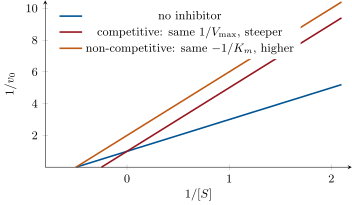
- competitive: the inhibitor resembles the substrate and occupies the active site; it raises the apparent (by the factor ) and leaves unchanged — enough substrate displaces it;
- non-competitive: the inhibitor binds elsewhere and spoils the catalysis whether or not substrate is bound; it lowers and leaves unchanged — no amount of substrate overcomes it;
- uncompetitive: the inhibitor binds only the complex; both and fall.
, the dissociation constant of the inhibitor, measures its potency: the lower, the stronger.
Examples
Example 13.10 (Competition as medicine)
Methanol is harmless until the liver’s alcohol dehydrogenase turns it into formaldehyde and formic acid, which blind and kill. The treatment is ethanol: a competing substrate with a lower , which keeps the enzyme busy while the methanol is excreted unchanged. Statins are competitive inhibitors, resembling the transition state, of the enzyme that commits carbon to cholesterol; sulfonamides resemble the substrate of a bacterial enzyme that makes folate, which humans do not make and so do not miss.