 Coach
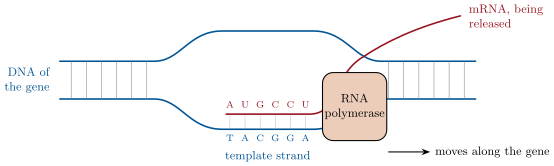
CoachRNA (ribonucleic acid) is a single-stranded chain of nucleotides like those of DNA, except that its sugar is ribose and the base uracil (U) replaces thymine (T). Transcription is the copying of a gene’s sequence into a molecule of messenger RNA (mRNA): the enzyme RNA polymerase opens the double helix along the gene, reads one strand (the template strand) and assembles the complementary RNA, U facing A, A facing T, G facing C and C facing G. The mRNA has the sequence of the gene’s other strand, with U for T; it leaves the nucleus for the cytoplasm.
Examples
Example 14.4 (A transcript)
Template strand 3’-TAC GGA CTT ATC-5’ gives the mRNA 5’-AUG CCU GAA UAG-3’. The gene’s other strand reads 5’-ATG CCT GAA TAG-3’: the mRNA is that strand’s sequence with U for T, which is why gene sequences are conventionally written as that strand, the coding strand.