High School Biology · Grades 10–12
3DNA: A Universal Genetic Molecule
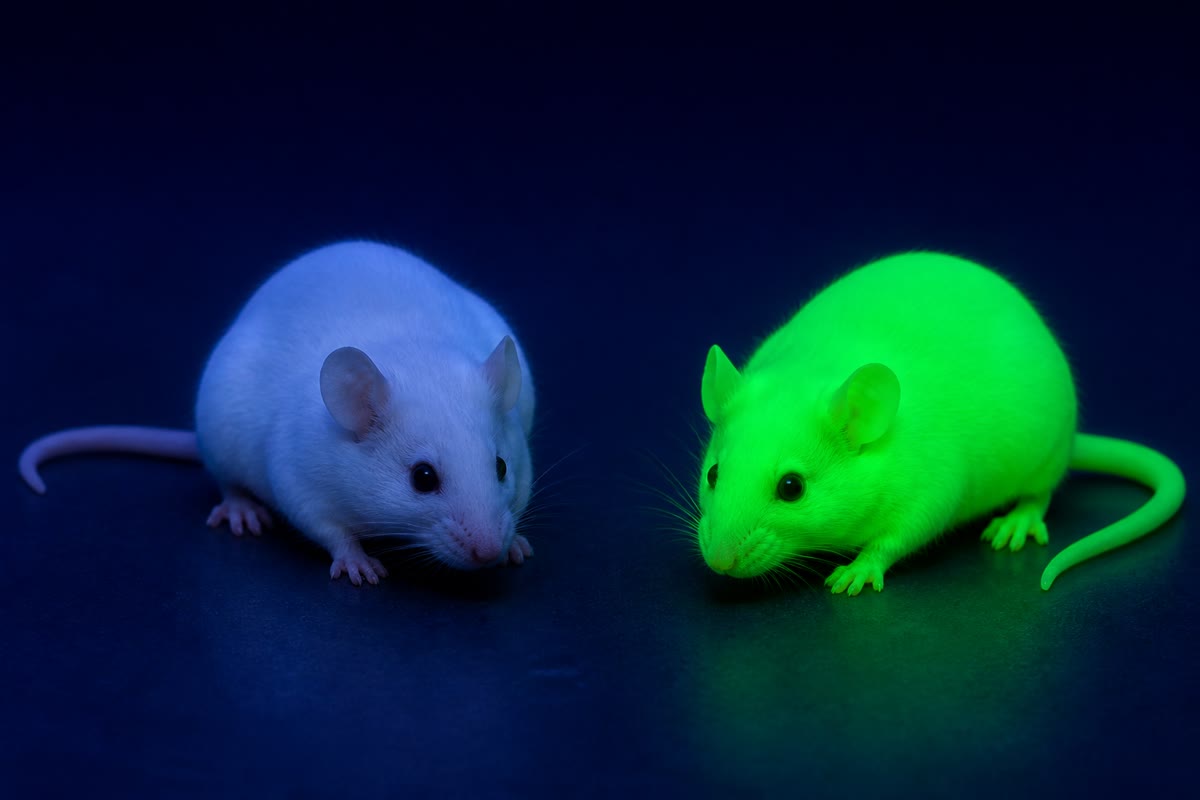
In a darkened laboratory, under a blue lamp, one of two white mice glows green from nose to tail. It carries, in every one of its cells, a single gene taken from a jellyfish that lights up in the Pacific — and the mouse’s cells read that jellyfish gene exactly as the jellyfish’s cells do. The experiment works because every living thing writes its genes in the same molecule, with the same four letters, and reads them by the same rules. This chapter is about that molecule, DNA: how it is built, what its structure explains, and what the glowing mouse proves.
3.1 The genetic material
Definition 3.1 (Genetic information)
The genetic information of a cell is the set of instructions, transmitted from a cell to its daughter cells and from parents to offspring, that determines the traits of the organism and the proteins its cells can make. In every living thing it is carried by molecules of DNA (deoxyribonucleic acid), packed with proteins into the chromosomes — in the nucleus of a eukaryotic cell, free in the cytoplasm of a bacterium.
Proposition 3.2 (DNA is the molecule of heredity)
The hereditary material of a cell is its DNA, not its proteins or any other constituent: transferring purified DNA from one strain of bacteria to another transfers the first strain’s traits.
Evidence. Griffith (1928) found that harmless pneumonia bacteria, mixed with killed cells of a deadly strain, became deadly and stayed so through generations: something from the dead cells had "transformed" them. Avery, MacLeod and McCarty (1944) separated the extract of the dead cells into its families of molecules and tested each one: only the DNA fraction transformed; treating the extract with an enzyme that destroys DNA abolished the effect, while enzymes destroying proteins or RNA did not. The transforming substance, and hence the carrier of the heritable trait, was DNA. ∎
Example 3.3 (Where the DNA is)
A dye specific for DNA stains the nucleus of a cheek cell and nothing else in the cytoplasm; in a dividing cell it stains the compact chromosomes. A bacterium takes up the dye in a central region without an envelope. In both, the amount of DNA doubles before each division and is halved between the two daughter cells — the behaviour expected of information that must be copied and shared.
3.2 The structure of DNA
Definition 3.4 (Nucleotide)
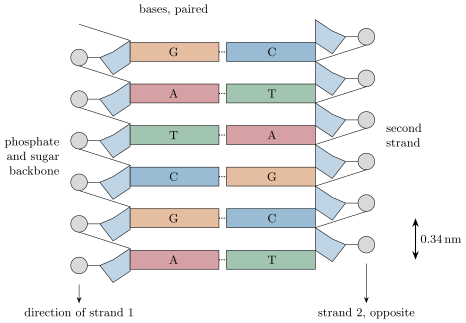
DNA is a chain of nucleotides. Each nucleotide is made of three parts: a phosphate group, a sugar (deoxyribose) and one of four nitrogen-containing bases: adenine (A), thymine (T), guanine (G) and cytosine (C). Sugars and phosphates alternate to form the backbone of the chain; the bases stick out from it, one per nucleotide. The four nucleotides differ only by their base, so a strand of DNA is described by the sequence of its bases, written as a string of letters: ATGGCTTAC…
Proposition 3.5 (The double helix)
A DNA molecule is made of two strands wound around each other in a right-handed double helix about wide, with one turn every ten base pairs (). The strands run in opposite directions and face each other by their bases, which pair according to a strict rule of complementarity: A pairs only with T, G only with C. The sequence of one strand therefore fixes the sequence of the other.
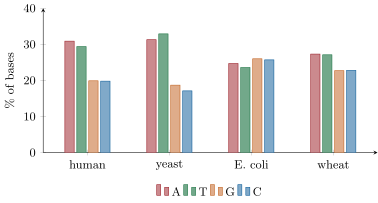
Evidence. Chargaff (1950) measured the base composition of DNA from many species and found, in every one, as much A as T and as much G as C, while the proportion of A+T to G+C varied from species to species — a pairing rule, not a chemical accident. Franklin’s X-ray photographs of DNA fibres (1952) showed the signature of a helix of diameter and pitch. Watson and Crick (1953) built the only model that fits both: two backbones outside, paired bases inside, A–T and G–C pairs having the same width so that the helix is regular. ∎
Example 3.6 (Chargaff’s rule in numbers)
Human DNA: A 30.9%, T 29.4%, G 19.9%, C 19.8% — AT and GC to within the precision of the measurement, and A+T . E. coli: A 24.7%, T 23.6%, G 26.0%, C 25.7%, A+T . Yeast: A+T . If a DNA sample contains 32% of A, complementarity predicts 32% of T and each of G and C.
Method 3.7 (Writing the complementary strand)
Given one strand, write under each base its partner (AT, GC), then read the result in the opposite direction if the convention of the exercise requires it. For 5’-ATGGCTTAC-3’ the partner strand, read in its own direction, is 5’-GTAAGCCAT-3’. Counting: a strand with adenines faces a strand with thymines, so in the whole molecule and .
Proposition 3.8 (What the structure explains)
Two properties of the genetic material follow from the structure.
- Information: the order of the bases along a strand is not constrained by the chemistry — any sequence is possible — so the sequence can carry a message, as the order of letters carries a text. A human cell holds base pairs in each set of chromosomes.
- Copying: since each strand determines the other, the molecule can be duplicated by separating the strands and building a new partner on each. The mechanism is the subject of Chapter 11.
Proof. Admitted at this level. ∎
3.3 Genes, alleles, chromosomes
Definition 3.9 (Gene and allele)
A gene is a segment of a DNA molecule — typically some thousands of base pairs — whose sequence carries the instructions for making one protein (or, sometimes, one working molecule of RNA). It occupies a fixed position on a given chromosome. The versions of a gene that differ by a few bases are its alleles: same position, same function, slightly different sequence, hence often a slightly different protein.
Example 3.10 (Numbers)
The human genome — one complete set of chromosomes — carries base pairs and about genes; genes occupy only a few per cent of the sequence. A cell of E. coli carries one circular DNA molecule of base pairs and about 4300 genes. Two unrelated humans differ at roughly one base in a thousand: some three million positions, most of them outside genes and of no consequence, a few of them alleles that change a trait.
Proposition 3.11 (Chromosomes)
A chromosome is one DNA molecule, wound around packing proteins and coiled on itself. Stretched out, the DNA of one human chromosome would be from to long; the 46 chromosomes of a cell together hold about of DNA in a nucleus across. Chromosomes are visible as separate bodies only during cell division, when they are coiled most tightly; between divisions they are unwound and fill the nucleus as a tangle.
Proof. Admitted at this level. ∎
3.4 One molecule for all living things
Proposition 3.12 (Universality of DNA)
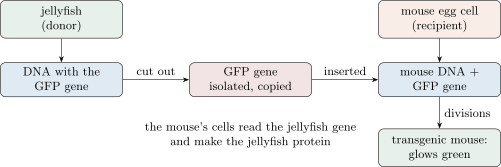
All living things — bacteria, fungi, plants, animals — carry their genetic information as DNA built from the same four nucleotides, and read a gene’s sequence by the same rules. Consequently a gene taken from one species and inserted into the DNA of another is read by the recipient’s cells, which make the protein it codes for: transgenesis is possible, and the transgenic organism passes the foreign gene to its descendants like any other.
Evidence. The gene for the green fluorescent protein (GFP) of the jellyfish Aequorea victoria has been inserted into bacteria, yeast, plants, fish, mice and rabbits: every one of them makes the protein and glows green under blue light, and the trait is inherited. The human gene for insulin, inserted into E. coli in 1978, makes the bacterium produce human insulin, which has been the source of the hormone for diabetics ever since. No case is known of a species whose genes are written in another chemistry. ∎
Example 3.13 (Uses of transgenesis)
Human insulin and growth hormone from bacteria; a gene for resistance to an insect pest inserted into maize or cotton; rice carrying genes for making a precursor of vitamin A; the GFP gene attached to another gene so that the cells where that gene is active light up under the microscope — the last use, a research tool, is the commonest of all. Each use raises its own questions of safety and of consequences for the environment; each rests on the same fact, the universality of the genetic molecule.
Remark 3.14 (Unity and diversity, at the molecular level)
The universality of DNA is the molecular face of the unity of life met in Chapter 1: one chemistry, one information molecule, one reading system for every organism on Earth, which is what a common origin predicts (Chapter 6). The diversity of life is written in the same molecule too, as differences of sequence: between two alleles a few bases, between two species a few per cent of the genome, between a bacterium and a human the whole organisation of the text.
3.5 Exercises
Exercise 3.1 ★
Name the three parts of a nucleotide and the four bases of DNA.
Solution
Solution of Exercise 3.1.
A phosphate group, a sugar (deoxyribose) and a base. Bases: adenine, thymine, guanine, cytosine.
Exercise 3.2 ★
Write the strand complementary to TACGGATTCA.
Solution
Solution of Exercise 3.2.
ATGCCTAAGT, written base under base.
Exercise 3.3 ★
A DNA sample contains 21% guanine. Give the percentages of C, A and T.
Solution
Solution of Exercise 3.3.
C ; A T each.
Exercise 3.4 ★
Define gene and allele in one sentence each, using the word "sequence".
Exercise 3.5 ★
What is a transgenic organism? Give two examples from the chapter.
Exercise 3.6 ★★
A gene is 1500 base pairs long. What is its length in nanometres, and how many turns of the helix does it make?
Solution
Solution of Exercise 3.6.
; turns.
Exercise 3.7 ★★
Compute the total length of the DNA in one human cell, given base pairs per set of chromosomes and two sets per cell. Compare with the diameter of the nucleus, .
Exercise 3.8 ★★
In Avery’s experiment, why was it necessary to test the extract treated with a DNA-destroying enzyme, and not only the purified DNA fraction?
Solution
Solution of Exercise 3.8.
A "purified" fraction might still contain traces of other molecules, so its activity alone does not prove that DNA is responsible. Destroying DNA specifically, in the complete extract, and seeing the activity vanish while protein- and RNA-destroying enzymes leave it intact, pins the effect on DNA and on nothing else.
Exercise 3.9 ★★
Explain why Chargaff’s data ruled out a model in which the bases were stacked in a regular repeating order such as ATGCATGC…
Solution
Solution of Exercise 3.9.
A fixed repeat would give the same composition (25% of each base) in every species. Chargaff found A+T ranging widely between species: the order of bases is not a fixed pattern, so the sequence is free to vary — which is what makes it capable of carrying information.
Exercise 3.10 ★★
Two alleles of a gene differ by a single base among 2000. Explain how such a small difference can change a protein, and why it may also change nothing.
Solution
Solution of Exercise 3.10.
The sequence is read in order to build the protein; a changed base at a position that specifies an amino acid can substitute one amino acid for another and alter the protein’s shape or activity. If the changed base lies in a part of the gene that is not read, or specifies the same amino acid, the protein is unchanged.
Exercise 3.11 ★★
The GFP gene inserted into a mouse’s fertilised egg is found in its skin cells, its liver cells and its sperm cells. Explain why, using the cell theory and Proposition 3.8.
Solution
Solution of Exercise 3.11.
All the cells of the mouse descend by division from the fertilised egg; at each division the DNA, transgene included, is copied (complementarity) and shared. Skin, liver and sperm cells therefore all carry the gene — and the sperm passes it to the next generation.
Exercise 3.12 ★★★
A bacterium’s DNA molecule is base pairs long. Compute its length; compare with the of the cell; then explain why a bacterium can nevertheless have room for it.
Exercise 3.13 ★★★
A friend claims that human DNA must be "more complex" than a bacterium’s because it has more bases. Compare and base pairs with and 4300 genes, and discuss what the extra DNA is and is not.
Solution
Solution of Exercise 3.13.
Human DNA is 700 times longer but carries only about 5 times more genes: most of it is not genes. Part of the extra DNA regulates when genes are used, part is repeated sequence with no known function. Base count measures the size of the text, not the complexity of the organism; the number of genes and, above all, how they are combined and regulated matter more.
Exercise 3.14 ★★★
Suppose a species were discovered whose genetic material used a different molecule and a different code. Which of the chapter’s propositions would it contradict, and what would it imply for the common origin of that species and the rest of life?
Solution
Solution of Exercise 3.14.
It would contradict the universality of DNA (Proposition 3.12). Since a shared molecule and code are inherited from a common ancestor, such a species would have to descend from a separate origin of life: its genes could not be read by our cells and transgenesis between the two lines would be impossible.
Exercise 3.15 ★★★
Human insulin produced by bacteria replaced insulin extracted from pig pancreases. List two biological reasons why the bacterial product was an improvement, and one question a regulator would still have to ask.
Solution
Solution of Exercise 3.15.
The bacterial product is the exact human protein (pig insulin differs by one amino acid and can provoke immune reactions), and it is made in unlimited quantity, free of pig pathogens. A regulator would still ask whether the purified protein is free of bacterial contaminants and whether it is correctly folded and active.
3.6 Problem: The Jellyfish Gene
Problem 3.1
Weekend problem — one gene from a jellyfish followed into a mouse: its length, its letters, why the mouse can read it, and the two metres of DNA that carry it in every cell
The green fluorescent protein of the jellyfish Aequorea victoria is a chain of 238 amino acids. Its gene, as used in the laboratory, is a DNA segment of 720 base pairs. Take per base pair, ten base pairs per turn, and a mouse genome of base pairs per set of chromosomes, two sets per cell.
Part I — The molecule.
- Compute the length of the GFP gene in nanometres, and the number of turns of helix it makes.
- One strand of the gene begins
ATGAGTAAAGGAGAAGAAC. Write the complementary strand. - In the whole gene, adenine represents 27% of the bases. Give the percentages of the other three bases.
- The gene has 720 base pairs and codes for 238 amino acids. Compute the ratio, and propose what it suggests about how many bases specify one amino acid (a hypothesis that Chapter 14 will confirm).
- How many different sequences of 720 bases are possible in principle? Write the answer as a power of 4, then explain in one sentence why the sequence can be called information.
Part II — Why the mouse can read it.
- State the property of DNA that makes it possible for a mouse cell to use a jellyfish gene.
- The gene is inserted into a fertilised egg rather than into the skin of an adult mouse. Using the cell theory, explain what difference this makes to where the gene ends up.
- The adult mouse glows in every tissue. What does this show about the DNA content of its different cell types?
- The glowing mouse is mated with an ordinary mouse. Predict, with a reason, whether some of the offspring glow.
- A control mouse is injected with purified GFP protein instead of the gene: it glows faintly for a few days, then stops. Explain the difference between the two experiments.
Part III — The evidence behind the story.
- In Avery’s experiment, name the fraction that transformed the bacteria and the treatment that abolished transformation.
- Explain why the transformation experiment is a natural version of transgenesis.
- Chargaff found AT and GC in every species but A+T varying from 25% to 75%. Which of the two observations supports base pairing, and which shows that the sequence is free?
- Franklin’s photographs gave the diameter of the helix as . Explain why pairing a large base with a small one (A with T, G with C) rather than two large ones makes the helix regular.
- Why did the discovery of the structure immediately suggest how DNA is copied?
Part IV — Two metres in a nucleus.
- Compute the total length of DNA in one mouse cell.
- The nucleus is across. By what factor must the DNA be shortened by coiling to fit?
- What fraction of the cell’s DNA is the GFP gene?
- A mouse has about genes averaging base pairs including their non-coding parts. What fraction of the genome do genes occupy?
- State the result in one sentence: how much DNA does a mouse cell carry, and what single fact about that DNA allows one jellyfish gene among its thousands to be read?
Solution
Solution of Problem 3.1.
1. ; turns.
2. TACTCATTTCCTCTTCTTG.
3. T ; G C .
4. : three bases per amino acid (the last three signal the end of the chain).
5. sequences, about . The chemistry allows any order, so the particular order chosen among all these possibilities is a message — information.
6. Universality: every living thing uses the same four nucleotides and reads a sequence by the same rules.
7. All the mouse’s cells descend from the egg by division, so a gene inserted in the egg is copied into every cell. Inserted into adult skin, it would be present only in the treated skin cells and their descendants.
8. Every cell type contains the whole DNA, transgene included: specialisation does not discard genes.
9. Yes: the germ cells carry the gene. If the mouse has one copy on one chromosome of a pair, about half its offspring inherit it and glow.
10. The protein is not information: it is used up and never renewed, so the glow fades. The gene is copied at every division and read continuously, so the glow is permanent and inherited.
11. The DNA fraction; treatment with an enzyme that destroys DNA.
12. Bacteria took up DNA from another strain, integrated it and expressed and transmitted the trait: a gene transferred from one organism to another, which is what transgenesis does deliberately.
13. AT and GC support pairing; the variable A+T share shows that the order of the pairs is free.
14. A and G are large two-ring bases, T and C small one-ring bases: a large paired with a small one always spans the same distance, so the two backbones stay apart along the whole molecule. Two large bases would bulge, two small ones leave a gap.
15. Because each strand is the complement of the other: separate them, build a partner on each by the pairing rule, and two identical molecules result.
16. .
17. : a three-hundred-thousand-fold compaction.
18. : about one ten-millionth of the cell’s DNA.
19. base pairs, about 22% of the genome; the rest lies between genes.
20. A mouse cell carries about of DNA; because that DNA is built and read exactly as the jellyfish’s, the one foreign gene among twenty thousand is read like the others.