 Coach
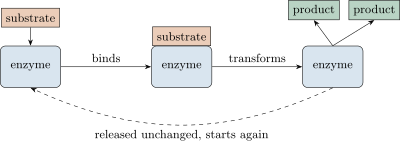
CoachThe metabolism of a cell is the set of all the chemical reactions that take place inside it: those that break molecules down to release energy, and those that build the cell’s own molecules from simpler ones. Every reaction of metabolism is driven by an enzyme, a protein that speeds up one specific reaction without being consumed by it.
Examples
Example 4.3 (One enzyme at work)
Pour hydrogen peroxide on a piece of raw liver or potato: it froths violently as oxygen is released. The enzyme catalase, present in almost every cell, splits the toxic peroxide into water and oxygen at a rate of millions of molecules per second per enzyme molecule. Boil the liver first and nothing happens: the enzyme, a protein, has been destroyed by heat. Bubble-free peroxide on a stone shows the reaction does not run by itself.
Example 4.6 (Euglena, both at once)
The single-celled Euglena has chloroplasts and swims with a flagellum. In the light, in mineral water, it grows: autotroph. In the dark it survives only if organic molecules are added to the water, which it absorbs: heterotroph. Kept long in the dark it loses its chloroplasts; brought back to light with a few days’ patience it makes them again. Its metabolism depends on its genes, which allow both options, and on its environment, which selects one.
Example 4.9 (Yeast in air and out of it)
Yeast bubbled with air uses glucose sparingly and grows fast: it respires. The same yeast in a sealed vat uses glucose greedily, grows little and makes ethanol: it ferments. Pasteur, who described this in 1861, called fermentation "life without air"; the cells switch their metabolism to whichever pathway their environment allows, and, since fermentation gives so little energy per glucose, they must burn through far more sugar to live.