Biology · Glossary

What is Fermentation?

Also known as: microbe (food)

Definition 43.4 Primary & Middle School Biology · Chapter 43 — Producing Our Food

Some foods are made by putting living things too small to see — microbes — to work on a raw material. Their feeding transforms it: the transformation is called fermentation, and humans have run it for thousands of years, since long before anyone knew the workers existed.
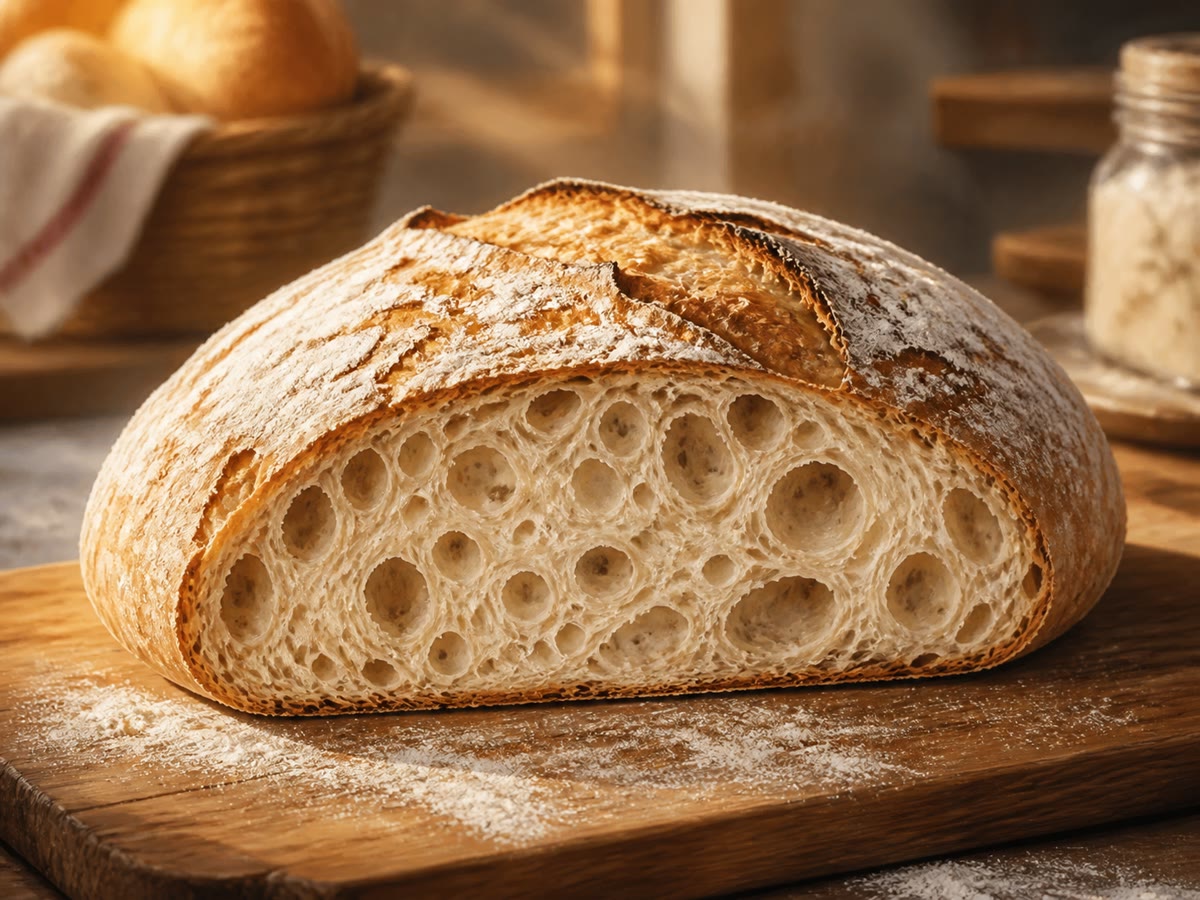
The workforce’s signature, baked in place: every hole in the crumb is a bubble the yeast blew.

Examples

Example 43.5 (Bread rises)

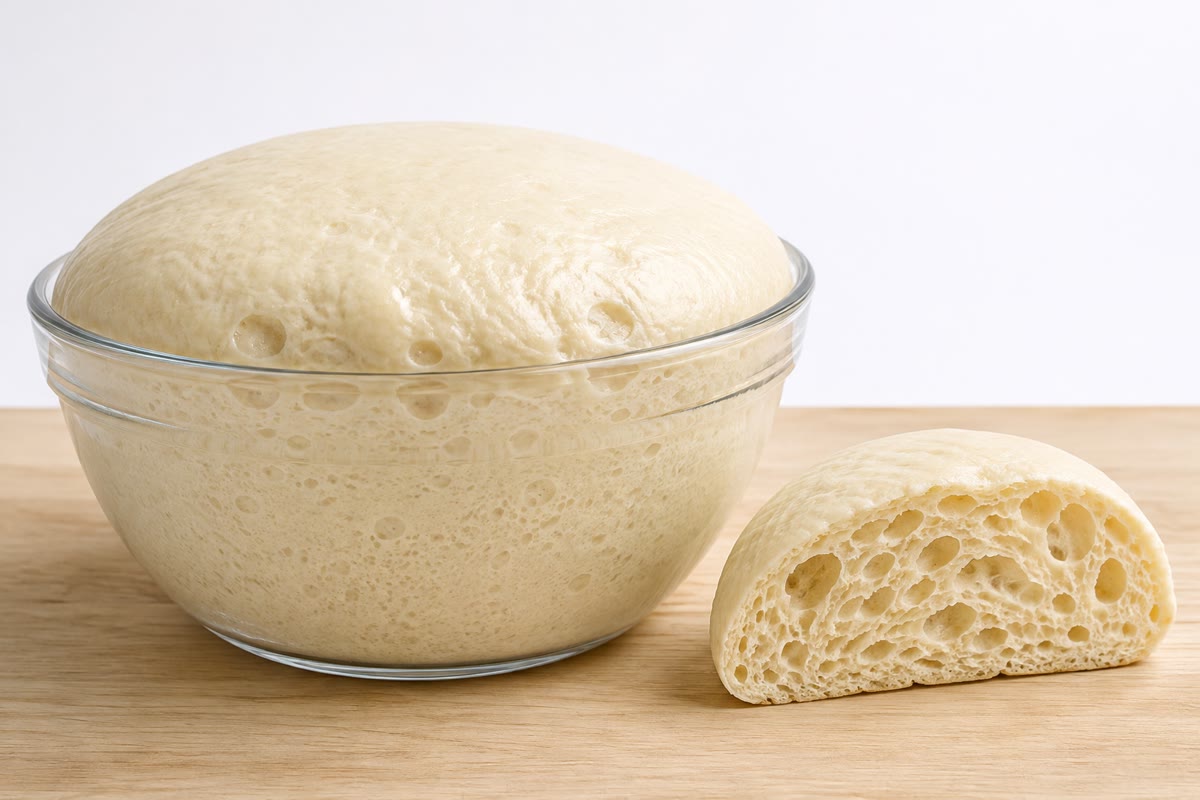
Bread’s raw dough is flour and water — plus yeast, a single-celled fungus (Remark 29.9 met such lives). The yeast feeds on the flour’s sugars and releases a gas; the gas’s bubbles, trapped in the stretchy dough, puff it up — the baker calls it rising. The oven’s heat then ends the workers’ shift and sets their work: the crumb’s holes are the yeast’s signature.

Example 43.6 (Milk becomes yogurt and cheese)

Warm milk seeded with the right microbes thickens overnight into yogurt: the workers feed on the milk’s sugar and release an acid, and the acid sets the milk — the fresh tang is the acid. Cheese starts similarly, then goes further: curds pressed, salted and ripened for months, the microbes working on through the ripening — a cheese’s holes, rind and power of smell are their long shift’s log.
Read in context →
Definition 4.8 High School Biology · Chapter 4 — Cell Metabolism

Without oxygen, some cells break glucose down only partially, in the cytoplasm, into smaller organic molecules that still hold most of the energy: this is fermentation. Yeast performs alcoholic fermentation,

C6H12O62C2H5OH+2CO2+energy,\mathrm{C_6H_{12}O_6} \longrightarrow 2\,\mathrm{C_2H_5OH} + 2\,\mathrm{CO_2} + \text{energy},

and muscle cells short of oxygen, as well as the bacteria of yoghurt, perform lactic fermentation, turning glucose into lactic acid. A fermentation yields about fifteen times less ATP per glucose than respiration.

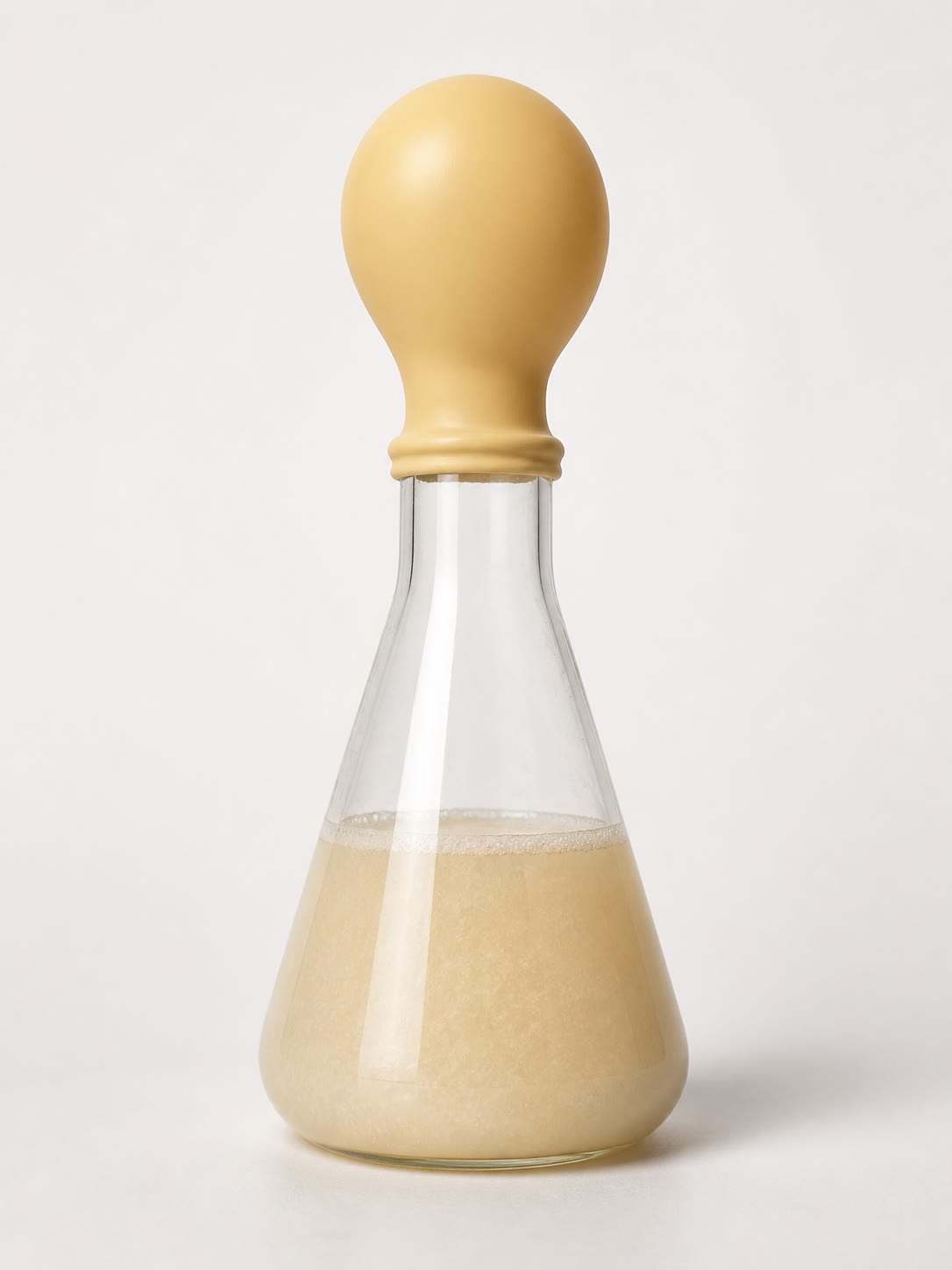
Yeast fermenting sugar in a flask: the carbon dioxide of alcoholic fermentation inflates the balloon. With no oxygen in the liquid, the sugar is only partly broken down and the ethanol stays behind.
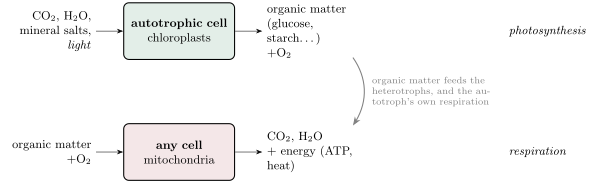
The two flows of cell metabolism. Photosynthesis stores light energy in organic matter; respiration, in every cell, releases it. Autotrophs run both; heterotrophs run only the second and must be fed organic matter.

Examples

Example 4.9 (Yeast in air and out of it)

Yeast bubbled with air uses glucose sparingly and grows fast: it respires. The same yeast in a sealed vat uses glucose greedily, grows little and makes ethanol: it ferments. Pasteur, who described this in 1861, called fermentation "life without air"; the cells switch their metabolism to whichever pathway their environment allows, and, since fermentation gives so little energy per glucose, they must burn through far more sugar to live.

Read in context →
Definition 15.11 University Biology — Year 1 · Chapter 15 — Cellular Respiration and Fermentation

Without oxygen the respiratory chain stops, NADH cannot be re-oxidised, and glycolysis would halt within seconds for lack of NAD+\mathrm{NAD^+}. Fermentation regenerates it by using pyruvate itself as the electron acceptor: in lactic fermentation (muscle, red cells, lactic bacteria) pyruvate is reduced to lactate; in alcoholic fermentation (yeast, some plants) it is decarboxylated to acetaldehyde, which is reduced to ethanol, releasing CO2\mathrm{CO_2}. The yield is glycolysis’ own: 2 ATP per glucose, a fifteenth of respiration’s; the carbon is barely oxidised and the products still hold nearly all the fuel’s energy. Anaerobic respiration — an electron-transport chain ending on nitrate, sulfate or carbonate instead of oxygen, in many bacteria — is a different thing, treated in the Year 2 volume.

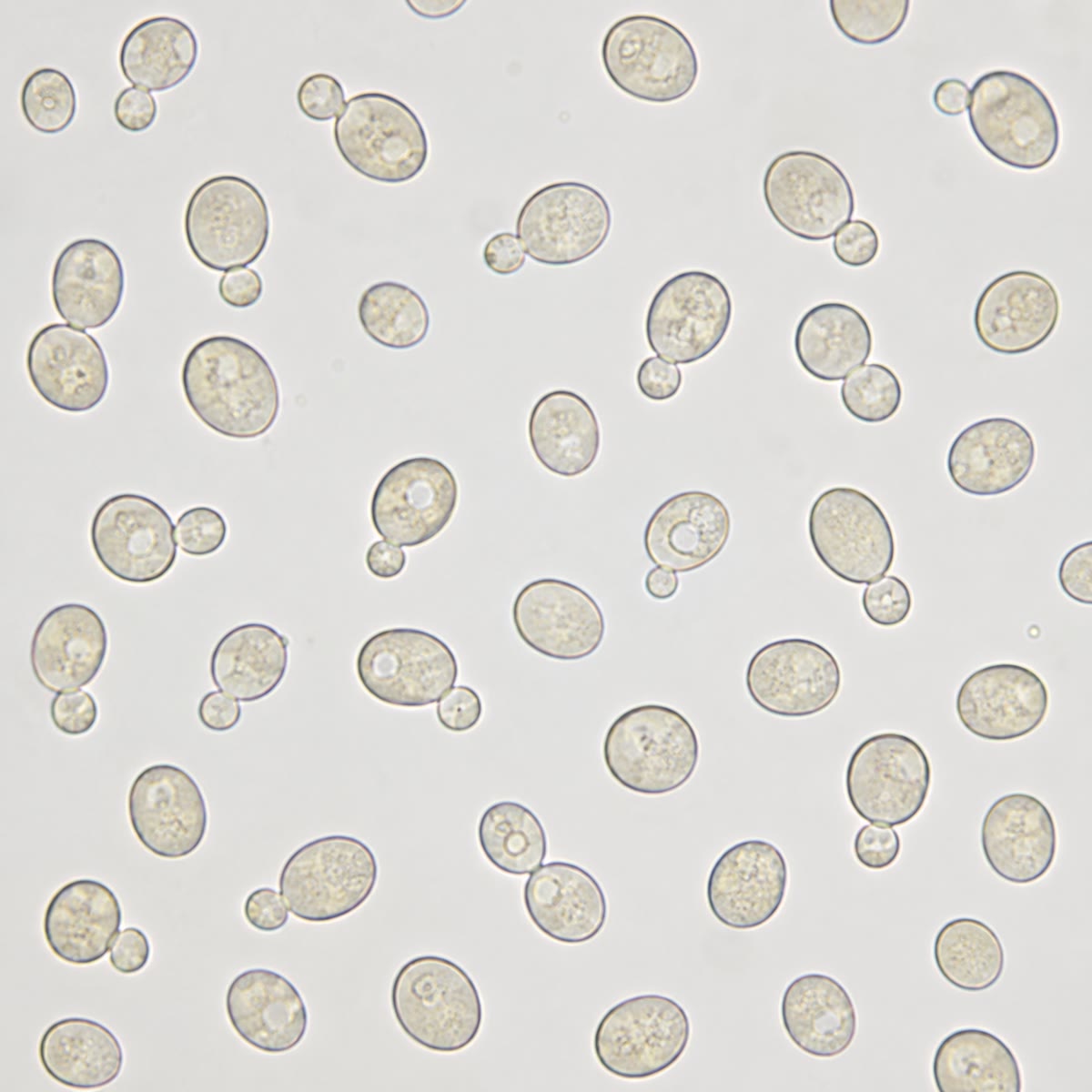
Left: baker’s yeast, budding. Right: what its fermentation does to dough: the CO_2 of two ATP’s worth of glycolysis per glucose, trapped in gluten. The ethanol bakes off.
Left: baker’s yeast, budding. Right: what its fermentation does to dough: the CO2\mathrm{CO_2} of two ATP’s worth of glycolysis per glucose, trapped in gluten. The ethanol bakes off.
Read in context →