High School Biology · Grades 10–12
4Cell Metabolism
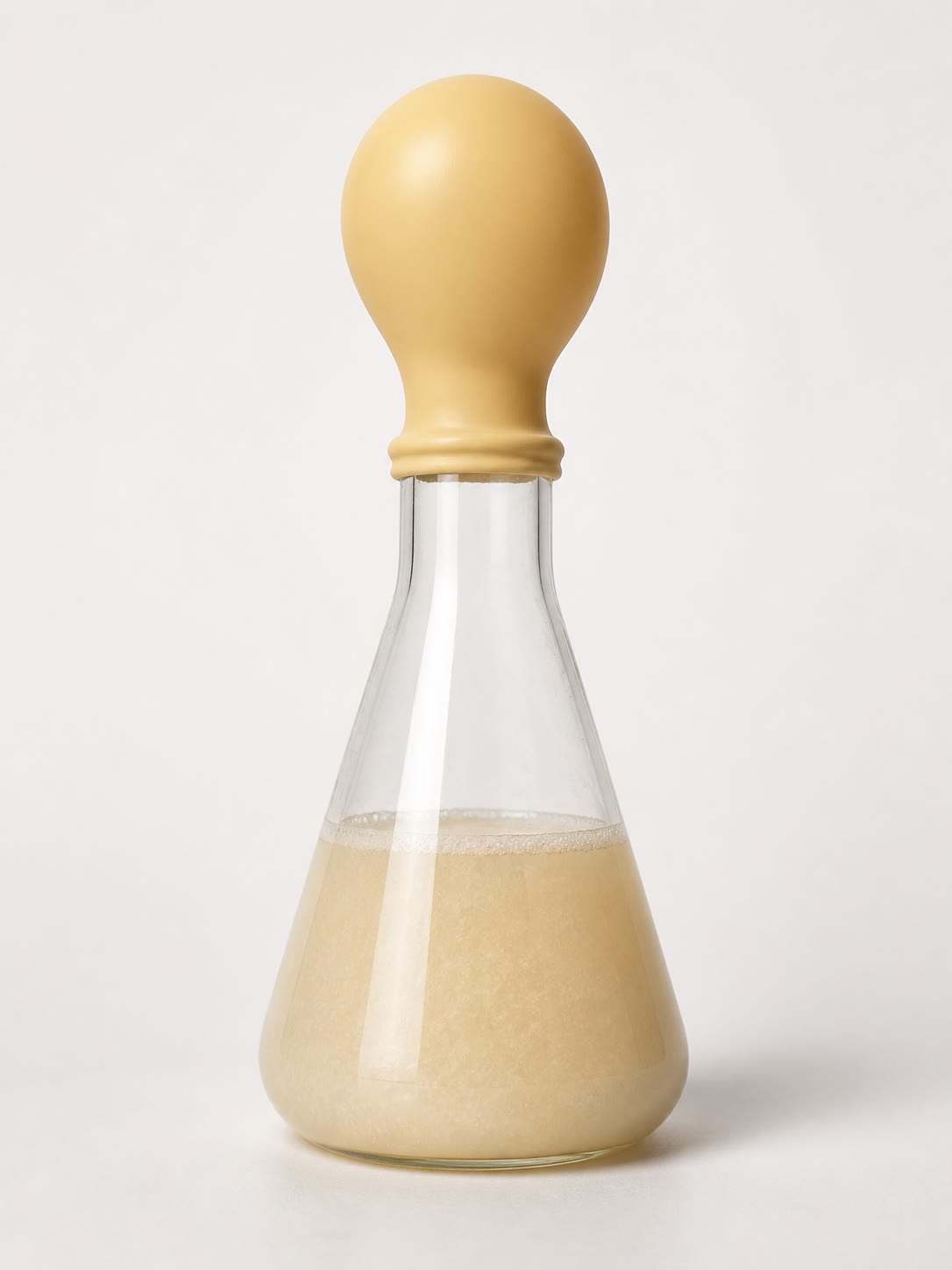
Stretch a balloon over the neck of a flask of warm sugar water with a spoonful of baker’s yeast in it. Within an hour the liquid clouds and fizzes, the balloon stands up, and the flask smells faintly of bread and beer. The yeast cells are eating the sugar and turning it into something else, and the gas they give off is the same carbon dioxide you breathe out. A leaf in the sun does the reverse: it takes carbon dioxide in and gives oxygen off. Both are chemistry, run inside cells, at body temperature, with no flame and no acid — and this chapter is about that chemistry.
4.1 Metabolism: the chemistry of a cell
Definition 4.1 (Metabolism)
The metabolism of a cell is the set of all the chemical reactions that take place inside it: those that break molecules down to release energy, and those that build the cell’s own molecules from simpler ones. Every reaction of metabolism is driven by an enzyme, a protein that speeds up one specific reaction without being consumed by it.
Proposition 4.2 (Enzymes make cell chemistry possible)
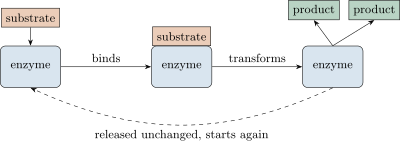
Glucose left in air at does not burn; in a cell it is fully oxidised within minutes. The difference is the enzymes: each one binds a particular molecule (its substrate), transforms it into a product, releases it and starts again, thousands of times per second. A cell’s metabolism is therefore fixed by the set of enzymes it possesses — and that set is fixed by its genes.
Proof. Admitted at this level. ∎
Example 4.3 (One enzyme at work)
Pour hydrogen peroxide on a piece of raw liver or potato: it froths violently as oxygen is released. The enzyme catalase, present in almost every cell, splits the toxic peroxide into water and oxygen at a rate of millions of molecules per second per enzyme molecule. Boil the liver first and nothing happens: the enzyme, a protein, has been destroyed by heat. Bubble-free peroxide on a stone shows the reaction does not run by itself.
4.2 Two ways of feeding a cell
Definition 4.4 (Autotrophy and heterotrophy)
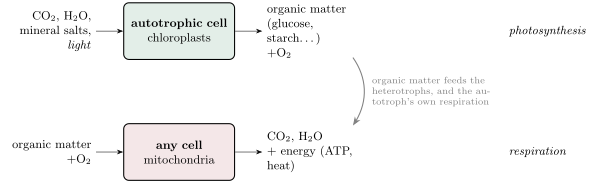
A cell is autotrophic if it builds its own organic molecules from mineral matter alone — carbon dioxide, water, mineral salts — using an external source of energy. Plant cells with chloroplasts, algae and some bacteria are autotrophs, and their energy source is light: this is photosynthesis. A cell is heterotrophic if it must take in organic molecules made by other organisms, both as building material and as a source of energy: animal cells, fungi, most bacteria, and the non-green cells of plants (roots, for instance) are heterotrophs.
Proposition 4.5 (Photosynthesis)
In the light, a chloroplast-containing cell absorbs carbon dioxide and water, releases oxygen, and builds glucose, which it then converts into starch, cellulose, lipids and, with mineral nitrogen, amino acids. In summary:
The energy of light is stored in the chemical bonds of the glucose.
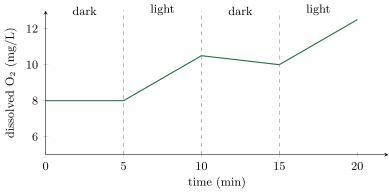
Evidence. A suspension of the green alga Chlorella in a sealed vessel fitted with an oxygen probe shows the dissolved oxygen rising steadily when the lamp is on and falling when it is off; the rise stops if the carbon dioxide of the water is removed. Leaves kept in the dark for two days no longer stain blue-black with iodine, and a leaf half covered with foil stains only on its exposed half: the starch is made where light falls. Radioactive carbon dioxide supplied to a plant ends up in its sugars within minutes. ∎
Example 4.6 (Euglena, both at once)
The single-celled Euglena has chloroplasts and swims with a flagellum. In the light, in mineral water, it grows: autotroph. In the dark it survives only if organic molecules are added to the water, which it absorbs: heterotroph. Kept long in the dark it loses its chloroplasts; brought back to light with a few days’ patience it makes them again. Its metabolism depends on its genes, which allow both options, and on its environment, which selects one.
4.3 Getting energy from organic molecules
Proposition 4.7 (Cellular respiration)
Every cell, autotroph or heterotroph, obtains usable energy by breaking down organic molecules. When oxygen is available the breakdown is complete — this is cellular respiration , in the mitochondria:
about per mole of glucose (), of which roughly 40% is captured in a small molecule, ATP, that every energy-requiring process of the cell — movement, transport, synthesis — draws on; the rest is released as heat.
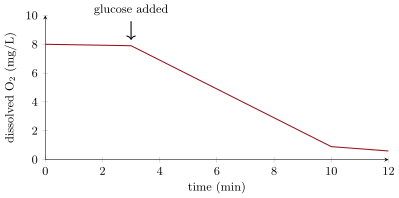
Evidence. Yeast in a sealed vessel with an oxygen probe consumes no oxygen while starved; add glucose and the dissolved oxygen falls at a steady rate while carbon dioxide appears, until the oxygen is exhausted. Germinating seeds in a vacuum flask warm the flask by several degrees within a day — the heat of respiration — while boiled seeds do not. Muscle cells seen in the electron microscope are crowded with mitochondria, and a poison of mitochondria stops the muscle. ∎
Definition 4.8 (Fermentation)
Without oxygen, some cells break glucose down only partially, in the cytoplasm, into smaller organic molecules that still hold most of the energy: this is fermentation. Yeast performs alcoholic fermentation,
and muscle cells short of oxygen, as well as the bacteria of yoghurt, perform lactic fermentation, turning glucose into lactic acid. A fermentation yields about fifteen times less ATP per glucose than respiration.
Example 4.9 (Yeast in air and out of it)
Yeast bubbled with air uses glucose sparingly and grows fast: it respires. The same yeast in a sealed vat uses glucose greedily, grows little and makes ethanol: it ferments. Pasteur, who described this in 1861, called fermentation "life without air"; the cells switch their metabolism to whichever pathway their environment allows, and, since fermentation gives so little energy per glucose, they must burn through far more sugar to live.
4.4 What decides a cell’s metabolism
Proposition 4.10 (Genes and environment)
A cell’s metabolism depends on two things: on its equipment — the enzymes and organelles its genes allow it to build, so that a cell without chlorophyll can never photosynthesise — and on its environment — light, oxygen, available nutrients — which decides which of the possible pathways actually runs. A yeast is a respirer in air and a fermenter without it; a Euglena is an autotroph in the light and a heterotroph in the dark; a root cell of a green plant is a heterotroph all its life, fed by the leaves.
Proof. Admitted at this level. ∎
Method 4.11 (Reading a metabolic trace)
Oxygen-probe experiments give a concentration against time.
- Identify what changed at each marked instant (light on, substrate added, oxygen exhausted).
- Read the slope of each straight segment: rise over run, in per minute. A positive slope means net production of oxygen, a negative one net consumption.
- Remember that a photosynthesising cell also respires: the slope in the light is production minus respiration, so the true rate of photosynthesis is the light slope plus the size of the dark slope.
- Convert if asked: at these concentrations of dissolved oxygen is millimole per litre.
Example 4.12 (The alga’s true rate)
In the Chlorella figure the oxygen rises by in 5 minutes of light (slope ) and falls by in 5 minutes of dark (slope ). Respiration consumes per minute in the light as well, so photosynthesis produces per minute: six times what respiration uses. The alga is a net producer of oxygen and organic matter, which is why it grows.
4.5 Exercises
Exercise 4.1 ★
Define metabolism, and state what an enzyme is and what it does.
Solution
Solution of Exercise 4.1.
Metabolism is the set of all chemical reactions in a cell, breaking molecules down for energy and building the cell’s own. An enzyme is a protein that speeds up one specific reaction, binding its substrate and releasing the product, without being consumed.
Exercise 4.2 ★
Write the summary equation of cellular respiration and of photosynthesis. In what sense is one the reverse of the other, and in what sense is it not?
Solution
Solution of Exercise 4.2.
Respiration: + energy. Photosynthesis: + light . The overall balance of matter is reversed; but the reactions, enzymes, places (mitochondrion versus chloroplast) and energy sources (chemical bonds versus light) are entirely different.
Exercise 4.3 ★
Classify as autotroph or heterotroph: a mushroom, a moss, a root cell of a carrot, a chlorella, a bacterium of yoghurt, a human muscle cell.
Exercise 4.4 ★
In the yeast-and-balloon experiment, what gas inflates the balloon, what liquid product accumulates, and what does the flask lack that would change the outcome?
Solution
Solution of Exercise 4.4.
Carbon dioxide inflates the balloon; ethanol accumulates in the liquid. The flask lacks oxygen: with air bubbled through, the yeast would respire, make no ethanol and use far less sugar.
Exercise 4.5 ★
Why does boiled liver no longer make hydrogen peroxide froth?
Solution
Solution of Exercise 4.5.
Catalase is a protein; boiling destroys its shape and hence its activity, and hydrogen peroxide does not decompose fast on its own.
Exercise 4.6 ★★
In the yeast figure, the oxygen falls from to between minutes 3 and 10. Compute the rate of respiration in per minute. Why does the curve flatten after minute 10, and what does the yeast do then?
Solution
Solution of Exercise 4.6.
per minute. It flattens because the oxygen is exhausted; the yeast then switches to fermentation, which consumes no oxygen.
Exercise 4.7 ★★
Chlorella in the light shows an oxygen slope of per minute, and in the dark . Compute the rate of photosynthesis.
Solution
Solution of Exercise 4.7.
per minute: the light slope is production minus the respiration that continues in the light.
Exercise 4.8 ★★
A cell respires of glucose. What mass of oxygen does it use and what mass of carbon dioxide does it release? (Molar masses: glucose , , .)
Solution
Solution of Exercise 4.8.
is of glucose; it needs of oxygen, , and releases of carbon dioxide, .
Exercise 4.9 ★★
Germinating peas in a vacuum flask raise its temperature by in a day; boiled peas do not. Explain both results, and say why the flask must not be sealed airtight.
Solution
Solution of Exercise 4.9.
Germinating peas respire their reserves and release heat; boiled peas are dead, their enzymes destroyed, so no reaction and no heat. Sealed airtight, the oxygen would run out and respiration stop.
Exercise 4.10 ★★
A green leaf is kept in the dark for 48 hours, then half of it is covered with black paper and the plant is put in the sun for a day. Iodine is applied. Predict and explain the result on each half, and say why the 48 hours of darkness were needed.
Solution
Solution of Exercise 4.10.
The exposed half stains blue-black (starch made by photosynthesis in the light); the covered half does not. The 48 hours of darkness let the leaf use up its previous starch, so that any starch found is due to the day’s light.
Exercise 4.11 ★★
Explain why yeast in a sealed vat consumes sugar much faster, per cell, than yeast bubbled with air.
Solution
Solution of Exercise 4.11.
Fermentation yields about fifteen times less ATP per glucose than respiration; to obtain the ATP it needs, a fermenting cell must break down fifteen times more sugar per minute.
Exercise 4.12 ★★★
A sprinter’s muscles become sore and acidic after a 400-metre race. Explain what happened in the muscle cells, why it happened, and why the same runner’s muscles do not become acidic during a slow jog.
Solution
Solution of Exercise 4.12.
During the race the muscle’s need for ATP outran the oxygen the blood could deliver; the cells switched to lactic fermentation, whose product, lactic acid, accumulated. In a slow jog the oxygen supply keeps pace, respiration alone provides the ATP, and no acid is made.
Exercise 4.13 ★★★
Euglena kept a month in the dark with organic food loses its chloroplasts, but its descendants regain them in the light. Which of the two factors of Proposition 4.10 has changed and which has not? What does the recovery prove about the cell’s genes?
Solution
Solution of Exercise 4.13.
The environment changed (no light, organic food); the genes did not. The descendants rebuild chloroplasts, so the instructions were never lost: the loss was a change of equipment in use, not of the possibilities the genes allow.
Exercise 4.14 ★★★
A sealed aquarium contains water, a snail and a water plant, in the light. Explain how the two organisms can each survive for months, what each supplies to the other, and what happens if the aquarium is kept in the dark.
Solution
Solution of Exercise 4.14.
The plant photosynthesises in the light, supplying oxygen and organic matter (leaves the snail eats); the snail respires, supplying carbon dioxide to the plant. In the dark the plant only respires: both consume oxygen, nobody produces it, and both die within days.
Exercise 4.15 ★★★
Respiration of one glucose yields about 30 ATP, fermentation 2. A yeast cell needs a fixed number of ATP per minute to live. Compute how many times more glucose it must consume per minute when fermenting; then explain why brewers keep air out of their vats even though it "wastes" sugar.
Solution
Solution of Exercise 4.15.
times more glucose per minute. Brewers want ethanol, which only fermentation makes; a respiring yeast would turn the sugar into carbon dioxide, water and more yeast, and no alcohol.
4.6 Problem: The Winemaker’s Vat
Problem 4.1
Weekend problem — a vat of grape juice left to the yeast: the alcohol it will hold, the gas it will give off, the heat it will make, and why a cellar can be a dangerous place
Grape juice (must) contains about of sugar per litre, which we take as glucose, and no dissolved oxygen once the vat is sealed. Molar masses: glucose , ethanol , carbon dioxide , oxygen . The density of ethanol is . One mole of gas occupies about at cellar temperature. The vat holds .
Part I — What the yeast makes.
- Which pathway does the yeast use in the sealed vat, and why? Write its equation.
- How many moles of glucose does one litre of must contain?
- Compute the mass of ethanol produced per litre, then its volume, then the alcohol content of the wine in per cent by volume.
- Compute the mass of carbon dioxide produced per litre of must, and its volume as a gas.
- For the whole vat, what volume of carbon dioxide is released? Compare with the volume of a cellar of by by .
Part II — If the yeast had air.
- Write the equation the yeast would follow if the must were continuously aerated.
- Compute the mass of oxygen needed to respire the sugar of one litre of must, and the mass of carbon dioxide released.
- Compare the carbon dioxide of question 7 with that of question 4, and explain the difference in terms of how far the glucose is broken down.
- Respiration yields about 30 ATP per glucose and fermentation 2. If the yeast needs the same ATP in both cases, in which case does the sugar last longer, and by what factor?
- Explain why a winemaker nevertheless keeps air out.
Part III — The heat of the vat. Fermentation releases about of heat per mole of glucose; heating of water by takes .
- Compute the heat released per litre of must, then for the vat.
- If none of it escaped, by how much would the vat’s temperature rise? (Take the must as water.)
- Yeast enzymes are destroyed above about . Starting from , would an uncooled vat survive? What does this tell you about why large vats are cooled?
- Explain, using Proposition 4.2, why heat stops fermentation even though the sugar is still there.
- Respiration would have released about per mole. Where does the energy that fermentation does not release remain?
Part IV — The cellar.
- Carbon dioxide is denser than air. Where in the cellar does it accumulate, and why is a lit candle carried low a traditional safety test?
- A worker’s cells, deprived of oxygen, would switch to which pathway — and why can a human body not live on it for more than minutes?
- The fermentation stops on its own when the alcohol reaches about 15% by volume. Propose an explanation in terms of the yeast’s enzymes.
- Bread dough uses the same yeast for an hour. What do the bubbles in the crumb contain, and where has the ethanol gone after baking?
- State the result: for one litre of must, the alcohol content and the volume of gas produced — and the single metabolic fact that explains both.
Solution
Solution of Problem 4.1.
1. Alcoholic fermentation, because the sealed vat holds no oxygen: .
2. .
3. Ethanol , i.e. ; volume ; about 13% by volume.
4. of carbon dioxide; of gas.
5. About . The cellar holds : the gas released would nearly fill it.
6. .
7. Oxygen , ; carbon dioxide .
8. Three times more: respiration turns all six carbons of glucose into carbon dioxide, fermentation only two, the other four staying in the ethanol.
9. With respiration, fifteen times longer: each glucose gives fifteen times more ATP.
10. Ethanol is made only by fermentation; an aerated vat would give carbon dioxide, water and yeast, and no wine.
11. per litre; , i.e. , for the vat.
12. .
13. : at the edge of the yeast’s limit, and a warm cellar would push it over. A large vat loses heat slowly because its surface is small compared with its volume, so it must be cooled deliberately.
14. Enzymes are proteins; heat unfolds them and they stop working. Without its enzymes the yeast cannot transform the sugar, however much remains.
15. In the chemical bonds of the ethanol: about per mole of glucose, which is why ethanol burns.
16. On the floor, in a layer that thickens as fermentation proceeds. A candle carried low goes out where the carbon dioxide has displaced the oxygen — a warning before a person is affected.
17. Lactic fermentation. It yields fifteen times less ATP; brain and heart cannot meet their needs that way, and the lactic acid accumulates. Loss of consciousness follows within a minute or two.
18. Ethanol at high concentration damages the yeast’s membranes and enzymes: the cells’ own product poisons their metabolism.
19. The bubbles are carbon dioxide from fermentation. The ethanol evaporates in the oven (it boils at ).
20. About 13% alcohol by volume and of gas per litre of must; both follow from the yeast fermenting, without oxygen, each glucose into two ethanol and two carbon dioxide.