 Coach
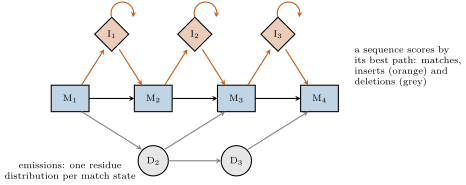
CoachA multiple sequence alignment arranges a family of sequences in columns of homologous residues. Exact dynamic programming over sequences costs and is impossible beyond three; practical programs align progressively, first the closest pair by a guide tree, then sequences and groups to the growing alignment, with rounds of refinement. A finished alignment is summarised as a profile: for each column, the frequency of each residue and of gaps. A profile hidden Markov model formalises this as a chain of match states, one per conserved column, each emitting residues with its own probabilities, with insert and delete states allowing extra or missing residues at each position; the model of a family (a Pfam entry) scores a new sequence by the probability of the best path through the states, and finds homologues far below the twilight zone of pairwise comparison, because a column that tolerates only hydrophobic residues says so, while a single sequence cannot.
Examples
Example 5.7 (Identity, similarity and the twilight zone)
Two random protein sequences aligned optimally with gaps reach about identity by chance. Above identity over a hundred residues two proteins are almost surely homologous; between and is the twilight zone, where identity alone cannot decide and the statistics below must. Homologues can fall far below the zone: haemoglobin and myoglobin subunits share identity, lysozyme and -lactalbumin , and many pairs of proteins with the same fold share less than , detectable only by comparing profiles or structures.
Example 5.10 (Reading an E-value)
A query of residues against a database of residues has . A hit with a bit score of has : essentially certainly a homologue. A hit with has : eleven such scores are expected by chance, and the hit means nothing. The same alignment, with the same bit score, searched against a database ten times larger, has an ten times larger — significance is a property of the search, not of the pair. The threshold in common use is for a confident homologue; – deserves a second look with a profile method.