 Coach
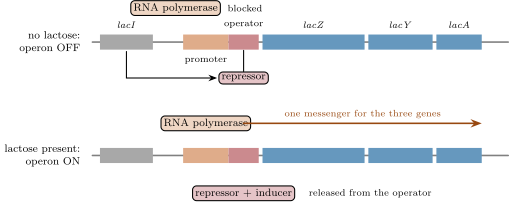
CoachAn operon is a group of bacterial genes transcribed together from one promoter into one messenger, and so controlled together. The lac operon of E. coli comprises three genes for the use of lactose — lacZ (-galactosidase), lacY (the lactose permease that imports it) and lacA — behind a promoter and an operator, a short sequence overlapping the promoter. A separate gene, lacI, makes the lac repressor, a protein that binds the operator and blocks the polymerase. Lactose, converted in the cell to allolactose, is the inducer: it binds the repressor, changes its shape, and makes it let go of the operator. The operon is thus off unless lactose is present — negative control lifted by induction.
Examples
Example 20.7 (Two partial diploids)
: the copy makes repressor that binds the next to ; inducible — the mutation is complemented. : the only working sits behind an operator the repressor cannot bind; constitutive — the normal operator on the other copy cannot help, since it controls only the broken .