University Biology — Year 1 · Bachelor Year 1
20Control of Gene Expression
A bacterium growing on glucose carries five molecules of the enzyme that digests lactose; give it lactose and, within minutes, it carries five thousand. A liver cell and a neuron carry the same twenty thousand genes and make almost entirely different sets of proteins, and neither will ever make the other’s. Nothing in Chapter 19 explains this: the machinery of expression is the same for every gene. What differs is whether a gene is read, how often, and for how long — decisions taken at the promoter by proteins that bind DNA, and after it by the fate of the messenger and the protein. This chapter describes how bacteria switch genes on and off in response to their food, how eukaryotes control their genes through chromatin, distant enhancers and combinations of factors, and how the same control, applied to different genes in different cells, makes a body out of one genome.
20.1 Why and where genes are controlled
Proposition 20.1 (Expression is regulated, at every level)
Some genes are constitutive — expressed always, at a steady level, because their products are always needed (the ribosome’s proteins, the enzymes of glycolysis). Most are regulated: expressed only in some conditions, some cells, some moments. The control acts at every step of the flow — chiefly at the start of transcription, the cheapest place to decide, but also at the processing, export, stability and translation of the messenger, and at the modification and degradation of the protein — and the response times range from seconds (a protein modified) through minutes (a bacterial gene switched on) to days (a chromatin state changed).
Example 20.2 (Making enzymes only when needed)
The enzyme -galactosidase, which splits lactose, is a tetramer of four chains of residues: five thousand copies are of a cell’s protein and cost ATP per generation. A bacterium that made them with no lactose to digest would grow about one percent slower than a competitor that did not, and in a few hundred generations would be outnumbered. Regulation is selected because expression is expensive.
20.2 The lac operon
Definition 20.3 (Operon, repressor, operator)
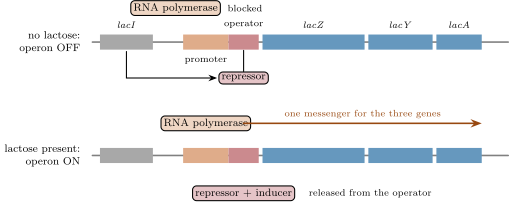
An operon is a group of bacterial genes transcribed together from one promoter into one messenger, and so controlled together. The lac operon of E. coli comprises three genes for the use of lactose — lacZ (-galactosidase), lacY (the lactose permease that imports it) and lacA — behind a promoter and an operator, a short sequence overlapping the promoter. A separate gene, lacI, makes the lac repressor, a protein that binds the operator and blocks the polymerase. Lactose, converted in the cell to allolactose, is the inducer: it binds the repressor, changes its shape, and makes it let go of the operator. The operon is thus off unless lactose is present — negative control lifted by induction.
Proposition 20.4 (The operon model)
The lac genes are controlled by a diffusible repressor acting on a site adjacent to the genes: control is negative, the repressor acts in trans (from anywhere in the cell), and the operator acts in cis (only on the genes next to it).
Evidence. Jacob and Monod (1959–1961) reasoned from mutants. Strains mutant in lacI () made the enzyme with or without lactose (constitutive); a normal lacI gene introduced on a second copy of the region restored regulation, so the gene’s product is a diffusible repressor that a mutant lacks. Strains mutant in the operator () were also constitutive, but a second normal operator on another copy did not restore regulation — the operator only controls the genes physically attached to it, so it is a site, not a product. A third class () could not be induced at all, and was dominant: a repressor that no longer binds the inducer. In the PaJaMo experiment (1959) a normal lacI gene transferred by conjugation into an cell shut off the enzyme synthesis within minutes: the repressor acts fast, and on transcription — the messenger was later shown to have a half-life of minutes. ∎
Definition 20.5 (Positive control: CAP and cAMP)
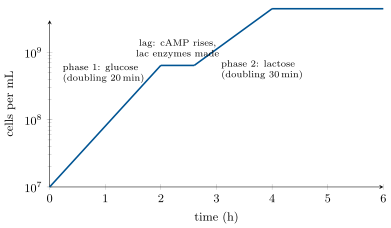
The lac promoter is weak: even without the repressor, the polymerase starts rarely unless a second protein, CAP (catabolite activator protein), is bound just upstream of it, bending the DNA and holding the polymerase in place. CAP binds DNA only when carrying cyclic AMP, whose level in the cell falls when glucose is abundant. The operon is therefore fully on only when lactose is present and glucose is absent: two signals, one negative and one positive, are integrated at one promoter. Given both sugars, E. coli eats the glucose first, pauses while cAMP rises and the lac enzymes are made, then eats the lactose — the two-phase growth curve called diauxie, which Monod described in 1941 and which set him on the road to the operon.
Method 20.6 (Predicting a lac phenotype)
- Write the genotype of each copy of the region: , , , ( normal, inactive, operator-constitutive, super-repressor).
- The repressor acts in trans: one anywhere represses every normal operator; represses whatever the inducer.
- The operator and promoter act in cis: an frees only the on its own DNA; a silences only its own genes.
- Ask, with and without inducer, whether each gene is transcribed; the phenotype is inducible, constitutive or uninducible accordingly. Then add glucose: without cAMP–CAP, transcription is low whatever the repressor does.
Example 20.7 (Two partial diploids)
: the copy makes repressor that binds the next to ; inducible — the mutation is complemented. : the only working sits behind an operator the repressor cannot bind; constitutive — the normal operator on the other copy cannot help, since it controls only the broken .
20.3 Other bacterial strategies
Proposition 20.8 (Repression, attenuation and sigma factors)
Operons for biosynthesis are controlled in the opposite sense: the trp operon, five genes for making tryptophan, is transcribed unless tryptophan is present — the amino acid binds the trp repressor and enables it to bind the operator (a corepressor). A second, finer control, attenuation, uses the coupling of transcription and translation in bacteria: the start of the messenger encodes a short peptide with two tryptophans in a row; if tryptophan-loaded tRNA is abundant, a ribosome translates it quickly and the RNA behind folds into a terminator hairpin that stops the polymerase before the genes; if tryptophan is scarce, the ribosome stalls at the tryptophan codons and the RNA folds differently, letting transcription continue. Bacteria also switch whole sets of genes by changing the subunit of their polymerase: a heat-shock directs it to the promoters of chaperone genes; a sporulation to those of spore formation.
20.4 Control in eukaryotes
Definition 20.9 (Transcription factors, enhancers)
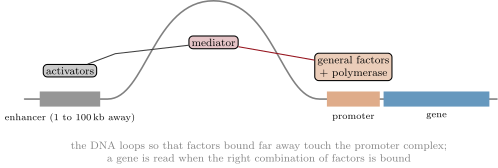
In eukaryotes the polymerase never starts by itself: the general factors at the promoter (Chapter 19) recruit it, and the rate is set by transcription factors bound to regulatory sequences — some near the promoter, many in enhancers that can lie thousands of base pairs away, upstream, downstream or in an intron, in either orientation, and act by looping the DNA so that the factors bound on them touch the promoter’s complex through mediator proteins. A transcription factor is modular: a DNA-binding domain that recognises a short sequence (helix-turn-helix, zinc finger, leucine zipper families) and an activation or repression domain that recruits or blocks the machinery. A gene is read when the right combination of factors is present: a few hundred factors, in combinations, control twenty thousand genes.
Proposition 20.10 (Chromatin is part of the control)
A gene wrapped in nucleosomes packed into heterochromatin cannot be read: the factors cannot reach it. Activators recruit enzymes that acetylate the histones, loosening their grip on the DNA and marking the region as open; repressors recruit enzymes that remove the acetyl groups and add marks that compact the chromatin. Methyl groups added to cytosines of a promoter silence it durably, and the marks are copied at replication, so that a cell’s pattern of open and closed genes is inherited by its daughters — the memory by which a liver cell’s daughters stay liver cells (the Year 3 volume treats these epigenetic mechanisms in depth).
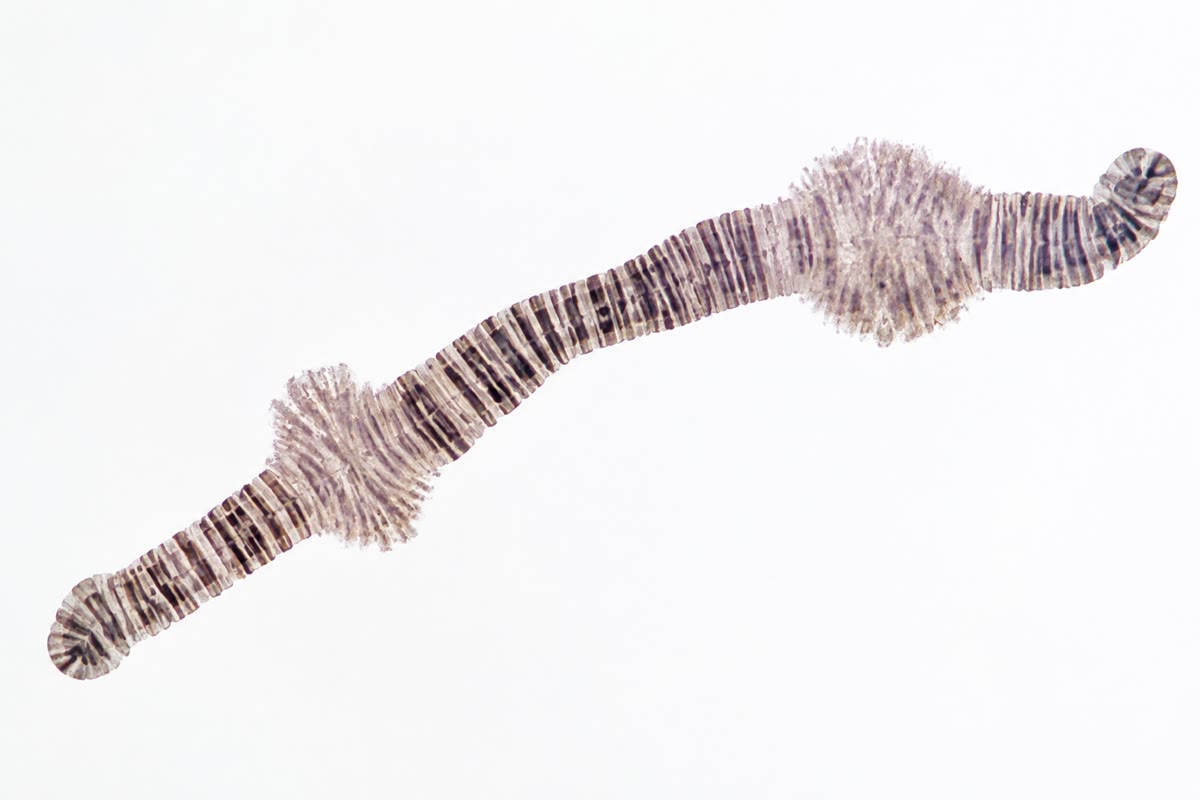
Evidence. In the giant polytene chromosomes of fly larvae (a thousand copies of each chromosome side by side, banded), genes being transcribed appear as puffs where the chromatin has unfolded; the hormone ecdysone, which triggers moulting, makes a specific set of puffs appear within minutes and others hours later, in a fixed sequence — transcription seen directly, and switched by a signal. Genes moved by chromosome rearrangement next to heterochromatin are silenced in some cells and not others, and the state is inherited by their daughters. ∎
Example 20.11 (A signal becomes a pattern of expression)
Cortisol enters a liver cell and binds its receptor, a transcription factor kept inactive in the cytosol; the complex enters the nucleus, binds a fifteen-base sequence present near a hundred genes — those of gluconeogenesis among them (Chapter 16) — and recruits acetylases and mediator: within an hour the enzymes of glucose synthesis are being made. The same hormone in a lymphocyte, whose open chromatin exposes a different set of those sequences, switches on genes that kill the cell. One signal, one receptor, two responses: the difference is which genes were accessible.
20.5 After transcription, and the making of a body
Proposition 20.12 (Control beyond the promoter)
A eukaryotic cell also decides how a transcript is spliced (alternative splicing gives a muscle and a brain different proteins from one gene), whether it is exported, how long it lasts (half-lives from minutes for regulatory proteins’ messages to days for haemoglobin’s, set by sequences in the untranslated regions that bind proteins and small regulatory RNAs), and whether it is translated (iron-starved cells block the translation of the ferritin message by a protein bound to its end, and release it when iron is present). The protein, once made, is controlled by modification and degradation (Chapter 13). Each later level is faster and more local than the one before, and more expensive: transcription decides what the cell can do, the later levels what it does now.
Proposition 20.13 (Differential expression makes a body)
Every cell of a multicellular organism carries the same genome; the cells differ because they express different subsets of it. Housekeeping genes — a few thousand for metabolism, the ribosome, the cytoskeleton — are on in every cell; the rest are switched on in some cells and off in others by the combinations of transcription factors each cell carries and the chromatin states it has inherited. A red cell’s precursor turns on globin and off nearly everything else; a neuron turns on its channels and never divides again. Differentiation is the acquisition of a stable pattern of expression, and development (the Year 2 volume) is the process by which signals between cells set those patterns in the right places.
Evidence. A nucleus taken from a differentiated frog cell and put into an egg whose own nucleus has been removed can direct the development of a whole tadpole (Gurdon, 1962; recalled from the High School volume): the differentiated cell had lost no genes, only switched them off, and the egg’s cytoplasm reset the switches. The proteins of a cell type, separated on a gel, differ from another type’s; its messengers, once sequenced, are a subset of the genome specific to it; and a handful of transcription factors introduced into a skin cell can reprogram it into a stem cell or a neuron. ∎
Example 20.14 (A gene read in two organs)
The gene for the enzyme that makes glucose from glucose-6-phosphate is expressed in the liver and the kidney and in no other tissue: its promoter carries sites for factors present only there, and in other cells its promoter is methylated and its chromatin closed. A muscle, which carries the gene intact, cannot release glucose into the blood (Chapter 16) — not for lack of the gene but because the gene is not read. The genome is the same; the expression is the organ.
20.6 Exercises
Exercise 20.1 ★
Name the elements of the lac operon and give the state of the operon with and without lactose, with and without glucose.
Exercise 20.2 ★
Explain the difference between a gene product that acts in trans and a site that acts in cis, with one example of each from the operon.
Exercise 20.3 ★
From the diauxie figure, read the duration of the lag and the doubling times on each sugar.
Solution
Solution of Exercise 20.3.
Lag about (from to ); doubling on glucose, on lactose.
Exercise 20.4 ★
Define enhancer, transcription factor and housekeeping gene.
Solution
Solution of Exercise 20.4.
Enhancer: a regulatory sequence, often distant, that raises a gene’s transcription when factors bind it. Transcription factor: a protein with a DNA-binding domain and an activation or repression domain that regulates transcription. Housekeeping gene: one expressed in every cell at a steady level.
Exercise 20.5 ★★
Give the phenotype (inducible, constitutive, uninducible) of: ; ; ; ; ; .
Solution
Solution of Exercise 20.5.
: constitutive. : constitutive. : uninducible. : inducible (the repressor acts in trans). : uninducible ( dominant). : inducible — the only working is behind a normal operator.
Exercise 20.6 ★★
Compare the lac and trp operons: what the small molecule does to the repressor in each, and why the logic is opposite.
Solution
Solution of Exercise 20.6.
Lac: the sugar (inducer) binds the repressor and releases it from the operator — the enzymes are made when their substrate is present. Trp: the amino acid (corepressor) binds the repressor and enables it to bind — the enzymes are made when their product is absent. Catabolic pathways are switched on by their input, anabolic ones off by their output.
Exercise 20.7 ★★
A mutant cannot make cAMP. Predict its growth on glucose, on lactose alone, and on both, and the level of -galactosidase in each case.
Solution
Solution of Exercise 20.7.
On glucose: normal growth (glucose needs no CAP). On lactose alone: almost no growth — without cAMP, CAP cannot activate the lac promoter, so the enzyme stays at a few percent of induced levels even with the repressor released. On both: growth on glucose, then a stop; no second phase. Enzyme low in every case.
Exercise 20.8 ★★
Explain why attenuation is impossible in eukaryotes, from the architecture of the eukaryotic cell.
Solution
Solution of Exercise 20.8.
Attenuation needs the ribosome to be translating the messenger while the polymerase is still transcribing it, so that the ribosome’s position shapes the RNA behind the polymerase. In eukaryotes transcription is in the nucleus and translation in the cytosol, and the message is not translated until it has been processed and exported.
Exercise 20.9 ★★
An enhancer is moved from upstream of its gene to downstream and inverted; the gene is still expressed. Explain what this shows about how enhancers work.
Solution
Solution of Exercise 20.9.
Enhancers act at a distance, in either orientation and on either side, so they cannot work by being read or by positioning the polymerase directly; they work by binding factors that contact the promoter through a loop of DNA, for which distance and orientation matter little.
Exercise 20.10 ★★★
Five thousand -galactosidase tetramers of residues cost how many ATP (four per residue)? A cell’s budget per generation is about ATP. Compute the growth disadvantage of a constitutive mutant, and the number of generations for its share of a mixed population to fall from a half to a hundredth.
Solution
Solution of Exercise 20.10.
ATP: of the budget. Growth rate lower by : per generation the mutant’s share falls by the factor . From to : , generations — a few weeks of continuous culture.
Exercise 20.11 ★★★
A liver cell and a neuron of the same person are compared: same genome, different proteins, and each division of the liver cell gives liver cells. Explain, with chromatin, factors and inheritance of marks, how the difference is made and how it is maintained.
Solution
Solution of Exercise 20.11.
Each cell type carries a specific set of transcription factors, which bind the enhancers of its genes and recruit acetylases that open their chromatin, while the genes of other types are methylated and packed into heterochromatin that no factor can reach. The factors maintain one another’s expression (a network with stable states), and the chromatin marks are copied at replication, so daughters inherit both the factors and the open and closed regions. The genome is the same; the accessible genome is not, and the inaccessibility is inherited.
Exercise 20.12 ★★★
“A bacterium reads its environment; a cell of a body reads its history.” Discuss in a paragraph the two kinds of control, their signals, their timescales and their reversibility.
Solution
Solution of Exercise 20.12.
A bacterium’s controls are tuned to the medium: a sugar, an amino acid, a temperature binds a repressor or a sigma factor and the response is complete in minutes and reversed as soon as the signal goes — expression tracks the environment. A body’s cell answers to signals too, but its main decisions were taken during development and locked in chromatin: what it can express was set by the factors it inherited and the marks on its DNA, changed only by division and mostly irreversible. The bacterium is a reader of the present; the differentiated cell has a memory that is its identity.
20.7 Problem: Diauxie
Problem 20.1
Weekend problem — Monod’s two-phase growth curve reconstructed cell by cell: glucose exhausted, lactose induced, enzymes counted, mutants predicted and the cost of regulation reckoned, ending on the induction factor of -galactosidase
A culture of E. coli starts at cells per millilitre in a medium with of glucose and of lactose. On glucose the cells double every , on lactose every ; a cell needs of sugar per division ( of glucose; lactose, , counts as two glucoses). Uninduced cells hold 5 molecules of -galactosidase; fully induced, . Induction takes . The enzyme is a tetramer of residues; each residue costs 4 ATP; a cell’s ATP budget is per division and its protein ( per residue).
Part I — The glucose phase.
- Compute the glucose available per millilitre, in grams.
- How many divisions per millilitre can it support?
- Starting from cells, how many cells are there when the glucose runs out? (A division makes one new cell.)
- How many doublings is that, and how long does the glucose phase last?
- During this phase, what is the state of the lac operon, and why, in molecular terms (repressor and CAP)?
Part II — The switch.
- When the glucose is gone, what rises inside the cells and what does it bind?
- Lactose was present all along. Why was the operon nevertheless almost off during the glucose phase?
- During the lag each cell makes its enzymes. Compute the enzyme molecules made per second per cell, and the residues per second.
- A cell holds ribosomes at residues per second. What fraction of its translation is devoted to -galactosidase during the lag?
- Compute the mass of tetramers and the fraction of the cell’s protein they represent.
- Compute the induction factor.
- Why is the permease (lacY) as necessary as the enzyme for growth on lactose, and what happens to a lacY mutant given lactose?
Part III — The lactose phase.
- Compute the lactose available per millilitre in glucose equivalents, in grams.
- How many further divisions does it support, and what is the final cell count?
- How long does the lactose phase last?
- Draw up the timeline: glucose phase, lag, lactose phase, total.
- Explain why the doubling time is longer on lactose (two reasons: one about the enzyme step, one about the permease).
Part IV — Mutants and costs.
- An mutant: describe its growth curve on the same medium and its enzyme level throughout.
- A CAP mutant: describe its curve and enzyme level.
- An mutant in a medium with lactose only: any difference from wild type? And with glucose only?
- Compute the ATP cost per generation of making tetramers, and the fraction of the cell’s budget.
- If that fraction lengthens the generation time by the same fraction, by how much does the mutant’s growth rate lag the wild type’s on glucose?
- Starting at equal numbers, after how many generations on glucose is the mutant one tenth of the population? ( with the ratio of growth rates per generation, i.e. for a lag in doublings.)
- Explain why, nevertheless, mutants are common in laboratory strains grown on lactose.
- State the result: the induction factor of -galactosidase, the cost of making it unnecessarily as a fraction of the ATP budget, and the total time of the diauxic experiment.
Solution
Solution of Problem 20.1.
1. . 2. divisions. 3. cells per mL. 4. : doublings, . 5. Off: lactose (allolactose) has released the repressor, but glucose keeps cAMP low, so CAP is not bound and the promoter is nearly silent; also the permease is scarce, so little lactose enters. 6. cAMP rises and binds CAP, which binds the promoter. 7. Negative control was lifted but positive control was absent: a weak promoter without CAP starts rarely (catabolite repression). 8. tetramers per second; residues per second. 9. Capacity residues per second: of the ribosomes. 10. : of the cell’s protein. 11. . 12. Lactose cannot cross the membrane without the permease; a lacY mutant has the enzyme but no substrate inside and does not grow on lactose (nor induce well, since the inducer is made from lactose inside the cell). 13. , worth of glucose per mole, i.e. . 14. divisions; final per mL. 15. : doublings, . 16. Glucose , lag , lactose : in all. 17. Lactose must first be hydrolysed, an extra enzymatic step whose rate limits the supply of glucose; and the permease uses the proton gradient to import it, a cost glucose transport does not pay. 18. : enzyme at throughout (constitutive, once glucose is gone; on glucose CAP still limits it, so the level is intermediate); its lag is shorter or absent, so the curve shows a smaller pause; the cost slows it slightly on glucose. 19. CAP: grows on glucose to , then stops: the lac operon cannot be activated, the enzyme stays near 5 molecules, and the lactose is never used. 20. On lactose only: none in enzyme level once induced (both fully on) and essentially none in growth; merely lacks the delay of induction. On glucose only: makes the enzyme uselessly (as far as CAP allows), wild type does not. 21. ATP: of . 22. Generation time longer by : growth rate lower by , doublings per generation. 23. ; : generations. 24. On lactose the enzyme is needed anyway, so the mutant pays nothing and gains the lag: it is not selected against and is sometimes selected for; and laboratory strains are grown for convenience, not competition. 25. Induction factor 1000 (5 to molecules); unnecessary synthesis costs of the ATP budget; the experiment lasts about two and a half hours.