 Coach
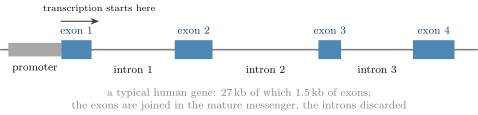
CoachA gene is a stretch of DNA transcribed into a functional RNA — usually a messenger for one protein. A eukaryotic protein-coding gene comprises a promoter, the sequence upstream where transcription begins and is controlled; exons, the parts kept in the mature message; introns, the parts transcribed and then cut out (Chapter 19); the untranslated regions at each end of the message; and a terminator. A human gene averages with eight exons totalling : nineteen twentieths of a typical gene is intron. Bacterial genes have no introns.
Examples
Example 17.9 (Reading a genome’s size)
A genome of with no introns and few repeats holds genes; one of with long introns and half its length in repeats holds ; one of holds the same twenty thousand. The size measures how much has accumulated in a lineage’s non-coding DNA, and how efficiently it has been removed, not how much the organism does.
Example 17.3 (A dense genome)
Of the E. coli chromosome’s , codes for protein: some genes of about pairs each, packed head to tail with a hundred pairs between them, many grouped into operons transcribed together (Chapter 20). A plasmid of may carry three genes and exist in fifty copies; the resistance gene it carries can spread through a hospital ward’s bacteria in weeks, by conjugation, faster than any mutation could arise.