 Coach
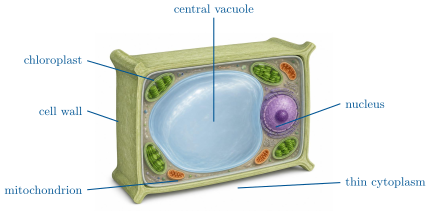
CoachA plant cell adds three structures to the common plan. The cell wall, outside the plasma membrane, is a composite of cellulose microfibrils in a matrix of other polysaccharides (Chapter 10); it fixes the cell’s shape, resists the pressure inside, and cements neighbouring cells together through a shared middle lamella. The vacuole, a single-membraned compartment holding up to of the cell’s volume, stores water, ions, sugars, pigments and wastes; its osmotic pressure pushes the membrane against the wall, and this turgor is what holds a leaf up. Plasmodesmata are channels through the walls, lined by plasma membrane, through which the cytosols of neighbouring cells are continuous, so that a plant tissue is in part one connected cytoplasm (the symplast).
Examples
Example 6.16 (Turgor)
A leaf cell whose vacuole holds of solutes draws water in until the wall pushes back with a pressure of about , seven atmospheres; the cell is then turgid and the leaf firm. Deprived of water, the vacuole loses volume, the pressure falls to zero, and the leaf wilts — the wall unchanged, the pressure gone (Chapter 7). An animal cell in the same solution, having no wall, would simply burst.