
Biology · Glossary

What is Osmosis, water potential?

Also known as: osmosis · water potential · solute potential · pressure potential · isotonic

Definition 7.6 University Biology — Year 1 · Chapter 7 — Membranes and Membrane Transport

Osmosis is the net diffusion of water across a membrane that lets water through but not the solutes, from the solution where water is more concentrated (fewer solutes) to the one where it is less. It is described by the water potential Ψ\Psi, the chemical potential of water expressed as a pressure, zero for pure water at atmospheric pressure:

Ψ=Ψs+Ψp,Ψs=RTcs,\Psi = \Psi_s + \Psi_p, \qquad \Psi_s = -RTc_s ,

where Ψs\Psi_s, the solute potential, falls with the total solute concentration csc_s (in osmoles per litre, the van ’t Hoff law) and Ψp\Psi_p, the pressure potential, is the hydrostatic pressure above atmospheric. Water moves from higher to lower Ψ\Psi. At 25C25\,{}^{\circ}\mathrm{C}, RT=2.48MPaL/molRT = 2.48\,\mathrm{MPa}\,\mathrm{L}/\mathrm{mol}: a 0.3osmol/L0.3\,\mathrm{osmol}/\mathrm{L} solution has Ψs=0.74MPa\Psi_s = -0.74\,\mathrm{MPa}. A solution is isotonic to a cell when no net water moves, hypotonic when water enters, hypertonic when it leaves.
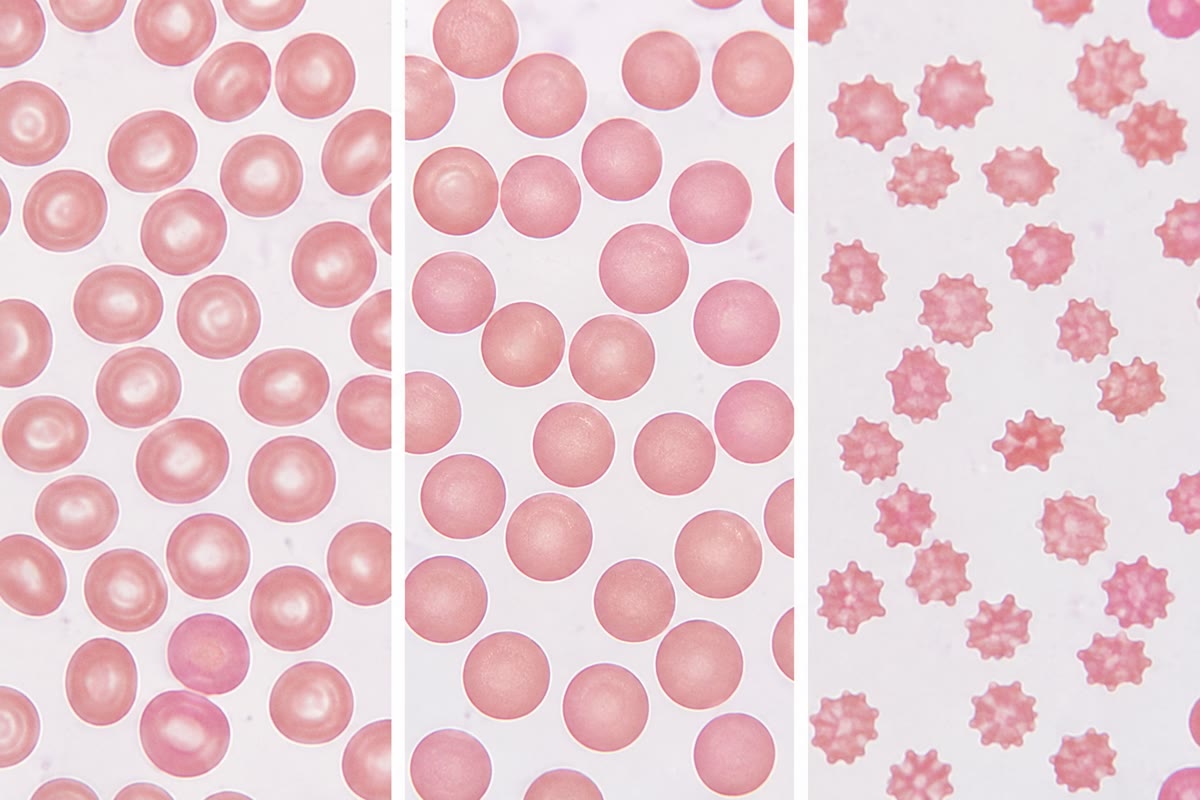
Red blood cells in an isotonic solution (biconcave discs), in a hypotonic one (swollen to spheres, about to burst) and in a hypertonic one (shrunken and crenated). Water follows its potential; the cell has no wall to resist.
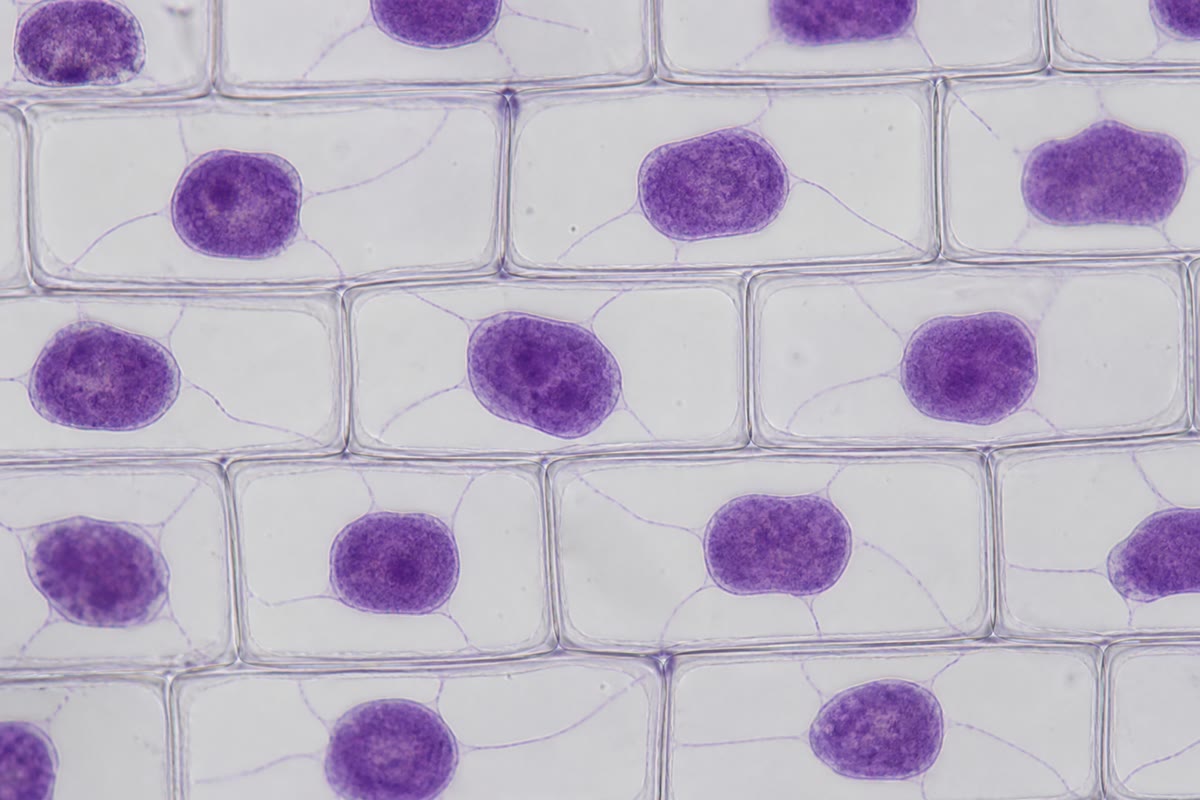
Plasmolysis: onion epidermis in a strong salt solution. The protoplast of each cell has lost water and pulled away from the rigid wall, which keeps its shape. In water the protoplast would swell back against the wall and stop, turgid.

Examples

Example 7.7 (A red cell in three solutions)

Plasma is 0.3osmol/L0.3\,\mathrm{osmol}/\mathrm{L}: Ψs=0.74MPa\Psi_s = -0.74\,\mathrm{MPa} on both sides, no net flow. In pure water (Ψ=0\Psi = 0) the cell, at 0.74MPa-0.74\,\mathrm{MPa} inside, takes up water until its membrane, which can stretch only a few percent, ruptures. In 0.6osmol/L0.6\,\mathrm{osmol}/\mathrm{L} salt it loses water until its inside is as concentrated, at half its volume. A plant cell in pure water does not burst: as water enters, the wall is stretched and Ψp\Psi_p rises until Ψp=Ψs\Psi_p = -\Psi_s, the water potential inside is zero, and the flow stops with the cell turgid at 0.74MPa0.74\,\mathrm{MPa}.

Read in context →