 Coach
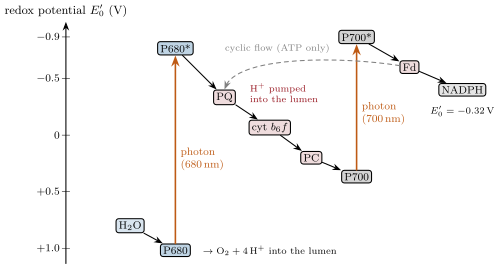
CoachTwo photosystems sit in the thylakoid membrane. In photosystem II (PSII, reaction centre P680) an absorbed photon raises an electron of the special pair to a high energy; the electron leaves, and the oxidised P680, the strongest biological oxidant, takes an electron from water: a manganese cluster splits two water molecules into , four protons (released into the lumen) and four electrons, one photon at a time. The electron descends an electron-transport chain — plastoquinone, the cytochrome complex, plastocyanin — and the energy it loses pumps protons into the lumen. In photosystem I (PSI, P700) a second photon lifts it again, to a potential low enough to reduce ferredoxin and then to NADPH. Drawn on a scale of redox potential, the path is a Z: two climbs by light, two descents by chemistry.
Examples
Example 14.7 (Cyclic and non-cyclic flow)
The linear path from water to NADPH gives, per , two NADPH and about three ATP; the Calvin cycle needs a ratio of three ATP to two NADPH exactly, and other work of the chloroplast needs more ATP. When ATP runs short, electrons from ferredoxin return to plastoquinone instead of going to (cyclic photophosphorylation): PSI alone, pumping protons and making ATP without oxygen or NADPH. The two modes are balanced to the demand.