
সব বই

পেশাদার

1 Markets I: The Ecosystem and Exchange-Traded Marketsবাজার অনলাইন 2 Markets II: Rates, FX and Creditবাজার অনলাইন 3 Markets III: Commodities, Energy and Cryptoবাজার অনলাইন 4 Quantitative Methodsপদ্ধতি অনলাইন 5 Derivatives and Volatilityডেরিভেটিভস অনলাইন 6 Rates, Credit, XVA and Riskসুদহার, ঋণ ও ঝুঁকি অনলাইন 7 Research Craft: Predictors, Backtests, Measurement, Portfoliosগবেষণা অনলাইন 8 Strategies I: Equities and Futuresকৌশল অনলাইন 9 Strategies II: Volatility, Relative Value, Macro and the Bank Desksকৌশল অনলাইন 10 Microstructure and Executionএক্সিকিউশন অনলাইন 11 Market Making and High-Frequency Tradingমার্কেট মেকিং অনলাইন 12 Machine Learning for Marketsমেশিন লার্নিং অনলাইন 13 Low-Latency Softwareপ্রযুক্তি অনলাইন 14 Networks, Hardware and Trading Infrastructureপ্রযুক্তি অনলাইন 15 Research, Data and Risk Platformsপ্রযুক্তি অনলাইন 16 The Desk and the Firmপ্রতিষ্ঠান অনলাইন 17 The Industry: Firms, Roles and Careersক্যারিয়ার অনলাইন 18 Interviews I: Maths, Probability and Speedক্যারিয়ার অনলাইন 19 Interviews II: Markets, Trading Games and the Final Roundক্যারিয়ার অনলাইন 20 Interviews III: Codeক্যারিয়ার অনলাইন
অ্যাপ পরিচিতি Coach সাইন ইন পড়া শুরু করো

বইগুলো এখনো বাংলা ভাষায় পাওয়া যায় না — ইংরেজি সংস্করণ দেখানো হচ্ছে।

Biology · পরিভাষা

Photosystems and the Z-scheme কী?

Definition 14.5 University Biology — Year 1 · অধ্যায় 14 — Photosynthesis and Autotrophy

Two photosystems sit in the thylakoid membrane. In photosystem II (PSII, reaction centre P680) an absorbed photon raises an electron of the special pair to a high energy; the electron leaves, and the oxidised P680, the strongest biological oxidant, takes an electron from water: a manganese cluster splits two water molecules into O2\mathrm{O_2}, four protons (released into the lumen) and four electrons, one photon at a time. The electron descends an electron-transport chain — plastoquinone, the cytochrome b6fb_6f complex, plastocyanin — and the energy it loses pumps protons into the lumen. In photosystem I (PSI, P700) a second photon lifts it again, to a potential low enough to reduce ferredoxin and then NADP+\mathrm{NADP^+} to NADPH. Drawn on a scale of redox potential, the path is a Z: two climbs by light, two descents by chemistry.
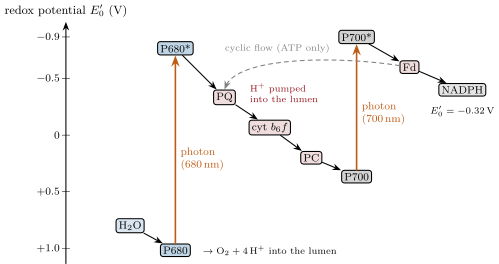
The Z-scheme. Electrons taken from water by P680 are lifted by a photon, descend a chain that pumps protons, are lifted again by P700 and end on NADPH. The vertical axis is redox potential, more negative upward: light does the climbing, chemistry the descending.

উদাহরণ

Example 14.7 (Cyclic and non-cyclic flow)

The linear path from water to NADPH gives, per O2\mathrm{O_2}, two NADPH and about three ATP; the Calvin cycle needs a ratio of three ATP to two NADPH exactly, and other work of the chloroplast needs more ATP. When ATP runs short, electrons from ferredoxin return to plastoquinone instead of going to NADP+\mathrm{NADP^+} (cyclic photophosphorylation): PSI alone, pumping protons and making ATP without oxygen or NADPH. The two modes are balanced to the demand.

প্রসঙ্গসহ পড়ো →