সব বই

পেশাদার

1 Markets I: The Ecosystem and Exchange-Traded Marketsবাজার অনলাইন 2 Markets II: Rates, FX and Creditবাজার অনলাইন 3 Markets III: Commodities, Energy and Cryptoবাজার অনলাইন 4 Quantitative Methodsপদ্ধতি অনলাইন 5 Derivatives and Volatilityডেরিভেটিভস অনলাইন 6 Rates, Credit, XVA and Riskসুদহার, ঋণ ও ঝুঁকি অনলাইন 7 Research Craft: Predictors, Backtests, Measurement, Portfoliosগবেষণা অনলাইন 8 Strategies I: Equities and Futuresকৌশল অনলাইন 9 Strategies II: Volatility, Relative Value, Macro and the Bank Desksকৌশল অনলাইন 10 Microstructure and Executionএক্সিকিউশন অনলাইন 11 Market Making and High-Frequency Tradingমার্কেট মেকিং অনলাইন 12 Machine Learning for Marketsমেশিন লার্নিং অনলাইন 13 Low-Latency Softwareপ্রযুক্তি অনলাইন 14 Networks, Hardware and Trading Infrastructureপ্রযুক্তি অনলাইন 15 Research, Data and Risk Platformsপ্রযুক্তি অনলাইন 16 The Desk and the Firmপ্রতিষ্ঠান অনলাইন 17 The Industry: Firms, Roles and Careersক্যারিয়ার অনলাইন 18 Interviews I: Maths, Probability and Speedক্যারিয়ার অনলাইন 19 Interviews II: Markets, Trading Games and the Final Roundক্যারিয়ার অনলাইন 20 Interviews III: Codeক্যারিয়ার অনলাইন
অ্যাপ পরিচিতি Coach সাইন ইন পড়া শুরু করো

বইগুলো এখনো বাংলা ভাষায় পাওয়া যায় না — ইংরেজি সংস্করণ দেখানো হচ্ছে।

Biology · পরিভাষা

Prokaryotic and eukaryotic cells কী?

অন্য নাম: prokaryotic cell · nucleoid · cell wall · eukaryotic cell · nucleus · organelle

Definition 5.4 University Biology — Year 1 · অধ্যায় 5 — The Cell: Unit of Life

A prokaryotic cell (bacteria, archaea) has no nucleus: its DNA, usually one circular chromosome, lies in a region of the cytoplasm called the nucleoid, and it has no membrane-bounded compartments. It is small (0.5 to 5 µm0.5\text{ to }5\,\text{µ}\mathrm{m}) and bounded by a plasma membrane and, outside it, a cell wall. A eukaryotic cell (protists, fungi, plants, animals) keeps its DNA, as several linear chromosomes, inside a nucleus bounded by a double membrane, and divides its cytoplasm into membrane-bounded organelles (Chapter 6). It is larger (10 to 100 µm10\text{ to }100\,\text{µ}\mathrm{m}) and has an internal skeleton of protein filaments.
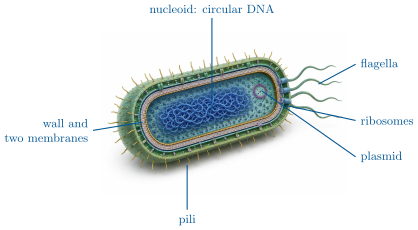
A bacterium (Escherichia coli) cut open. No nucleus, no organelles: a circular chromosome loosely folded in the cytoplasm among thousands of ribosomes, a wall outside the plasma membrane, flagella for swimming and pili for attachment. Length about 2\, µ m.
A bacterium (Escherichia coli) cut open. No nucleus, no organelles: a circular chromosome loosely folded in the cytoplasm among thousands of ribosomes, a wall outside the plasma membrane, flagella for swimming and pili for attachment. Length about 2 µm2\,\text{µ}\mathrm{m}.
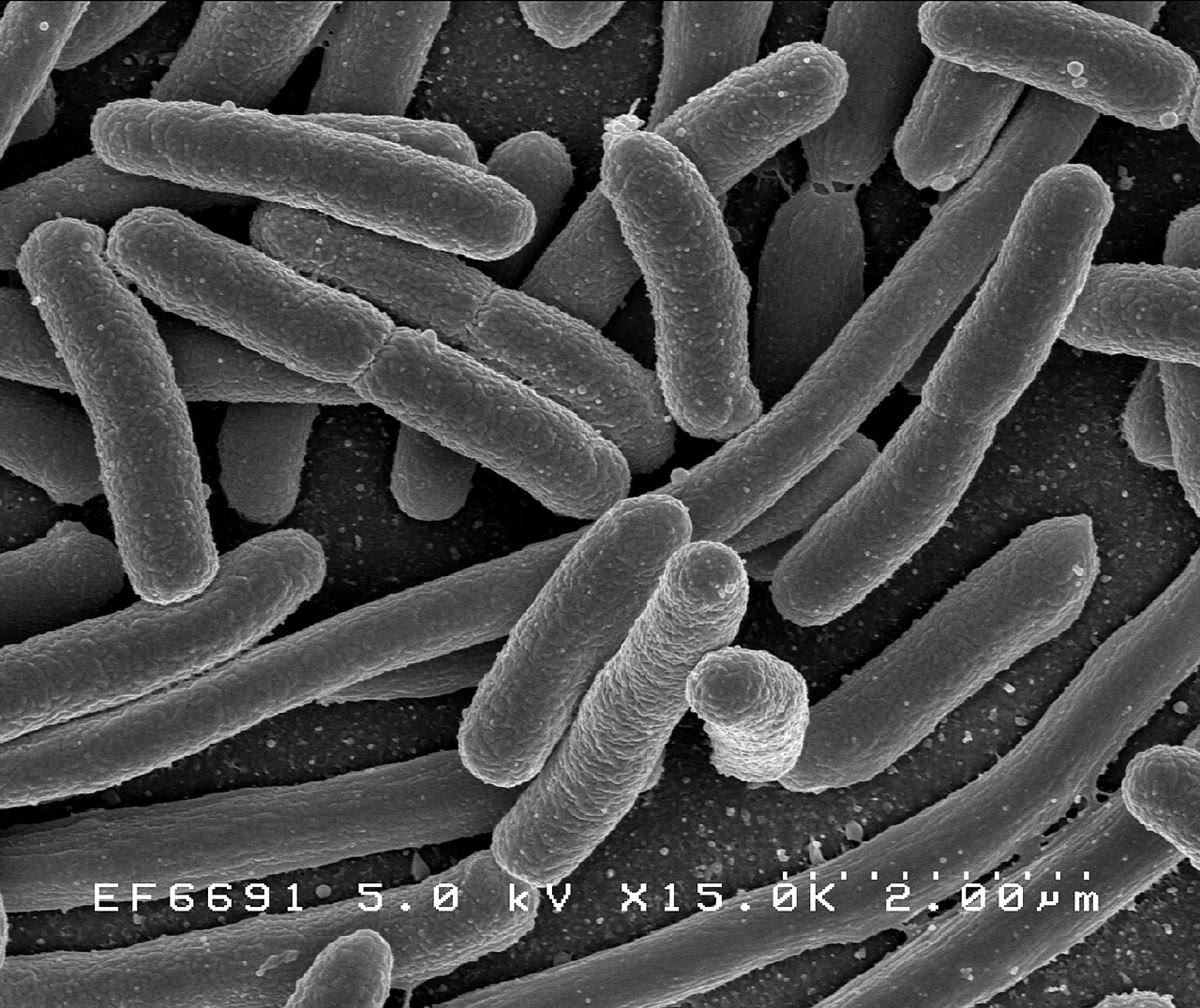
Escherichia coli under the scanning electron microscope (the bar at the foot of the image is 2\, µ m). Rods 2\, µ m long, a thousand of which would fit across a millimetre; a single cell divides every twenty minutes in a rich medium. Image: NIAID, public domain.
Escherichia coli under the scanning electron microscope (the bar at the foot of the image is 2 µm2\,\text{µ}\mathrm{m}). Rods 2 µm2\,\text{µ}\mathrm{m} long, a thousand of which would fit across a millimetre; a single cell divides every twenty minutes in a rich medium. Image: NIAID, public domain.

উদাহরণ

Example 5.7 (Why the eukaryotic cell is compartmented)

A cell of 20 µm20\,\text{µ}\mathrm{m} has a thousand times the volume of a bacterium but only a hundred times its membrane surface (Proposition 1.6). Membranes are where a cell carries its energy-transducing chains and its transport systems; the eukaryote recovers surface by folding membranes inside itself — the inner membrane of a mitochondrion, the sheets of the endoplasmic reticulum — and gains, besides, separate chambers in which incompatible chemistries (digestion in the lysosome, synthesis in the cytosol) can run side by side.

Example 5.11 (A bacterium and a mitochondrion)

Under the light microscope at 1000×1000\times, an E. coli cell is a rod 2 mm2\,\mathrm{mm} long on the retina’s scale, with no visible interior; a mitochondrion is a dot at the limit of resolution. In a TEM section the same bacterium shows its two membranes, its wall, its nucleoid as a pale fibrous region and its ribosomes as dark grains; the mitochondrion shows its double membrane and the folds of the inner one. Neither is alive.

প্রসঙ্গসহ পড়ো →