
সব বই

পেশাদার

1 Markets I: The Ecosystem and Exchange-Traded Marketsবাজার অনলাইন 2 Markets II: Rates, FX and Creditবাজার অনলাইন 3 Markets III: Commodities, Energy and Cryptoবাজার অনলাইন 4 Quantitative Methodsপদ্ধতি অনলাইন 5 Derivatives and Volatilityডেরিভেটিভস অনলাইন 6 Rates, Credit, XVA and Riskসুদহার, ঋণ ও ঝুঁকি অনলাইন 7 Research Craft: Predictors, Backtests, Measurement, Portfoliosগবেষণা অনলাইন 8 Strategies I: Equities and Futuresকৌশল অনলাইন 9 Strategies II: Volatility, Relative Value, Macro and the Bank Desksকৌশল অনলাইন 10 Microstructure and Executionএক্সিকিউশন অনলাইন 11 Market Making and High-Frequency Tradingমার্কেট মেকিং অনলাইন 12 Machine Learning for Marketsমেশিন লার্নিং অনলাইন 13 Low-Latency Softwareপ্রযুক্তি অনলাইন 14 Networks, Hardware and Trading Infrastructureপ্রযুক্তি অনলাইন 15 Research, Data and Risk Platformsপ্রযুক্তি অনলাইন 16 The Desk and the Firmপ্রতিষ্ঠান অনলাইন 17 The Industry: Firms, Roles and Careersক্যারিয়ার অনলাইন 18 Interviews I: Maths, Probability and Speedক্যারিয়ার অনলাইন 19 Interviews II: Markets, Trading Games and the Final Roundক্যারিয়ার অনলাইন 20 Interviews III: Codeক্যারিয়ার অনলাইন
অ্যাপ পরিচিতি Coach সাইন ইন পড়া শুরু করো

বইগুলো এখনো বাংলা ভাষায় পাওয়া যায় না — ইংরেজি সংস্করণ দেখানো হচ্ছে।

Biology · পরিভাষা

Restriction enzymes, ligase and vectors কী?

Definition 6.1 University Biology — Year 3 · অধ্যায় 6 — Genetic Engineering and Biotechnology

A type II restriction enzyme is a bacterial endonuclease that cuts double-stranded DNA at a specific sequence of 4 to 84\text{ to }8 base pairs, usually a palindrome: EcoRI cuts G↓^{\downarrow}AATTC, leaving four-base single-stranded overhangs (sticky ends) complementary to any other EcoRI end; other enzymes leave blunt ends. DNA ligase seals two fragments whose ends fit. A vector is a DNA molecule that replicates in a host and can carry an inserted fragment: a plasmid of a few kilobases with an origin of replication, a selectable marker (an antibiotic resistance gene, so that only cells that took up the plasmid grow on the antibiotic) and a cluster of unique restriction sites for the insert; bacteriophage λ\lambda, cosmids, and bacterial or yeast artificial chromosomes for inserts of 20 to 1000 kb20\text{ to }1000\,\mathrm{kb}. DNA enters a bacterium by transformation, after a chemical or electrical shock that makes the membrane transiently permeable, with an efficiency of 10610^{6} to 10910^{9} transformants per microgram of plasmid. A recombinant molecule is one that joins DNA from two sources.
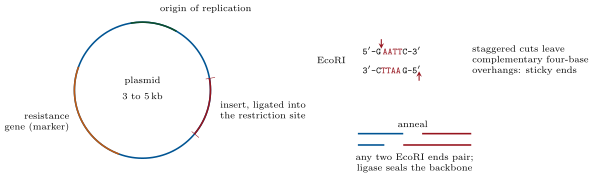
A cloning vector and its chemistry. The plasmid carries an origin, a selectable marker and a unique restriction site into which a fragment cut with the same enzyme is ligated; sticky ends make any two fragments cut by the same enzyme compatible.
প্রসঙ্গসহ পড়ো →