 Coach
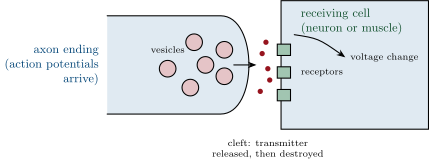
CoachA synapse is the junction where the ending of one neuron’s axon meets the next cell — a neuron or a muscle fibre — across a gap of some , the synaptic cleft. The signal does not jump the gap electrically: the arriving action potentials make the ending release, from small vesicles, a chemical messenger, the neurotransmitter, into the cleft; it binds receptors on the receiving cell’s membrane, which change that cell’s voltage; it is then destroyed or taken back within milliseconds. The synapse converts an electrical message into a chemical one and back, and the amount of transmitter released — set by the frequency of the arriving action potentials — codes the message’s intensity.
Examples
Example 35.6 (Speed)
Action potentials travel at in thin unmyelinated fibres and up to in the thick myelinated fibres of the stretch reflex. From the knee to the spinal cord and back is about : some of travel, to which the spindle’s response, one synapse and the muscle’s activation add another — the of the knee jerk. A message from a toe to the brain, away, takes about ; the decision to move it, and its execution, some more.